Most gifting brands build their entire year around a six week stretch. Marketing budgets, inventory planning, and email calendars all point toward November and December, and the rest of the year gets treated as the slow season to survive until the next holiday push. That instinct is understandable, but it misses something the data has been showing for a while. Birthdays account for 36% of personalized gift purchases on their own, more than double the share driven by the holiday season, and anniversaries add another 21% on top of that. Meanwhile, industry tracking shows non-holiday "any occasion" gifting activity growing sharply, with roughly a quarter of all gifting now happening off the traditional calendar entirely.
That means a brand optimized only for Q4 is leaving most of its addressable gifting demand on the table. The tool best suited to capturing that demand year-round isn't a seasonal campaign. It's a wishlist, because a wishlist doesn't expire when the holiday banner comes down. It sits quietly on a customer's account, gets updated whenever something new catches their eye, and stays ready for whatever occasion comes next. Here are ten ways gifting brands can use one properly.
Key takeaways
- Birthdays and anniversaries together drive more personalized gift purchases than the holiday season, making year-round wishlist strategy a bigger opportunity than most brands realize.
- An always-on wishlist gives customers a permanent place to collect gift ideas, rather than forcing them to rebuild a list for every new occasion.
- Guest wishlisting matters as much for gift-givers browsing on someone else's behalf as it does for shoppers building their own list.
- Wishlist collections solve the real coordination problem large families and friend groups face around duplicate gifts.
- Back-in-stock alerts protect sales tied to hard deadlines, since a gift bought two days late often isn't bought at all.
- Wishlist analytics reveal which products and occasions are driving off-season demand that most brands never plan around.
- An app like Flits Wishlist can support all of this without requiring a gifting brand to build custom infrastructure from scratch.
1. Build a wishlist that never expires between occasions
A registry created for one wedding or one baby shower has a natural end date. A wishlist doesn't need one. The most useful version of a gifting wishlist is one a customer keeps adding to continuously, whether they're thinking about their own birthday in March, a friend's graduation in May, or a holiday gift in December. That continuity is exactly what the shift toward non-holiday gifting is rewarding. Brands that treat the wishlist as a permanent, always-available feature rather than something tied to a single seasonal campaign are the ones positioned to catch that off-calendar 25% of gifting activity that most competitors are structurally set up to miss.
Also Read: Shopify Wishlist Guide
2. Let gift-givers browse and save without creating an account first
A huge share of wishlist activity on a gifting site isn't the eventual recipient building their own list. It's someone else browsing on their behalf, trying to figure out what a parent, partner, or coworker might actually want. That person is often shopping under time pressure and has no interest in creating an account just to bookmark a few ideas before deciding. Guest wishlisting removes that barrier entirely, letting a visitor save candidate gifts without an email address or password standing between them and the browsing they came to do. Flits Wishlist supports guest wishlisting on its paid plan, which matters specifically for this kind of low-commitment, exploratory gift research that makes up a meaningful share of traffic on any gifting site.
3. Turn a customer's own wishlist into a gift guide for other people
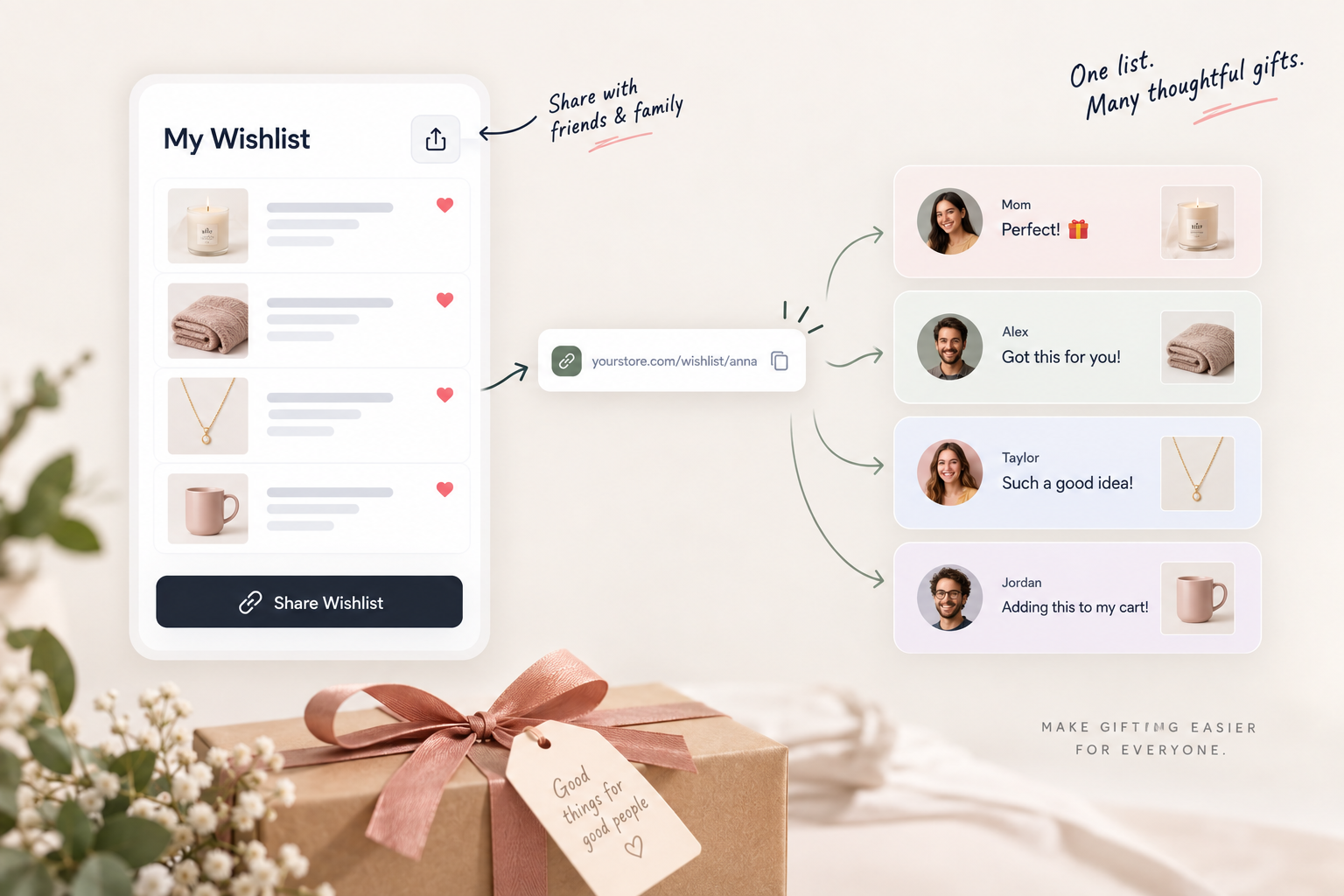
The person most qualified to know what someone wants is usually that person, not the friend or relative trying to guess on their behalf. A shareable wishlist flips the usual gifting dynamic by letting the recipient do the specifying, and the gift-giver simply choose from a pre-approved list. This removes the single biggest source of gifting anxiety, which is not knowing whether a purchase will land well. Wishlist sharing via link or social media makes this practical at scale, since a customer can send their list to an entire group ahead of a birthday or holiday rather than fielding "what do you want" texts individually from everyone who plans to buy them something.
4. Solve the duplicate gift problem for families and friend groups
Large families run into a predictable problem every gifting season. Two people buy the same item for the same person because nobody had visibility into what had already been claimed or purchased. Wishlist collections help here by letting customers group and organize saved items clearly, and when paired with sharing, give an entire group visibility into one central list instead of scattered guesses. This isn't just a convenience feature. It directly protects a brand's return rate, since duplicate gifts are a common driver of post-holiday returns and exchanges that erode margin on top of the shipping cost already spent getting the product to the customer in the first place.
5. Protect deadline-sensitive sales with back-in-stock alerts
Gifting has a characteristic that most retail categories don't share as strongly: a hard deadline. A birthday gift bought two days after the birthday isn't really a birthday gift anymore, and a holiday gift that arrives in January has largely lost its purpose. That makes stockouts especially costly in this category, because a customer who finds their ideal gift sold out often can't simply wait a week the way they might for a personal purchase. A back-in-stock alert tied to the wishlist recovers that sale automatically the moment inventory returns, and for gifting specifically, sending that alert with enough lead time before a known occasion date can be the difference between a completed sale and a customer who moved on to a competitor out of necessity rather than preference.
6. Time email reminders around occasions, not just around the calendar
Most gifting brands send the same seasonal emails to their entire list regardless of what any individual customer has actually shown interest in. A customer who wishlisted a specific item for a parent's upcoming retirement gets the same generic "holiday shopping starts now" email as everyone else, which misses an opportunity that's already sitting in the data. Wishlist activity synced to an email platform allows for much more targeted timing instead. Flits Wishlist connects directly to Klaviyo, syncing every save, share, and back-in-stock trigger as a structured customer event, which means a brand can build flows around a specific saved item rather than a blanket seasonal push. A reminder email sent two weeks before a typical gifting deadline, referencing the exact product a customer saved, performs very differently than a generic promotional blast competing for attention in an already crowded inbox.
7. Use wishlist data to find your off-season bestsellers
Most gifting brands can describe their December bestsellers in detail and have almost no visibility into what drives sales the rest of the year. Wishlist analytics change that by surfacing which products get saved heavily outside the traditional holiday window, which is often a strong early signal of a birthday or anniversary favorite that never gets the merchandising attention it deserves. A brand that reviews wishlist data on a rolling basis, rather than only after a big seasonal push, can catch these patterns early and build dedicated campaigns around them instead of treating every month outside Q4 as an undifferentiated slow period.
8. Reduce decision paralysis with variant-specific saving
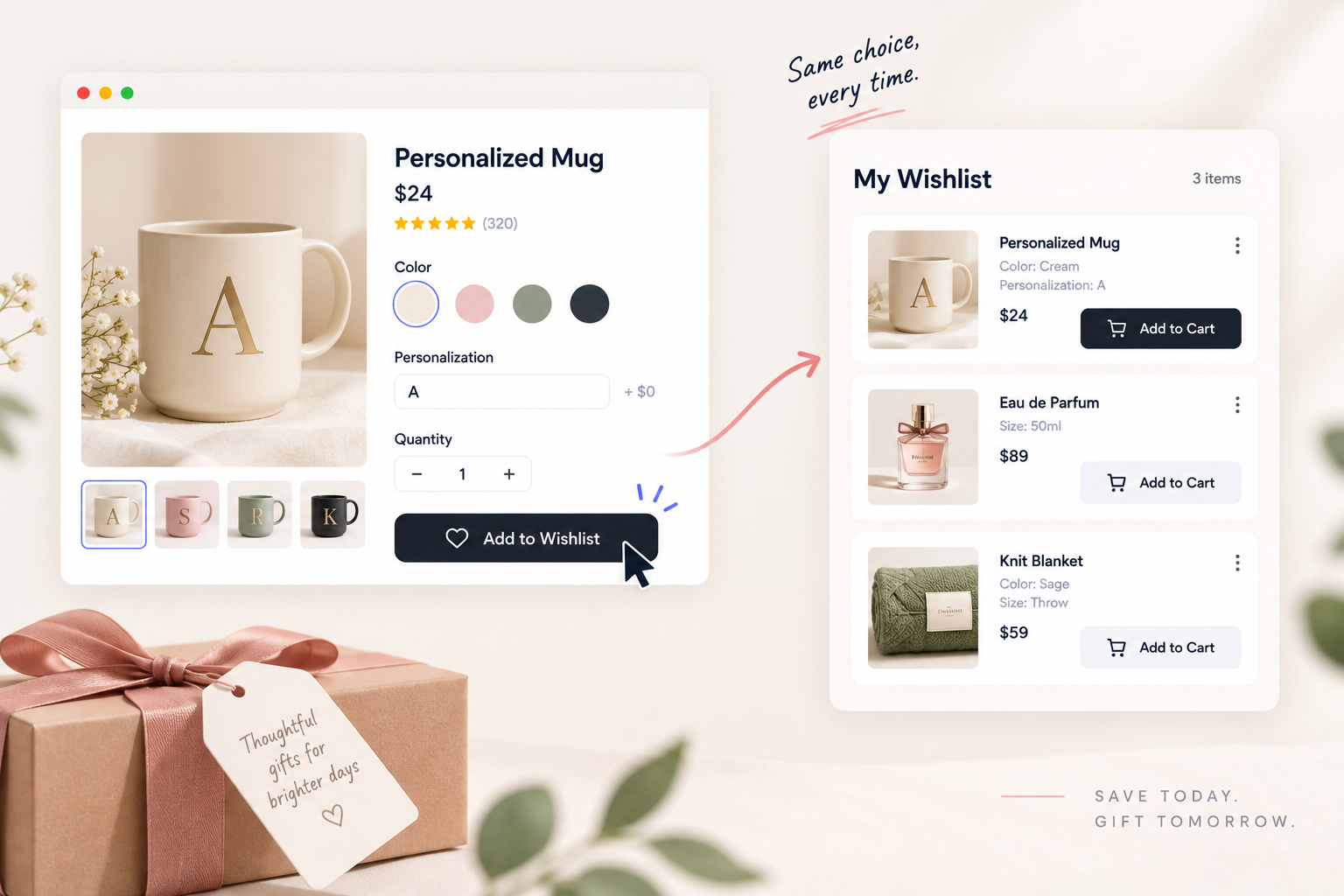
Gifting decisions often stall on a detail as small as color, size, or a personalization option, and that hesitation is a common reason a promising cart never converts. If a customer has to reconfigure those choices every time they revisit a saved item, the friction compounds and the decision gets delayed again. Wishlist saving that preserves the exact variant, whether that's an engraved initial, a specific color, or a particular size, means the customer returns to precisely what they had already decided on, rather than starting the decision over from scratch. For gifting specifically, where the "right" choice often carries more emotional weight than a typical personal purchase, that consistency removes a real source of delay.
9. Give recipients a way to update their list as their taste changes
A list built once, months before an occasion, often goes stale by the time gift-givers actually start buying. Interests shift, a product goes out of stock, or the recipient simply changes their mind, and a static list stops being useful right when it matters most. An always-editable wishlist solves this naturally, since the recipient can update it at any point without needing to rebuild anything or notify anyone directly. Gift-givers checking the list closer to the actual date see an accurate, current picture rather than an outdated snapshot from months earlier, which reduces the odds of a purchase the recipient no longer actually wants.
10. Make the wishlist experience feel like part of the gifting brand, automatically
Gifting brands tend to invest heavily in visual identity, since presentation is part of the product experience in a way it often isn't for purely functional categories. A wishlist page that looks disconnected from the rest of the site, with mismatched fonts or generic styling, can undercut that carefully built brand feel at exactly the moment a customer is deciding what to buy for someone they care about. Flits Wishlist includes an AI-generated wishlist page and flow builder that matches the design automatically to a store's existing theme, so smaller gifting brands without a dedicated designer can offer a polished, on-brand wishlist experience without adding development work to an already busy team.
Bringing it together
The gifting brands that grow fastest are rarely the ones with the loudest holiday campaign. They're the ones that recognize gifting doesn't actually concentrate around six weeks in December, no matter how much marketing spend gets pointed there. Birthdays, anniversaries, graduations, and dozens of smaller unscheduled occasions make up the majority of real gifting demand, and a wishlist is the one feature built specifically to catch that demand whenever it happens rather than only during a predictable seasonal window.
Flits Wishlist supports this with guest saving, variant-specific accuracy, sharing, collections, back-in-stock recovery, and a direct sync into Klaviyo, all for a flat $19 a month with no feature gates and no scaling fees as order volume grows. For a gifting brand trying to build demand around every occasion on the calendar rather than just one, that complete, predictable pricing model is easy to plan around.
FAQs
Is a wishlist only useful for holiday gifting?
No. Birthdays and anniversaries together drive more personalized gift purchases than the holiday season does, and a wishlist is most valuable when it stays active year-round rather than being treated as a seasonal feature.
How does a wishlist help someone shopping for another person's gift?
Guest wishlisting lets a gift-giver save candidate items without creating an account first, and if the intended recipient has their own shareable list, the gift-giver can shop from that list directly instead of guessing.
Can a wishlist prevent duplicate gifts within a family?
Wishlist collections and sharing give a group visibility into one central list, which reduces the odds of two people independently buying the same item for the same occasion.
Does Flits Wishlist connect to email marketing tools?
Yes. Flits Wishlist syncs saves, shares, and back-in-stock triggers to Klaviyo as customer events, allowing brands to build reminder flows around specific saved products rather than generic seasonal promotions.
What happens if a wishlisted gift item goes out of stock before an occasion?
A back-in-stock alert notifies the customer automatically once inventory returns, which helps recover the sale as long as there's still time before the relevant date.