Luxury customers rarely buy on impulse, and they rarely buy quickly. A luxury purchase often follows weeks of quiet consideration, several visits across different devices, and a healthy dose of purchase anxiety that comes with spending real money on something the customer wants to feel certain about.
Luxury cart abandonment sits between 78% and 82%, among the highest of any retail category, not because interest is weak but because the decision itself takes time. A wishlist gives that decision somewhere to live in the meantime, and for luxury brands specifically, it can do far more than hold a product for later. Here are 11 ways to use it well.
Let’s dive right in!
Meet the luxury research cycle where it actually happens
1. Give high-consideration shoppers a private place to return to
A luxury shopper rarely lands on a product page and buys within the same session. They come back, sometimes across several weeks, comparing a piece against others they've seen, waiting for a bonus to land, or simply letting the decision settle before committing to a five- or six-figure purchase. Without a place to hold that interest, every return visit starts from zero, and the shopper has to relocate the exact piece, the exact size, the exact configuration they were considering before. A wishlist removes that friction entirely, giving the shopper a fixed point to return to that reflects exactly where they left off, which matters more in luxury than almost any other category given how long the consideration window typically runs.
Also Read: 15 Ways Fashion Brands Can Use Wishlists to Increase Sales
2. Support guest browsing for shoppers who value discretion
Not every luxury shopper wants to create an account the first time they browse a six-figure watch or a piece of fine jewelry. Some are researching a gift for someone else and don't want a trail of saved items tied to an email address that partner might see. Others simply prefer to browse anonymously until they're genuinely ready to engage. Guest wishlisting respects that instinct by letting a visitor save pieces without any account commitment upfront. Flits Wishlist supports guest saving on its paid plan, which lets a luxury brand capture that early, cautious browsing behavior instead of losing it entirely to a signup wall the shopper wasn't ready to clear.
3. Save the exact piece, not a general category
Luxury products are rarely interchangeable within their own category. A ring saved in one size and metal is a completely different purchase decision from the same ring in another size and finish, and a shopper who has to reconfigure those details every time they return is being asked to redo work they'd already finished. Variant-level saving keeps the precise selection intact, whether that's a specific case size on a watch, a particular leather color on a bag, or an engraving option on a piece of jewelry, so the shopper returns to exactly the version they were already leaning toward rather than starting the decision over.
4. Sync the wishlist across every device a shopper uses
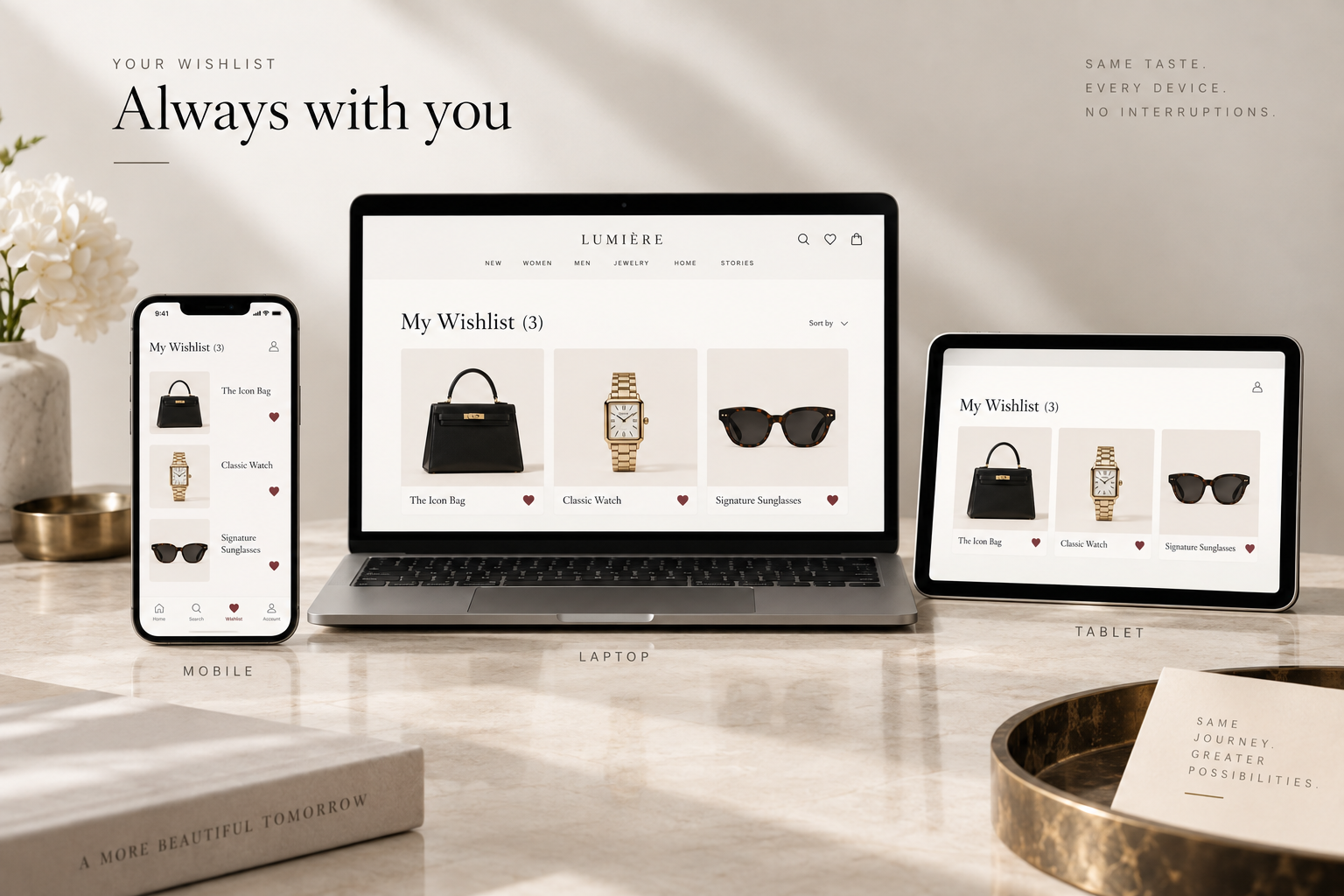
Luxury research rarely happens on a single device. A shopper might discover a piece on mobile during a commute, study it further on a laptop that evening, and finally decide to buy from a tablet a week later. Each of those transitions is a chance to lose momentum if the saved item doesn't carry over cleanly, and expecting a shopper to remember exact product names or search from scratch on a new device adds unnecessary friction to an already long decision. A wishlist tied to the customer's account rather than a single browser session keeps that continuity intact, which matters given how often luxury shoppers are known to spend meaningfully more when they engage across multiple channels rather than just one.
Make scarcity work for you, not against you
5. Turn the wishlist into a soft waitlist for limited pieces
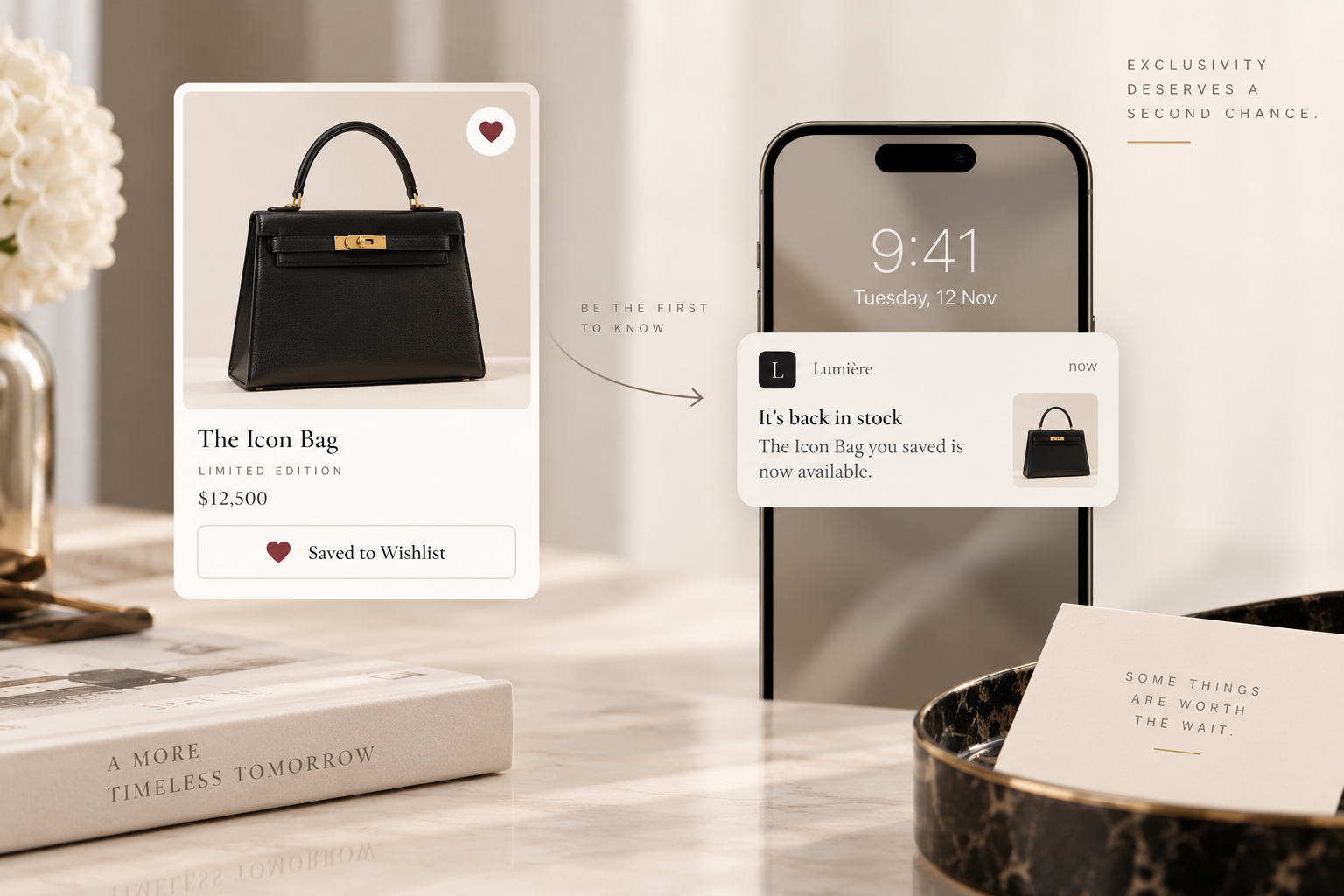
Scarcity is a deliberate part of luxury positioning, but it creates a real risk of losing a sale entirely when the piece a customer wants sells out or sells through before they're ready to commit. A back-in-stock alert tied to the wishlist solves this without undermining the exclusivity the brand has built. Rather than restocking loudly to the entire list, a targeted alert reaches only the customers who specifically saved that piece, which preserves the sense of scarcity for everyone else while still recovering a sale from the shopper who was genuinely waiting for their opportunity. For made-to-order or limited-run luxury items, this quietly functions as a waitlist without requiring the brand to build separate waitlist infrastructure.
6. Let saved items inform smarter release timing
Luxury brands often decide when to restock or reissue a piece based on gut instinct or broad sales history, without a clear read on which specific items still have live, unmet demand behind them. Wishlist data closes that gap. A piece with a high concentration of saves that never converted is a strong signal of real, current demand, distinct from a general bestseller list that reflects past sales rather than present interest. A brand reviewing this data regularly can time a re-release or restock announcement around actual accumulated demand instead of guessing, and can even prioritize which saved pieces to bring back first when only limited production capacity is available.
7. Protect exclusivity while still recovering revenue
There's a tension in luxury retail between exclusivity and revenue that most brands feel constantly. Marketing a scarce item too aggressively cheapens it, but staying silent means losing sales to customers who simply forget to check back. A wishlist resolves this tension by making the follow-up personal rather than promotional. A back-in-stock notification framed around a specific saved piece reads as a quiet, individual courtesy rather than a mass marketing push, which fits the tone luxury customers expect far better than a storewide restock announcement ever could.
Turn saved intent into a client relationship
8. Feed wishlist activity into personalized outreach
Traditional luxury retail runs on clienteling, where a sales associate remembers a client's taste and reaches out personally when something relevant becomes available. Recreating that experience online requires the brand to actually know what a specific customer has shown interest in, and a wishlist is the clearest record of that available. Flits Wishlist syncs every save, share, and back-in-stock trigger to Klaviyo as a structured customer event, which lets a brand build outreach around a specific piece a specific client saved rather than a generic seasonal email. For a category where the top sliver of clients often accounts for a disproportionate share of total revenue, treating wishlist data as the digital equivalent of a clienteling notebook is a meaningfully different approach than blanket email marketing.
Also Read: How to Build a Loyalty Tier Strategy [Guide]
9. Use wishlist sharing for high-stakes, high-emotion purchases
Certain luxury categories carry an interpersonal dimension that pure self-purchase categories don't. An engagement ring, a milestone anniversary gift, or a significant piece bought jointly by a couple often involves one person expressing a preference that someone else will ultimately purchase. A shareable wishlist gives the shopper expressing that preference a clean, low-pressure way to communicate it, without an awkward conversation about specifics. The eventual buyer arrives already knowing the exact piece, size, and configuration wanted, which shortens what might otherwise be weeks of back-and-forth guessing into a single, confident purchase decision.
Also Read: Shopify Wishlist Statistics 2026: What Consumer Shopping Behaviour Data Actually Shows
10. Shorten the final step once the decision is finally made
After weeks of research and consideration, the moment a luxury shopper actually decides to buy is not the moment to introduce new friction. Letting a customer add a wishlisted piece straight to cart from the wishlist page itself, without navigating back through a full product page and reconfiguring options, respects the fact that the decision has already been made. For a purchase this considered, unnecessary steps between "I've decided" and "I've paid" risk reopening hesitation that took weeks to resolve in the first place.
11. Match the wishlist experience to the brand's aesthetic exactly
Luxury brands are judged on presentation as much as product, and a wishlist page that feels generic or visually inconsistent with the rest of the site can undercut the sense of quality the brand has spent years building. Even a small mismatch, an off-brand font or a layout that looks templated, registers instantly to a customer accustomed to a consistently considered experience. Flits Wishlist includes an AI-generated wishlist page and flow builder that adapts automatically to a store's existing theme, allowing smaller luxury and premium brands to offer a wishlist experience that feels native to the brand without requiring a dedicated design resource to build it from scratch.
Bringing it together
Luxury customers move slowly by nature, and most of that time is spent thinking, comparing, and waiting for the right moment rather than shopping impulsively. A wishlist built for discretion, precision, and quiet follow-up gives a brand somewhere to meet that customer inside their own decision-making process, instead of relying entirely on the customer remembering to come back on their own. Done well, it functions less like a feature and more like a digital extension of the clienteling relationship luxury retail has always depended on.
Flits Wishlist offers this as a single Shopify app at $19 a month, with no feature restrictions and no pricing that scales up as order volume grows. For a luxury brand where a single recovered sale can represent significant revenue on its own, that flat, predictable cost is easy to justify against the sales it helps preserve.
FAQs
Why is a wishlist particularly useful for luxury brands specifically?
Luxury purchases involve long consideration cycles and high cart abandonment driven by purchase anxiety rather than price comparison, so a wishlist gives shoppers a place to hold their decision across multiple visits instead of starting over each time.
Can a wishlist support limited or made-to-order luxury items?
Yes. A back-in-stock alert tied to a wishlist can function as a quiet, targeted waitlist, notifying only the customers who saved a specific scarce item once it becomes available again.
Does guest wishlisting matter for luxury shoppers who value privacy?
Yes. Guest wishlisting lets shoppers save items without creating an account, which suits customers researching a gift discreetly or simply not ready to commit to an account at that stage.
How does wishlist data support a clienteling-style relationship online?
Syncing wishlist activity to an email platform like Klaviyo lets a brand follow up around the specific piece a client saved, rather than sending generic promotional emails to the entire list.