Swish does a number of things well. The product is polished, the customization service is genuinely useful, and the Klaviyo and Meta integrations work. For a certain type of Shopify store, it's a clean, well-supported solution.
But Swish has a pricing architecture that catches merchants off guard. There's no free plan. The entry point is $19/month, and if your store grows into the Shopify or Advanced Shopify tier, that bill climbs to $29 and then $49, not because you're accessing more features, but simply because of which Shopify plan you're on. The features stay the same. The invoice doesn't.
Add in the fact that Swish is exclusively a wishlist tool no built-in email recovery, no loyalty integration, no retention features beyond the wishlist itself and you have a product that works well within a narrow scope but requires a growing stack of additional apps the moment you want to do more.
If that's the wall you've hit, this guide covers nine alternatives across the full range of what's available: from complete retention platforms to lean, purpose-built wishlist tools, each reviewed in enough depth to make the decision clear.
Here's the full list:
- Flits Wishlist: Best overall Swish alternative for Shopify
- Swym Wishlist Plus: Best for high-volume stores needing enterprise-grade reporting
- Growave: Best for stores replacing multiple retention apps at once
- Hulk Wishlist & Favorites: Best for stores with large catalogs and multiple list types
- WC Wishlist Club: Best for stores in early growth stages
- SE Wishlist Engine: Best for automated, trigger-based email recovery
- Mst: Wishlist Prime: Best for lightweight wishlist-triggered marketing
- Wishify: Best for zero-configuration installation
- Wishlist Hero: When you need a basic wishlist and have limited expectations
Swish (Wishlist King) alternatives at a glance
Why Shopify merchants are switching from Swish (Wishlist King)
Swish has earned its strong rating. The installation experience is smooth, the support team is well-reviewed, and the product does what it promises within the boundaries it sets for itself. But those boundaries are where the friction starts. The reasons merchants switch are less about something going wrong and more about recognizing that the product's structure doesn't match where the store is heading.
Reason #1: Pricing climbs as your Shopify plan grows, not as your needs change
The most unusual thing about Swish's pricing is the mechanism behind it. The plan you pay for isn't based on how many wishlists you're running, how many customers are using the feature, or how much extra revenue the app is generating for your store. It's based on which Shopify plan you're subscribed to.
A store on Shopify Basic pays $19/month. The same store, after upgrading to the Shopify plan for other reasons, starts paying $29/month for identical wishlist functionality. An Advanced Shopify merchant pays $49/month. A Shopify Plus merchant pays $99/month. The feature set across all four tiers is the same: unlimited wishlists, free setup, and the same core product. What changes is only the price, and the trigger for that change is a Shopify billing decision that has nothing to do with how the merchant is using the wishlist app.
For a store that upgrades its Shopify plan to access better shipping rates or more staff accounts, suddenly paying significantly more for a wishlist app they haven't changed how they use is a hard thing to reconcile. It's the kind of pricing logic that feels disconnected from value delivered, and for merchants who notice it, it's a legitimate reason to look for something else.
Reason #2: There is no free plan, and no low-commitment way to evaluate the product
Swish's minimum commitment is $19/month from day one. There's no free tier. There's no 14-day trial period. The free setup service is included, which helps with initial configuration, but merchants are paying before they know whether the wishlist is generating meaningful engagement in their specific store.
This is a real barrier for smaller stores and for any merchant who's been burned before by an app that worked in demos but underperformed in production. Most competing apps offer a free plan that covers core functionality, letting merchants validate actual engagement before committing to a monthly charge. Swish skips that layer entirely, which means the risk of the decision sits entirely with the merchant.
Reason #3: The product scope ends at the wishlist
Swish is a wishlist app. It captures saved products, sends notifications via Klaviyo, and gives you analytics on what your customers are saving. That's the full scope. There's no loyalty program, no reviews feature, no referral program, and no email recovery that works independently of an external email platform.
This isn't inherently a problem. A focused product with a narrow scope can be the right answer. But for stores building out a retention strategy, a wishlist-only tool means adding more apps for the pieces Swish doesn't cover. Over time, the cost of the wishlist app plus the loyalty app plus the reviews app plus the email automation tool adds up. Merchants who reach that point start asking whether a platform that handles several of those jobs in one place is a better answer.
Reason #4: Email recovery is only as good as the tools you connect to it
Swish integrates with Klaviyo, Google Analytics 4, and Meta — which is a genuinely useful set of integrations for stores already running those platforms. But the integration is the mechanism, not the email layer. If a product a customer saved goes out of stock and comes back, Swish doesn't send a back-in-stock email on its own. That alert depends on Klaviyo receiving the event and a flow being configured to act on it.
For stores already running Klaviyo with a reasonably sophisticated setup, this is manageable. For stores that haven't invested in Klaviyo, or that want back-in-stock and price drop alerts to fire without building and maintaining flows in a separate platform, this is a gap that competing apps close differently. Several alternatives on this list include built-in email alerts that work without any external tool.
Also Read: The Complete Guide to Shopify Wishlist for Merchants
9 best Swish alternatives for Shopify
1. Flits Wishlist
Best overall Swish alternative for Shopify
Shopify App Store rating: 5/5 stars
Pricing: Free plan available. $19/month Unlimited plan.
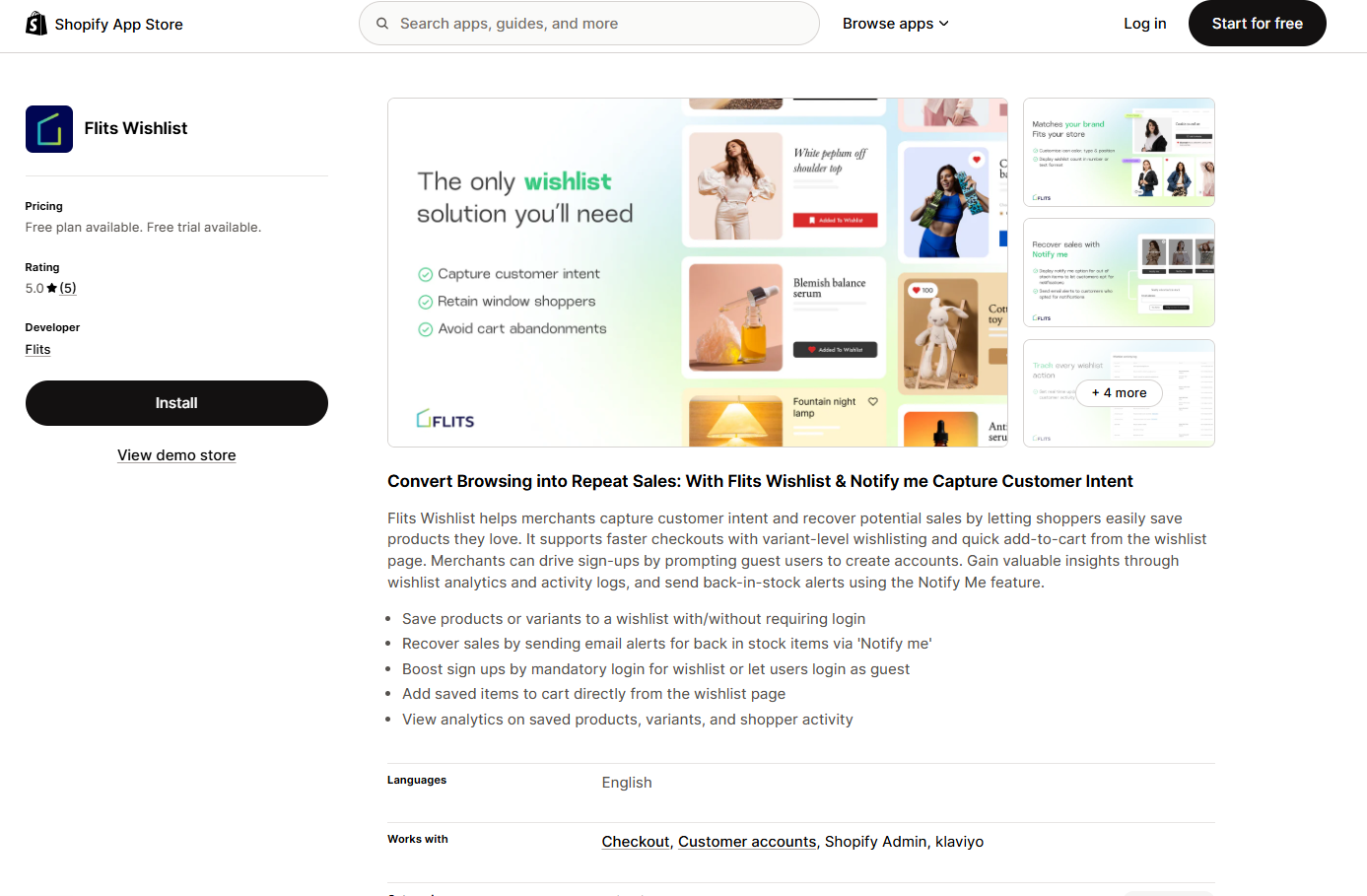
Every friction point that sends merchants looking for a Swish alternative points toward something specific. Pricing that climbs with your Shopify plan. No way to test before committing. A product that does one thing and stops. Email alerts that need a separate platform to function. Flits addresses each of these directly, but the product case starts before any of that comparison.
Flits has been building for Shopify merchants for over nine years. That history means the reliability questions that newer apps still encounter unexpected conflicts with theme updates, edge cases around custom storefronts, data sync issues are problems the Flits team has already worked through and resolved for an installed base of 5,000 merchants across 100 countries. You're not getting a product at an early stage of its development. You're getting a mature tool with a long track record.
Setup starts with something no other app on this list offers in quite the same way: an AI-generated wishlist page and flow builder. Instead of configuring the wishlist layout manually or waiting for a setup service to do it for you, Flits reads your store's existing theme and generates a matching wishlist experience. The page design, the button placement, and the flow all align with what your store already looks like. For merchants who've spent time on visual consistency, this matters. You're not introducing something that feels bolted on.

From that starting point, the product covers every placement a serious store needs. Wishlist buttons appear on product pages, collection pages, the customer account page, and the mini account drawer. A dedicated wishlist page is accessible from the header.

Customers can save the exact product variant they want not just a product which means the size they saved is the size that gets tracked, alerted on, and reported against. Wishlist Share lets customers send their saved list via link or social media, which extends the reach of your inventory beyond the shopper who saved it. Wishlist Collections let shoppers organize saved products into named groups, a feature that becomes meaningfully useful for stores with wide product ranges where customers browse across categories over multiple sessions.
When a saved product returns to stock, Flits fires a back-in-stock alert automatically. This is built into the product. There is no Klaviyo flow to configure, no Zapier connection to set up, and no external trigger to maintain. The alert goes out at the moment the product is available again, to the customer who already told you they want it. That timing is the point, a back-in-stock email sent days late is worth far less than one sent when the product is genuinely there to buy.

Flit’s integration with Klaviyo gives every wishlist action a save, a back-in-stock trigger, a variant saved flows into Klaviyo as a structured customer event. This gives you segmentation capability that goes well beyond what a standard browse or cart event can support. A customer who saved four products in the same category over three sessions represents a materially different buying signal than someone who added one thing to cart and left. Klaviyo receives that distinction. You can build flows against it. That's a different level of intent data than most wishlist apps pass to their email integrations.

Analytics gives the full picture. The admin shows which products are being saved most, which wishlisted products have converted to purchases, how many customers are actively using the wishlist, and per-customer timelines showing exactly what each shopper has saved and when. That data has direct applications in merchandising, stock planning, and campaign targeting not just in understanding that your wishlist is being used.

Now for the comparison that matters in this context. Swish charges $19/month on Shopify Basic and scales that bill to $29, $49, and $99 as your Shopify plan grows, with no change to the features you receive. Flits charges $19/month Unlimited regardless of which Shopify plan your store is on. The price doesn't move when you upgrade your store. What you get at $19/month is everything: the AI builder, the Klaviyo integration, the built-in alerts, the analytics, Wishlist Collections, Wishlist Share, and the managed migration if you're coming from Swish.
Migration, specifically: you share a CSV export of your wishlist data and the Flits team handles the import. Your customers keep their saved products on the other side.
Key features
- AI-generated wishlist page and flow builder matched to your store's existing theme
- Guest wishlist support (paid plan)
- Back-in-stock email alerts built in, no external automation tool required
- Klaviyo integration: wishlist saves and back-in-stock triggers sync as structured customer events
- Wishlist Share via link and social media
- Wishlist Collections for customer-organized saved product groups
- Variant-level saving: customers save the exact size, color, or style they want
- Wishlist placements across product pages, collection pages, account pages, the mini account drawer, and a dedicated header-accessible page
- Analytics covering top-saved products, wishlist-driven revenue, cart abandonment, and per-customer activity timelines
- Managed migration from Swish via CSV, handled by the Flits support team
Pros
- $19/month Unlimited stays flat regardless of which Shopify plan you're on. No Shopify-tier-based pricing
- Free plan available for stores that want to test before committing
- Back-in-stock alerts fire automatically. No Klaviyo flow required for the core alert function
- Nine years of Shopify experience means the edge cases are already handled
- AI builder removes the manual setup that Swish's service handles manually
Cons
- Price drop alerts are on the roadmap but are not live yet. Back-in-stock is available now
- Guest wishlist requires the paid plan. The free plan covers the core wishlist experience but not guest access
Flits vs. Swish
Swish offers a polished product with a Shopify-tier pricing model that penalizes you for growing your store, no free plan to evaluate before committing, and no built-in email layer without Klaviyo. Flits charges one flat price that doesn't move, includes a free plan, and ships back-in-stock alerts without external configuration.
For most stores switching from Swish, Flits is not a compromise. It's a more complete product at a more honest price.
2. Swym Wishlist Plus
Best for high-volume stores needing enterprise-grade reporting
Shopify App Store rating: 4.7/5 (1343 reviews)
Pricing: Paid plans from $29.99/month.
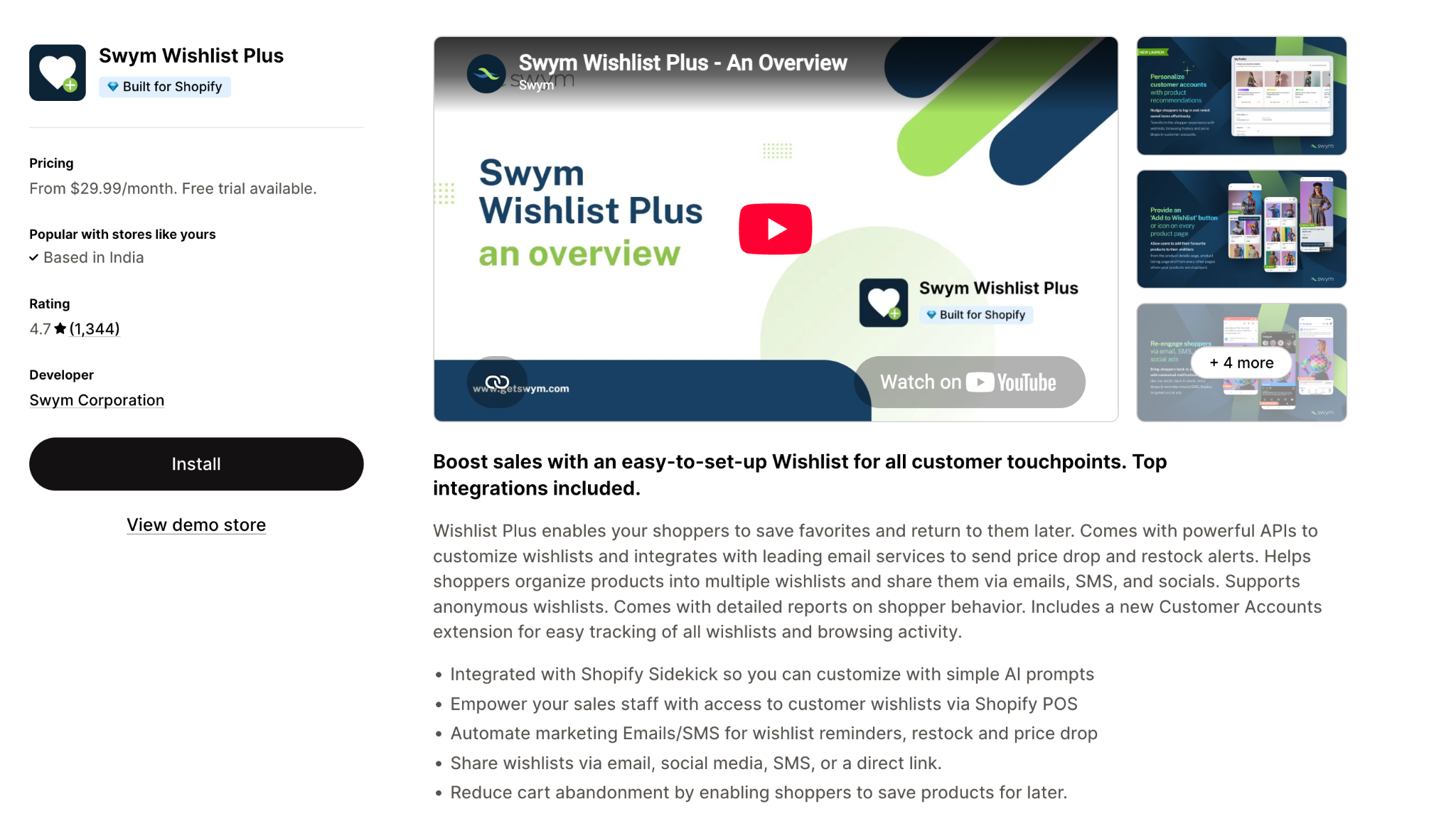
Swym is the largest wishlist app on the Shopify App Store by review volume, and that scale reflects something real. The product has been tested across an enormous range of store types, catalog sizes, and traffic levels. At its upper tiers, the analytics and reporting go deeper than almost any other wishlist app on this list: detailed cohort breakdowns, demand forecasting signals from wishlist data, and Shopify Flow integration that lets advanced merchants build automated responses to wishlist events without writing any logic manually.
The core trade-off is access. Guest wishlists and email alerts both sit behind the $19.99/month entry plan. The free tier is technically available but functionally limited in ways that will matter to any store running meaningful traffic. The pricing also scales across higher tiers, meaning merchants looking for the full analytics suite are paying significantly more than the entry point.
For a store processing high order volumes where wishlist data informs actual merchandising and restocking decisions, Swym at scale can justify the cost. For everyone else, the value gap between what the entry plan offers and what Swish already provided is narrow enough that switching for its own sake may not be worth it.
Key features
- Guest wishlist support on paid plans
- Back-in-stock and price drop email alerts
- Shopify Flow integration for advanced automation logic
- Detailed analytics with demand forecasting signals at higher tiers
- Multi-device wishlist sync for seamless cross-device shopping
- Supports headless and custom storefront implementations
Pros
- Largest installed base on Shopify. The reliability questions have been answered at scale
- Analytics depth at higher tiers is genuinely superior to most alternatives
- Shopify Flow integration offers automation capability that doesn't require Klaviyo
- Extensive documentation and a well-resourced support operation
Cons
- Guest wishlists and email alerts both require the paid plan
- Free tier is too limited for stores with active wishlist usage
- Pricing climbs as feature access expands, similar structural issue to Swish
- No broader retention features beyond the wishlist itself
Swym vs. Swish
Both are dedicated wishlist tools with similar pricing floors. Swym's advantage is analytics depth and reporting at scale. Swish's advantage is the free setup service and stronger UI customization flexibility. For stores whose primary driver for switching is the pricing model, neither Swym nor Swish resolves that concern; both scale pricing upward.
3. Growave
Best for stores replacing multiple retention apps at once
Shopify App Store rating: 4.8/5 (1172 reviews)
Pricing: Free plan available. Paid plans from $15/month.
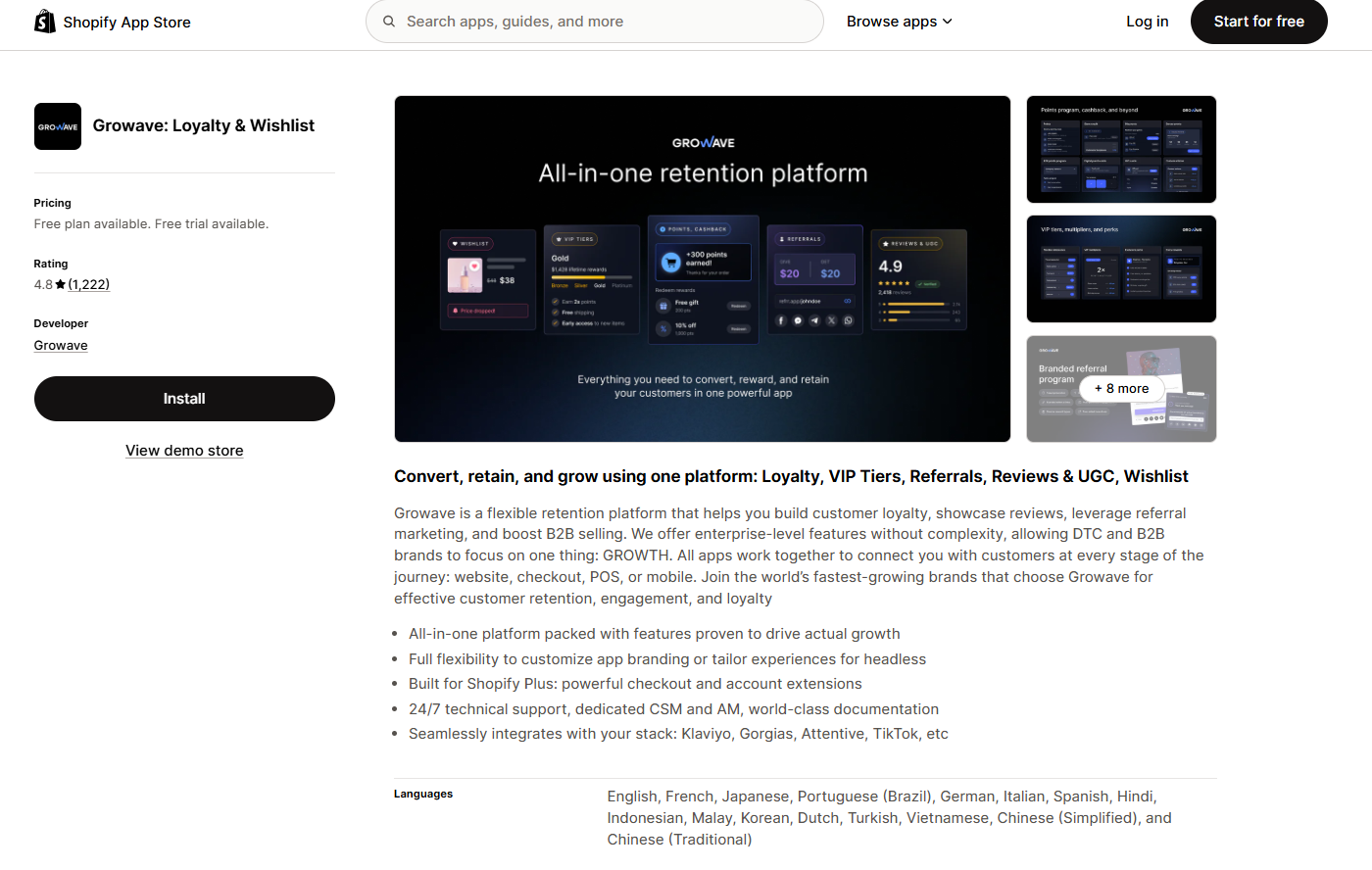
Growave occupies a different strategic position from every other app on this list. Where Swish is a wishlist tool that does one thing extremely well, Growave is a retention platform that handles wishlists, loyalty programs, product reviews, referrals, and social login from a single dashboard. The wishlist component is solid on its own. The case for Growave is what surrounds it.
For stores currently paying for a wishlist app, a separate loyalty tool, and a reviews platform, Growave consolidates those costs and integrations into one product. The customer data lives in one place, which means a shopper who saves a product, earns loyalty points on a purchase, and leaves a review after delivery is tracked as one continuous customer relationship rather than three separate data points across three systems. That coherence has real value in how you segment, target, and re-engage.
The meaningful limitation is guest wishlist support. Growave does not offer guest wishlist access on any plan. Customers need to create an account to save products. For stores with significant guest traffic, that's a customer cohort who simply won't use the wishlist, which undercuts the intent capture argument.
Key features
- Wishlist with email alerts for price changes and restocks
- Points-based loyalty program with configurable earning and redemption rules
- Product reviews with photo and video support
- Referral program with custom reward structures
- Social login via Google and Facebook
- VIP tier programs for high-value customer segmentation
Pros
- Replaces multiple standalone apps, reducing total monthly cost and integration overhead
- Shared customer profile connects wishlist, loyalty, review, and purchase data in one system
- Strong track record and one of the highest review counts on the Shopify App Store
- Free plan available for stores getting started
Cons
- No guest wishlist on any plan. High guest-traffic stores will lose a meaningful portion of wishlist activity
- The bundled approach means individual features are less configurable than dedicated tools
- Entry price at $9/month is higher than wishlist-only alternatives at the lower end of the market
Growave vs. Swish
Swish does one thing with precision. Growave does several things with reasonable depth. The decision comes down to whether consolidation is the goal. If you want loyalty and reviews alongside your wishlist under one roof, Growave is the clearest path. If visual control and wishlist-specific customization matter more than platform breadth, Swish still wins on that dimension.
4. Hulk Wishlist & Favorites
Best for stores with large catalogs and multiple list types
Shopify App Store rating: 4.8/5 (125 reviews)
Pricing: Free plan available. Paid plans from $9.90/month.
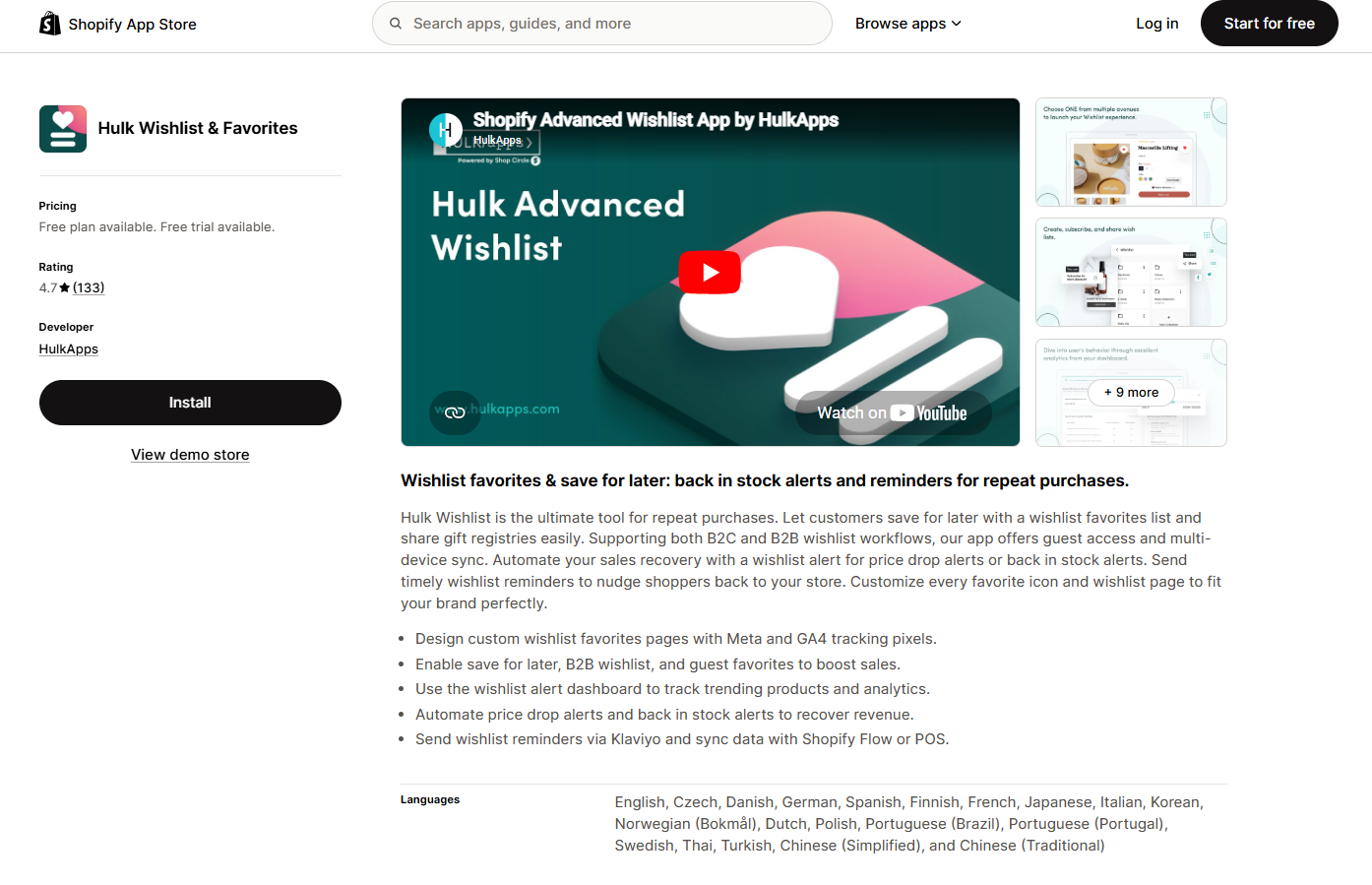
Hulk takes a structural approach to wishlists that most apps don't consider: instead of one list per customer, it gives each shopper the ability to create multiple separate wishlists with their own names and purposes. A customer can maintain a personal favorites list, a gift ideas list organized around an occasion, and a seasonal collection tracking products they plan to buy later in the year, all running in parallel.
For stores with wide product ranges, this organizational flexibility is a real differentiator. Shoppers who browse apparel, home goods, or any catalog-heavy vertical often save products with different buying timelines and different intentions. Hulk lets them reflect that in how they structure their saved items, which increases the likelihood that the wishlist stays active rather than becoming an undifferentiated pile of products they lose track of.
The gap is email alerts. Hulk doesn't include built-in back-in-stock or price drop notifications. Wishlist recovery email relies on connecting to an external tool, and not all merchants have that in place. For stores where passive list curation matters more than active email recovery, this trade-off is manageable. For stores where alerts are core to the wishlist's commercial purpose, Hulk requires additional tooling.
Key features
- Multiple wishlists per customer: favorites, gift lists, themed collections
- Unlimited products per wishlist on all plans
- Guest wishlist support
- Wishlist sharing via link
- Add-to-cart shortcut directly from the wishlist page
- Clean admin overview showing wishlist activity across the store
Pros
- No caps on products per list or number of lists per customer
- Multiple list types reflect how customers actually shop across different intents
- Strong fit for fashion, home goods, gift-oriented, and catalog-heavy stores
- Significantly lower price point than Swish while covering guest wishlists
Cons
- No built-in email alerts for back-in-stock or price drops
- Smaller review base than established alternatives, less social proof at scale
- Analytics are basic. Not suitable for data-driven merchandising decisions
Hulk vs. Swish
Swish has stronger customization control and email integration capability. Hulk has unlimited list types and a free plan. For a store where the primary motivation for switching is Swish's pricing structure and the lack of multiple list types, Hulk offers a genuinely different product model at a fraction of the cost.
5. WC Wishlist Club
Best for stores in early growth stages
Shopify App Store rating: 4.8/5 (150+ reviews)
Pricing: Paid plans from $4.99/month.
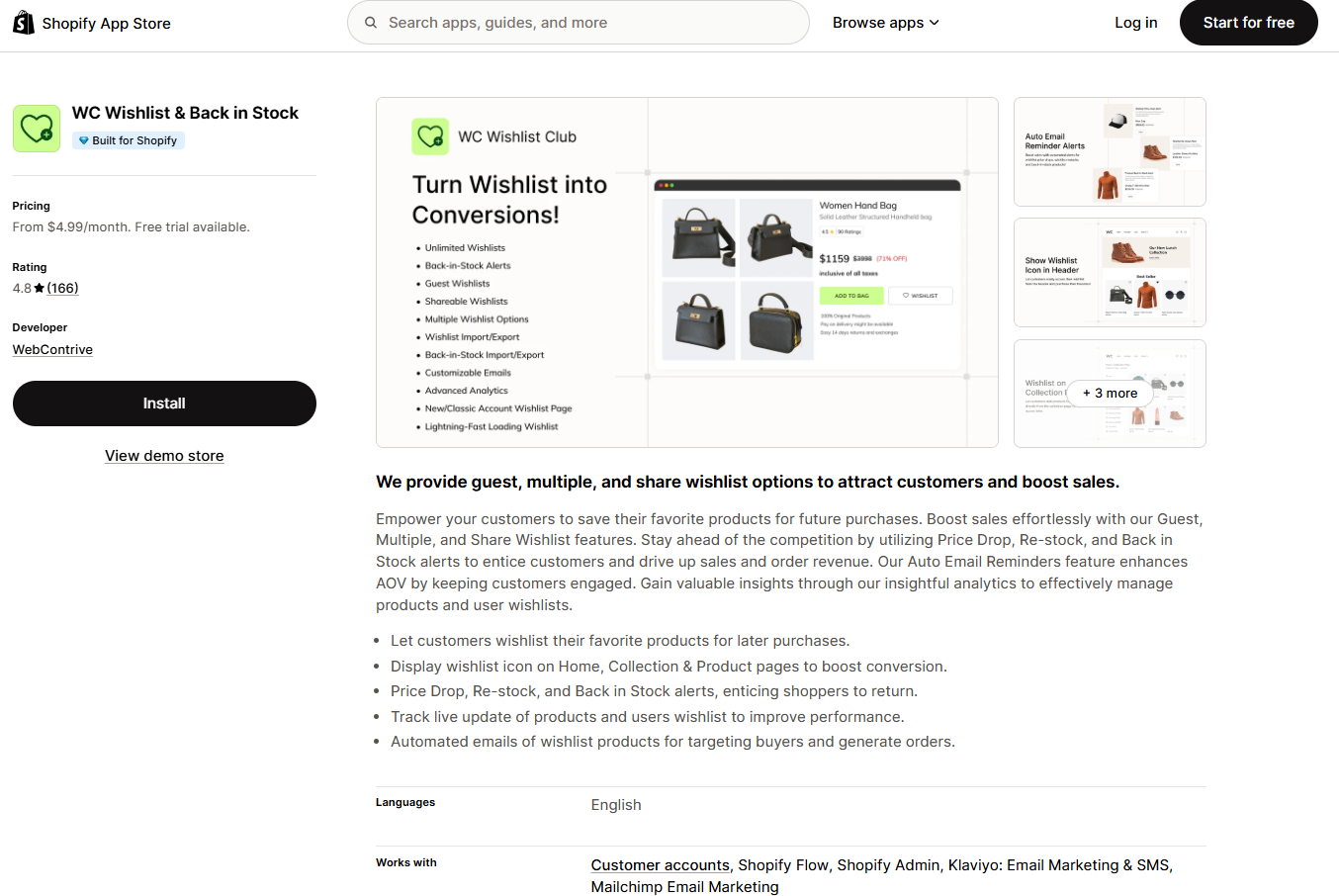
WC Wishlist Club sits at the opposite end of the market from Swish in almost every dimension. No white-glove onboarding, no advanced analytics, no premium support structure but a fully functional wishlist at the lowest price point of any app on this list, with guest wishlist access and email alerts available from early in the plan structure.
For stores that are still working out whether a wishlist drives meaningful engagement for their specific customer base, starting with WC Wishlist Club is a rational decision. The investment is low enough to validate the channel without the commitment that Swish's $19 minimum requires from day one. If the data shows the wishlist is generating real return visits and conversions, moving to a more feature-complete tool is a straightforward upgrade. If it doesn't, the experiment cost very little.
This isn't an app for a store with serious scale or a sophisticated retention strategy. The analytics don't support the kind of segmentation and merchandising decisions that larger stores rely on. But as an entry point or a bridge, WC Wishlist Club covers the fundamentals reliably.
Key features
- Guest wishlist support included from the free plan
- Email reminder alerts for saved products
- Basic analytics showing saved product counts and popular items
- Social sharing for wishlist lists
- Add-to-cart shortcut from the wishlist page
- Simple, clean admin with straightforward configuration
Pros
- Lowest paid-plan cost of any app on this list
- Guest wishlist works without a plan upgrade
- Stable performance across a variety of Shopify themes
- Genuinely usable free plan for early-stage stores
Cons
- Analytics are too basic for data-driven campaigns or stock planning
- Customization options are minimal compared to Swish or Flits
- Not a realistic choice for stores with high wishlist traffic or active email marketing programs
WC Wishlist Club vs. Swish
Swish charges $19/month from day one and scales pricing with your Shopify plan. WC Wishlist Club starts at $2.99/month and includes guest wishlist support. For a store that doesn't yet have the traffic volume to justify Swish's entry cost, WC Wishlist Club covers the basics until that threshold is reached.
6. SE Wishlist Engine
Best for automated, trigger-based email recovery
Shopify App Store rating: 4.8/5 (200+ reviews)
Pricing: Free plan available. Paid plans from $7.99/month.
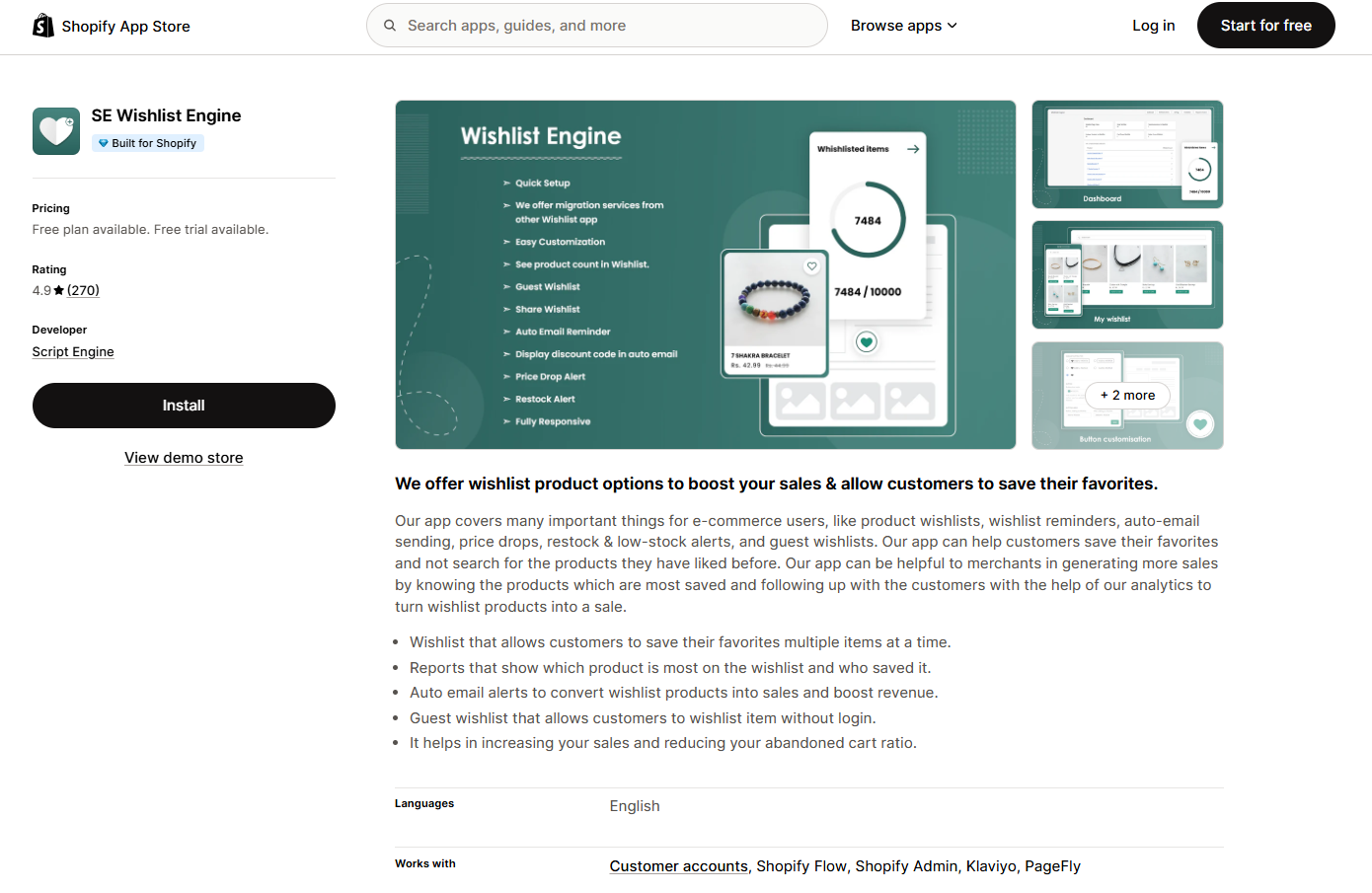
SE Wishlist Engine was designed with a specific thesis: the most valuable thing a wishlist app can do is not just capture saves but convert them. Every feature in the product is oriented around bringing customers back to what they saved, through timely and relevant automated emails. The result is an email recovery layer that's more granular than what most wishlist apps at this price point include.
The setup gives merchants control over multiple trigger types: back-in-stock alerts when a product returns to inventory, price drop notifications when a saved item goes on sale, and reminder emails for items saved but not purchased within a configurable time window. Each trigger type has its own customizable email template, and the open rate and conversion analytics at the campaign level let you measure which recovery type is doing the actual work.
For stores switching from Swish specifically because of the email dependency on Klaviyo, SE Wishlist Engine solves that directly. The email recovery runs within the app. Klaviyo is optional, not required. Guest wishlist access is included, and the free plan is usable enough to validate whether the recovery emails are generating meaningful return traffic before committing to a paid tier.
Key features
- Automated email recovery for back-in-stock, price drops, and abandoned wishlist reminders
- Guest wishlist with optional email capture for non-logged-in shoppers
- Per-trigger customizable email templates
- Analytics on email open rates, click rates, and wishlist-driven conversions
- Direct add-to-cart button embedded in recovery emails
- Works without Klaviyo or any external email platform
Pros
- Email recovery is the core design priority, not an afterthought
- Multiple trigger types with independent templates and send logic
- Guest wishlist works on the free plan
- No external email tool required for full alert functionality
Cons
- UI customization options are more limited than Swish or Flits
- No loyalty, reviews, or broader retention features
- Not the right tool if customer analytics or account-level data is the priority
SE Wishlist Engine vs. Swish
Swish routes email recovery through Klaviyo. SE Wishlist Engine handles it internally. For stores that aren't running Klaviyo, or that want recovery emails to work without maintaining flows in a separate platform, SE Wishlist Engine closes the gap Swish leaves open at roughly a fifth of the monthly cost.
7. Mst: Wishlist Prime
Best for lightweight wishlist-triggered marketing
Shopify App Store rating: 4.8/5 (100+ reviews)
Pricing: $2/month.
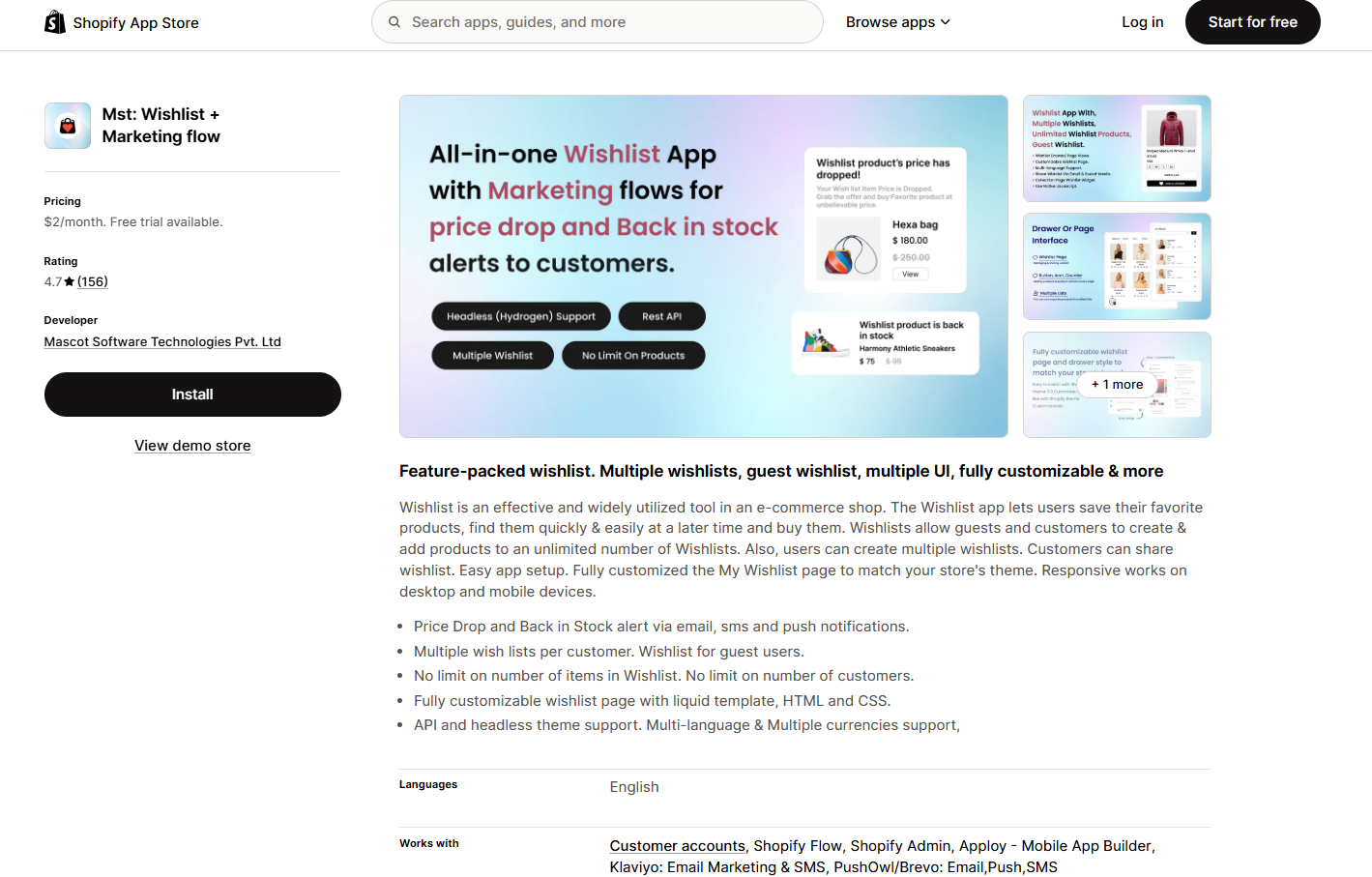
MST sits between a standard wishlist app and a lightweight marketing automation tool. The core wishlist functions guest support, back-in-stock and price drop alerts, variant saving, and social sharing are all included. But MST adds a layer on top: marketing flows that fire based on what customers have saved. Cart nudge emails go out when a saved product has been sitting without a purchase. Product recommendation emails are generated based on wishlist activity. Promotional campaigns can be triggered against customer segments defined by their saved items.
None of these flows require Klaviyo to operate. They run inside the app, which means a store without a sophisticated email marketing stack can still send reasonably targeted outreach based on actual purchase intent data. For merchants who want wishlist-informed email campaigns but aren't ready to invest in and configure a full Klaviyo setup, MST covers that middle ground.
The limitation is depth. The marketing flows are straightforward by design. A merchant wanting complex multi-step sequences, granular segmentation, or detailed attribution won't find that here. MST is a solution for stores that want automated wishlist marketing to work without significant investment in configuration and maintenance not a replacement for a dedicated marketing automation platform.
Key features
- Wishlist with guest support across all plans
- Automated back-in-stock and price drop email alerts
- Cart nudge emails for saved products not purchased within a set window
- Product recommendations based on wishlist activity
- Marketing flows built on wishlist event triggers
- Basic performance analytics on wishlist and email activity
Pros
- Marketing automation works within the app. No Klaviyo dependency for core functions
- Guest wishlist supported from day one
- Lower price entry point than Swish with more built-in functionality for early-stage stores
Cons
- Marketing flows are basic. Not suitable for multi-step automation or complex campaign logic
- Newer app with fewer reviews and less market validation than established alternatives
- Analytics don't support the kind of detailed attribution that higher-traffic stores need
MST vs. Swish
Swish handles email through Klaviyo and Meta integrations. MST includes basic marketing automation built into the product. For stores where external email platforms aren't set up, MST delivers more out-of-the-box marketing capability than Swish at a lower price.
8. Wishlists - Wishify
Best for zero-configuration installation
Shopify App Store rating: 4.9/5 (197 reviews)
Pricing: Free plan available. Paid plans from $5.99/month.
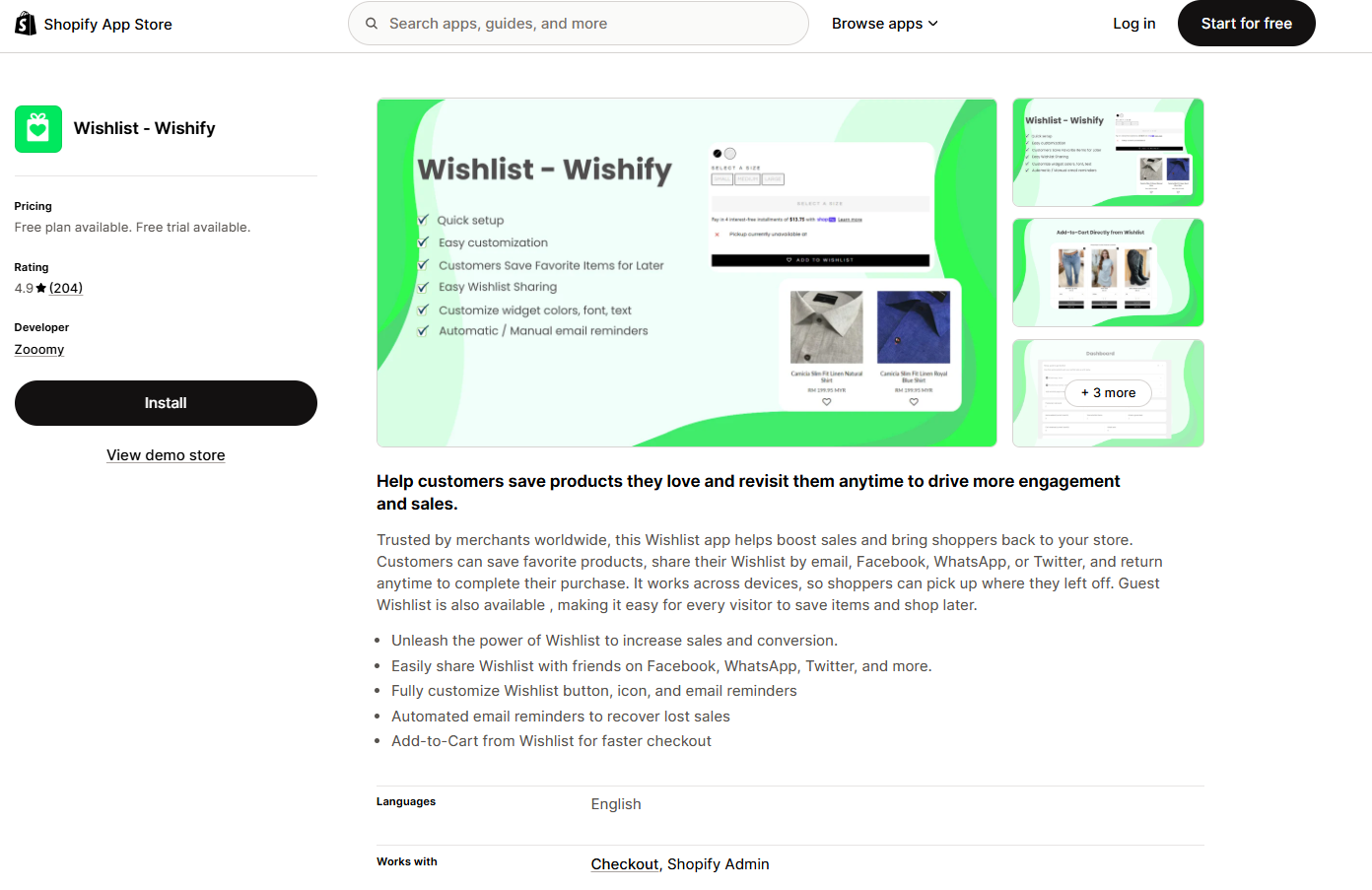
Wishify's positioning is simple: install it, and it works. The app uses automatic theme detection to identify your store's design system and configure the wishlist button placement without any manual input from the merchant. Guest wishlist access is included on the free plan. Back-in-stock and price drop alerts activate on paid tiers. The admin is clean and requires no configuration expertise to navigate.
For a merchant switching from Swish who wants a lower-cost alternative that gets back to working with minimal friction, Wishify does exactly that. There's no white-glove setup service because, in most cases, no setup is required. The app handles the placement, the styling decisions are handled automatically, and the store is running a wishlist within minutes.
The trade-off is flexibility. Wishify's customization options are limited. Merchants with strong brand standards and specific ideas about how the wishlist experience should look will hit the boundaries of what Wishify permits fairly quickly. The analytics are also basic, which limits how much merchandising insight you can extract from the wishlist data. For stores where simplicity is the actual priority and customization is secondary, Wishify is a strong choice. For stores that want to grow into deeper wishlist functionality, it may be a stepping stone rather than a destination.
Key features
- Automatic theme detection with immediate wishlist activation post-install
- Guest wishlist support available on the free plan
- Back-in-stock and price drop email alerts on paid tiers
- Social sharing for saved wishlists
- Add-to-cart shortcut from the wishlist page
- Clean, minimal admin requiring no technical knowledge
Pros
- Fastest time from install to live of any app on this list
- Guest wishlist works immediately without configuration
- Reliable theme compatibility across most standard Shopify themes
- Free plan is genuinely functional for basic wishlist needs
Cons
- Limited customization beyond basic color adjustments
- Analytics are too thin for data-driven decisions
- No Klaviyo integration or deeper marketing stack connection
Wishify vs. Swish
Swish offers more customization depth, better analytics, and a more comprehensive integration set. Wishify gets you live faster and costs less. For a store where Swish's pricing model was the primary problem and feature depth is secondary, Wishify gets the job done at a meaningfully lower monthly cost and with no onboarding overhead.
9. Wishlist Hero
When you need a basic wishlist and have limited expectations
Shopify App Store rating: 4.7/5 (370 reviews)
Pricing: Free plan available. Paid plans from $4/month.
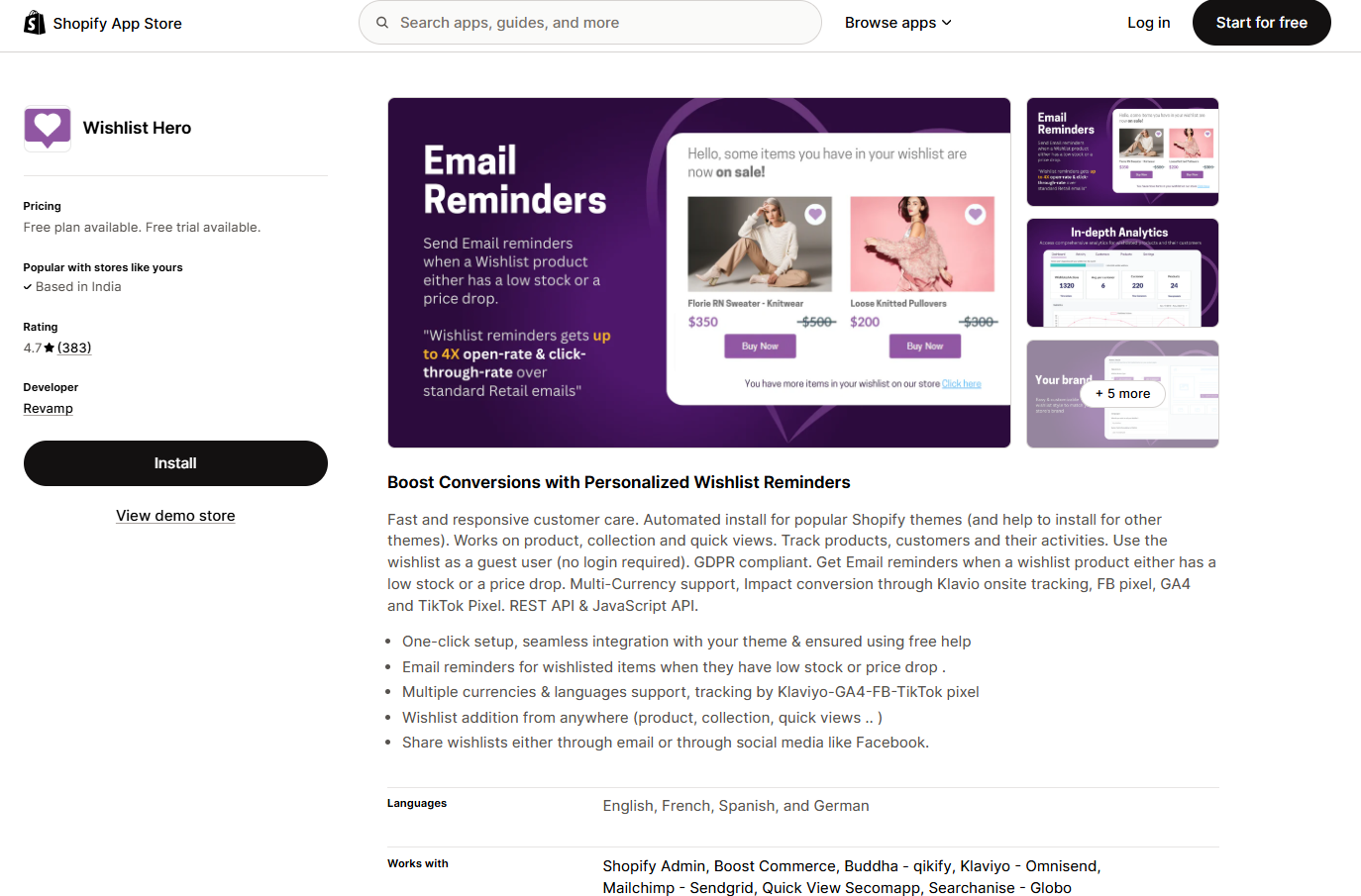
Wishlist Hero is on this list because it appears in most Shopify wishlist comparisons, and a complete guide should address it honestly. The pricing is accessible, the feature list covers the basics, and the free plan makes it a low-risk first installation.
The important context, which is reflected in recent Shopify App Store reviews, is that the product has a reliability track record that warrants caution. Multiple merchants have documented the app redirecting rather than loading in the admin, guest wishlist functionality breaking without explanation, and support response times that have stretched into weeks. One merchant flagged residual code left behind in the theme after uninstallation a problem that requires developer intervention to clean up.
There are merchants for whom Wishlist Hero has worked without issue for extended periods. But there are enough documented cases of it failing in production, combined with inconsistent support response, that recommending it as a primary tool for a store with meaningful traffic would be difficult to justify. It's the last option on this list for a reason.
If you're on an extremely limited budget and want to test whether a wishlist drives any engagement at all before investing further, Wishlist Hero can serve that temporary purpose. For any store where the wishlist is a real part of the retention strategy, one of the other apps on this list is a more dependable choice.
Key features
- Guest wishlist support on paid plans
- Back-in-stock and price drop email alerts
- Multi-currency support for international stores
- GDPR-compliant email capture for guest wishlist users
- Social sharing and dedicated wishlist page
Pros
- Very low price floor at $2.99/month
- Multi-currency support for international stores is included
- GDPR-compliant guest email capture is built in
Cons
- Documented reliability issues across multiple independent merchant reviews
- Support response times that have been described as weeks in some cases
- Residual theme code reported after uninstallation, requiring manual cleanup
- Not a dependable choice for a store where the wishlist is commercially important
Wishlist Hero vs. Swish
Swish is more reliable, better supported, and more customizable than Wishlist Hero by a significant margin. The only reason Wishlist Hero appears as an alternative is cost. If that's the primary driver, WC Wishlist Club or SE Wishlist Engine cover the same price range with fewer documented problems.
Final verdict: Which Swish alternative should you choose?
Swish is a well-built product. That's worth acknowledging directly. If your reason for switching is something other than its pricing model or its wishlist-only scope, it's worth re-examining whether switching is necessary at all.
But if you've noticed that your Swish bill climbed when you upgraded your Shopify plan without any change in what you're getting, or if you've realized you need email recovery that works independently of Klaviyo, or if you want your wishlist to be one part of a broader retention strategy rather than the whole of it, then every alternative on this list serves that need better than Swish does.
For stores that want UI precision and design control above all else, and don't mind the pricing model, staying with Swish remains defensible. Swym is the right choice if detailed analytics at scale is the primary requirement. Growave makes sense when wishlist, loyalty, and reviews need to live in one platform rather than three. SE Wishlist Engine earns its place for stores where email recovery is the core use case and external platform dependency is the problem. Hulk is the answer when multiple list types and unlimited saved items matter more than email alerts. WC Wishlist Club and Wishify serve early-stage stores that want reliable basics at minimal cost.
For every other store the ones that want a complete, stable wishlist product with built-in email alerts, Klaviyo integration that doesn't require an external flow to do basic work, a flat price that doesn't penalize Shopify plan upgrades, and a team behind it that has been building for this ecosystem for nearly a decade, Flits is the clearest choice.
The $19/month Unlimited plan doesn't move when your store grows. The features don't unlock in tiers. The AI builder gets you live faster than any setup service. The migration is handled by the Flits team. And everything that made you start looking for a Swish alternative the pricing mechanic, the email dependency, the narrow scope is resolved.
Try Flits Wishlist on the Shopify App Store
Frequently asked questions
Why does Swish charge different prices for the same features?
Swish's pricing is tied directly to the Shopify plan a merchant is subscribed to. Basic Shopify merchants pay $19/month, Shopify plan merchants pay $29/month, and Advanced Shopify merchants pay $49/month. All three tiers include the same features. The price difference reflects the Shopify plan tier, not any difference in what the app delivers.
Which Swish alternative works without Klaviyo?
Flits Wishlist, SE Wishlist Engine, MST, and WC Wishlist Club all include built-in email alerts that operate without Klaviyo. Flits also connects to Klaviyo for stores that want to layer wishlist events into broader flows, but the core back-in-stock alert doesn't require it.
Is there a free alternative to Swish?
Yes. Flits Wishlist, Growave, WC Wishlist Club, SE Wishlist Engine, MST, Hulk, and Wishify all offer free plans. Swym's free plan exists but is limited in ways that make it functionally restrictive for active stores. Swish has no free plan.
Can I migrate my wishlist data from Swish to Flits?
Yes. Flits supports migration from most wishlist apps, including Swish. The process involves exporting your wishlist data as a CSV and sharing it with the Flits support team, who handle the import. Customer saved products are preserved through the migration.
Which alternative is best if I also need a loyalty program?
Growave is the clearest choice for stores that want wishlist and loyalty managed in one platform. Growave includes points-based loyalty, product reviews, and referral programs alongside its wishlist functionality. Flits' loyalty and rewards features sit in a separate product offering from the Flits suite.
Does Flits pricing change if I upgrade my Shopify plan?
No. Flits charges $19/month for the Unlimited plan regardless of which Shopify plan your store is on. This is a direct structural difference from Swish, where the monthly fee rises with each Shopify plan tier.