Most Shopify merchants only see intent after it's too late to act on it. A customer browses, gets distracted, closes the tab, and the only record left behind is an abandoned cart the merchant might catch with a discount email a day later, if the platform even flags it. Everything the customer actually cared about, the specific product, the size they wanted, how seriously they were considering it, disappears the moment the session ends.
A wishlist changes that. It's one of the few features a Shopify store can add that captures intent directly from the customer, in their own words, at the exact moment they're deciding what they want. This guide covers what customer intent actually means in an ecommerce context, why a wishlist captures it more cleanly than almost any other on-site signal, how to set one up so it actually gets used, and what to do with the data once you have it, including the honest limitations most guides on this topic leave out.
TL;DR
- Customer intent data comes in layers: what a customer declares, how they behave, and what they eventually buy. A wishlist sits closer to the declared layer than almost any other free browsing signal.
- As third-party cookies and cross-site tracking keep eroding, intent signals a store collects directly, called zero-party and first-party data, become significantly more valuable than anything purchased from an outside source.
- A wishlist save is a stronger signal than an add-to-cart in one specific way: it reflects a considered choice, not a step toward checkout that gets triggered by casual browsing.
- Guest wishlisting, variant-level saving, and visible placement all directly affect how much intent data a wishlist actually collects, and most stores get at least one of these wrong.
- Wishlist usage rates across the industry are genuinely low, typically 1-3% of visitors, so the value isn't in volume. It's in the quality and specificity of the signal from the customers who do use it.
- The real payoff comes from what happens after the save: back-in-stock alerts, targeted email flows, and analytics that most merchants never build out.
What Customer Intent Actually Means in Ecommerce
"Customer intent" gets used loosely in ecommerce marketing, often as a stand-in for anything a visitor does on a site. It's worth being precise about it, because the precision changes what you should actually build.
The three layers of intent data
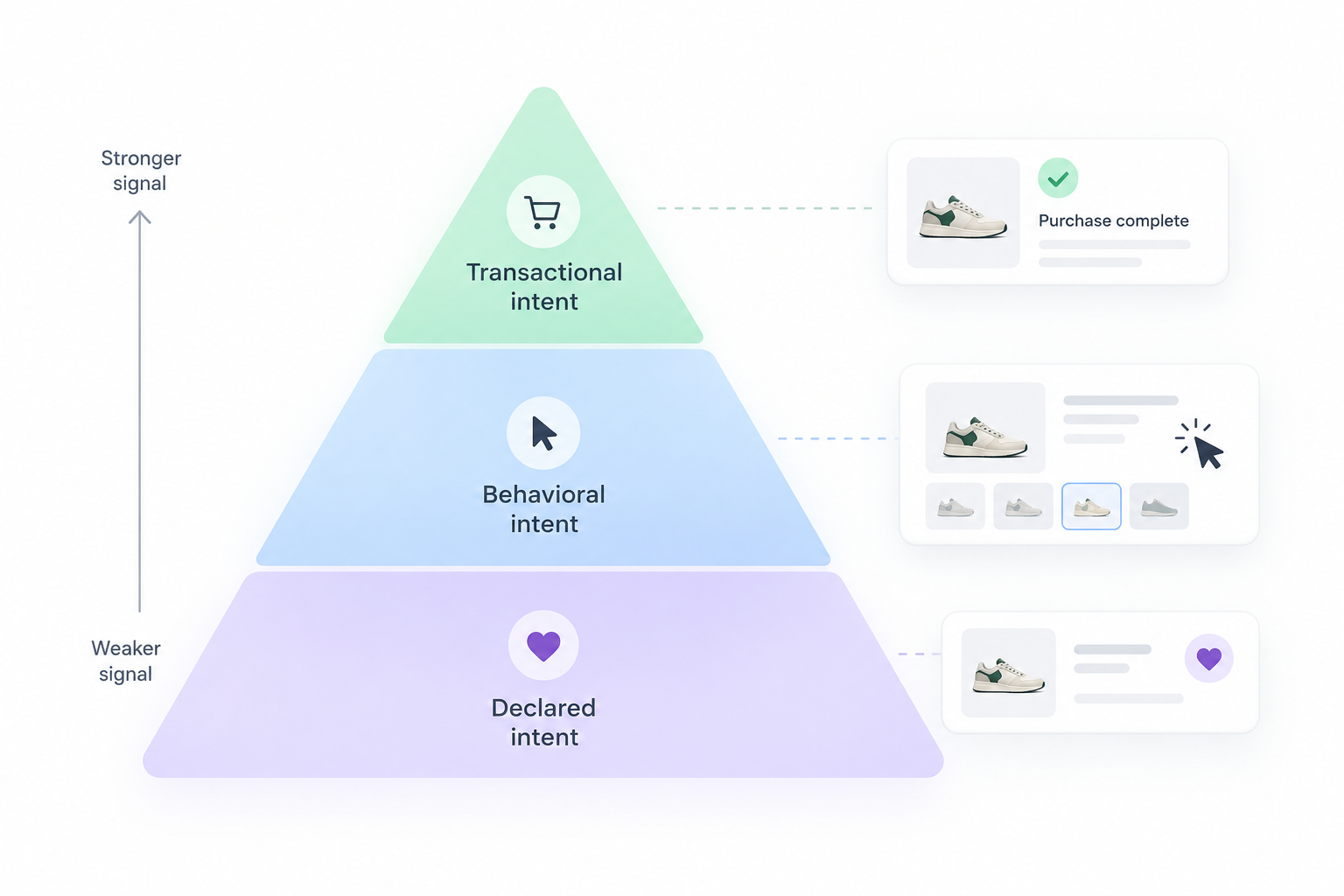
Intent data generally falls into three layers, and each one tells a different part of the story. The first is declared intent, information a customer tells you directly, whether that's a quiz answer, a stated preference, or a saved item. The second is behavioral intent, inferred from what a customer does without explicitly stating it, like repeat visits to a product page or time spent scrolling a category. The third is transactional intent, the strongest and rarest signal, which is an actual completed purchase.
Most ecommerce tracking lives entirely in the second layer. Page views, session duration, and scroll depth are all behavioral proxies, useful in aggregate but noisy at the individual level, since a long session could mean genuine interest or it could mean someone left a tab open while they made coffee. A wishlist save sits in the first layer instead. It's a customer explicitly telling you "I want this," which is a categorically cleaner signal than inferring interest from ambiguous browsing behavior.
Why cookie deprecation makes owned intent data more valuable
The broader industry shift away from third-party cookies has pushed marketers toward what's often called zero-party and first-party data, meaning information a brand collects directly from its own customers rather than purchasing it from an external aggregator or inferring it from cross-site tracking. Declared preferences, quiz responses, and wishlists are commonly cited as core examples of zero-party data specifically, because the customer is handing the information over voluntarily rather than having it inferred or tracked.
For a Shopify store, this matters practically as much as it matters strategically. A wishlist doesn't rely on a third-party pixel that might get blocked by a browser update or a privacy regulation. It's a first-party record living inside your own store, tied to your own customer accounts, unaffected by whatever happens to the broader ad-tracking ecosystem.
Why a Wishlist Is One of the Purest Intent Signals You Can Collect
Not every on-site action is equally valuable as an intent signal, and it's worth being specific about where a wishlist save actually ranks.
1. The wishlist tells you what, not just that
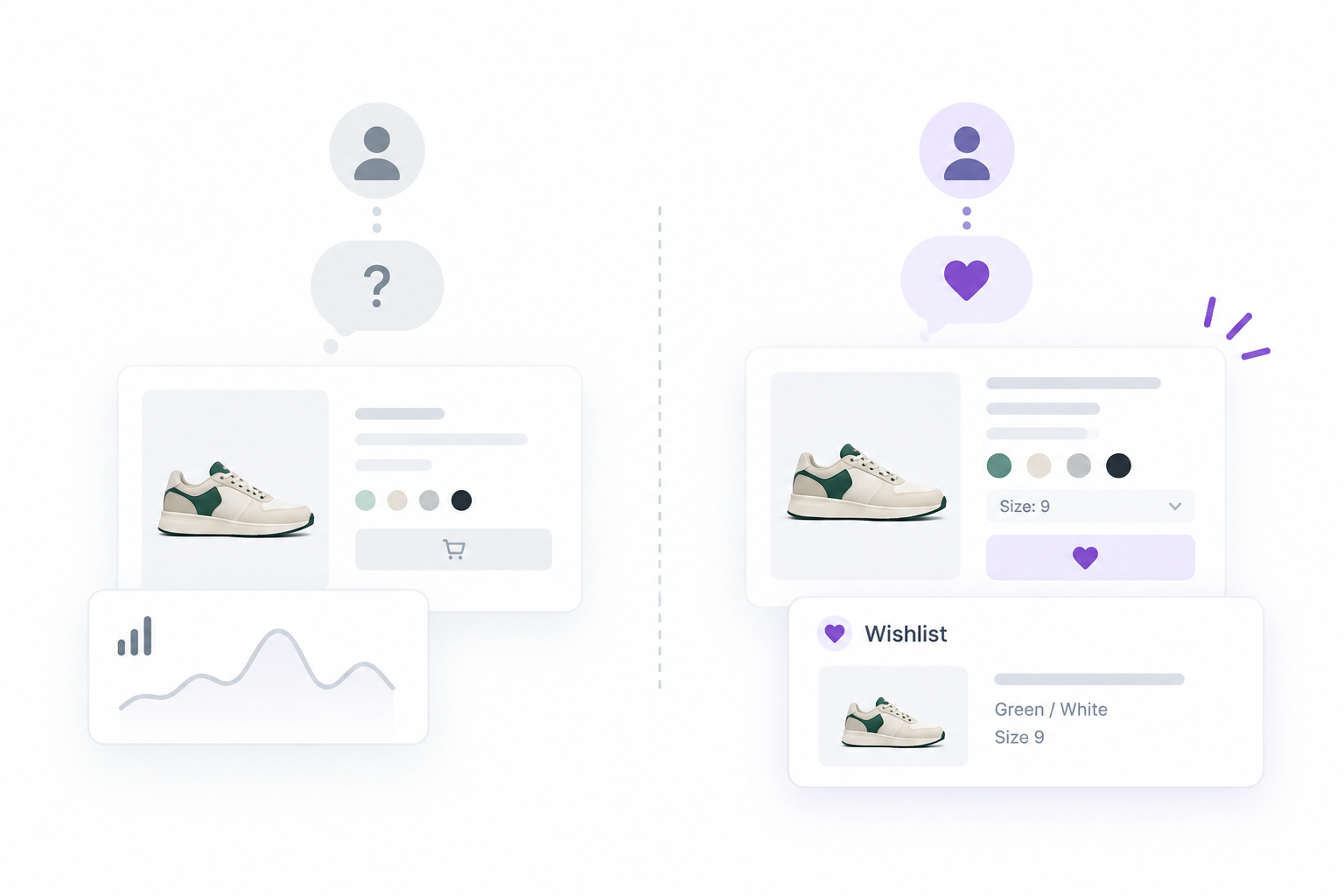
A lot of ecommerce analytics tells you that something happened without telling you clearly what it means. A high bounce rate on a product page could mean disinterest, or it could mean the customer already knew everything they needed and left to compare prices elsewhere. A wishlist save doesn't carry that ambiguity. When a customer saves a specific product, in a specific size or color, you know exactly what they want, which removes the guesswork that makes most behavioral analytics hard to act on directly.
2. Add-to-cart vs wishlist: different signals, different timing
Add-to-cart is often treated as the gold standard intent signal in ecommerce, and it's a strong one, but it measures something slightly different than a wishlist does. An add-to-cart usually signals near-term purchase intent, the customer is close to buying now. A wishlist save more often signals considered, longer-horizon intent: the customer wants this, but isn't ready yet, whether because of price, timing, or simply still deciding. Both signals matter, but they call for different responses. Treating every wishlist save like an abandoned cart, with an immediate discount push, misreads what the customer was actually telling you. A wishlist save is patient information. It's built for a slower follow-up, not a same-day rescue email.
Also Read: Shopify Wishlist vs Save for Later: What's the Difference?
3. The honest caveat most guides leave out
What rarely gets mentioned when brands are promoting their wishlist app: industry-wide wishlist usage typically sits between 1% and 3% of total store visitors. That means in a store with 10,000 monthly visitors, you might see 100 to 300 people actually use the wishlist at all. The conversion lift among that group is real, but the group itself is small.
This isn't a reason to skip building one. It's a reason to be clear about what a wishlist is actually good for. It's not going to move your overall store conversion rate by itself. What it does is give you an unusually clean, high-intent signal from the small slice of visitors who are seriously considering a purchase, and that signal becomes valuable specifically because of what you do with it afterward, not because of the raw usage number on its own.
How to Set Up a Shopify Wishlist to Actually Capture Intent
Shopify doesn't include native wishlist functionality, so this requires a third-party app, and how that app is configured determines whether it actually captures meaningful intent data or sits unused.
1. Remove the account wall with guest wishlisting
The single biggest reason wishlist usage rates stay low is that many apps require an account before a customer can save anything. That single extra step eliminates most casual browsers before they've had the chance to signal interest at all. Guest wishlisting removes that barrier, letting a visitor save an item immediately and decide later whether to create an account.
Flits supports guest wishlisting on its paid plan specifically because this early, low-commitment save is often the first and only intent signal you'll get from a first-time visitor, and losing it to an unnecessary signup wall means losing the data entirely.
2. Capture variant-level detail, not just product-level
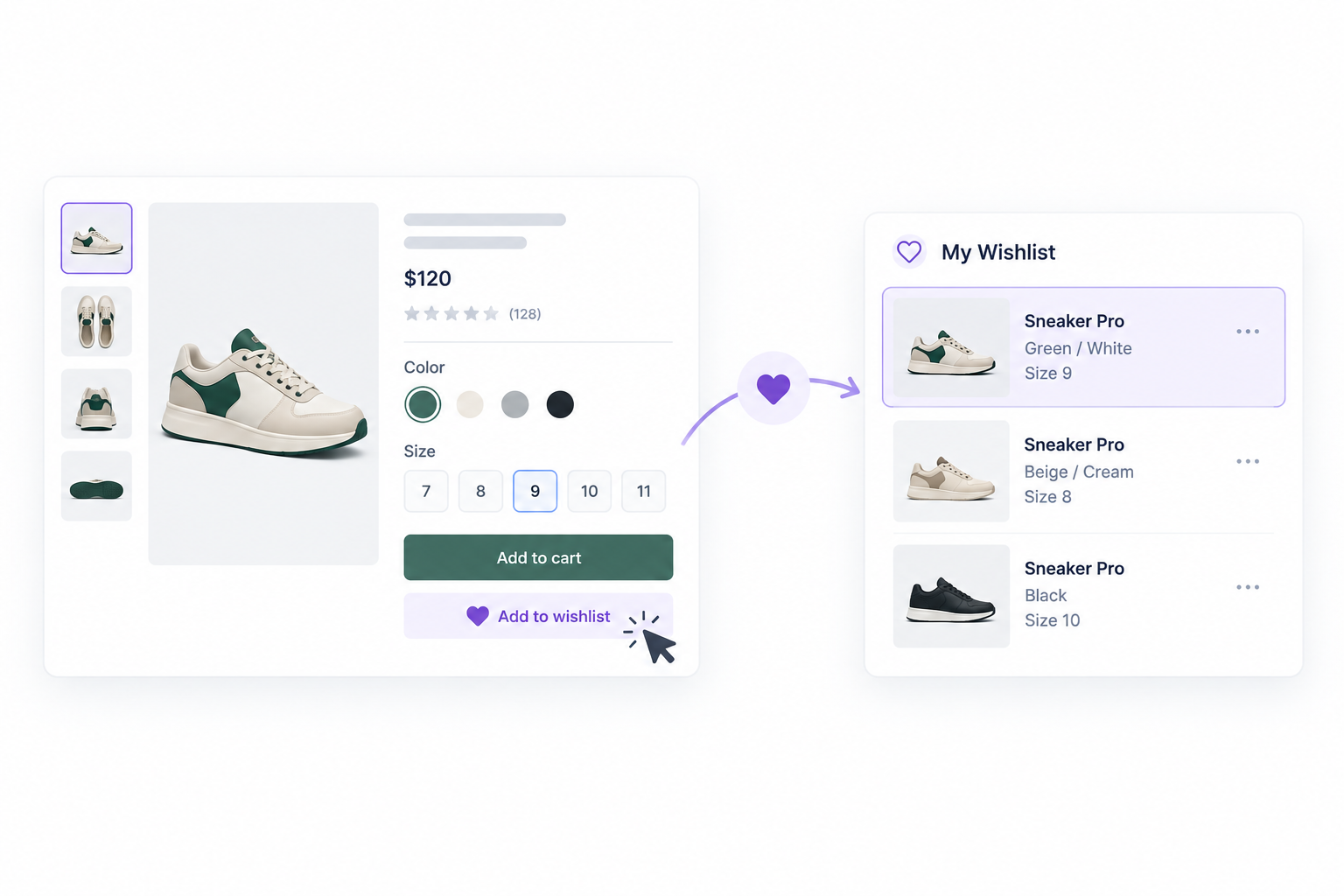
A wishlist that only records "this shopper likes this product" is missing most of the useful detail. The version of a product a customer saves, the size, the color, the specific configuration, is often the actual purchase decision, and losing that detail means the customer has to redo their decision from scratch when they return.
Variant-level saving keeps that precision intact, which matters just as much for your own data quality as it does for the customer's convenience. A wishlist save tied to a specific SKU is a far more actionable intent signal than one tied to a generic product listing.
3. Make the wishlist visible, not buried
A wishlist that only appears on the product page, without any presence in the account area or navigation, gets used less simply because customers forget it exists. Placing the wishlist icon or link somewhere visible, in the header, the account menu, or the mini cart drawer, keeps it top of mind during a session, and surfacing saved items again on return visits reinforces the habit. This is a small implementation detail with an outsized effect on how much intent data actually gets collected, since a feature nobody notices generates no signal at all.
Turning Captured Intent into Revenue
Collecting the data is only half the work. The value comes from what happens with it after the save.
1. Back-in-stock alerts as an automatic recovery mechanism
A wishlist save on an out-of-stock item is a particularly valuable signal, because it tells you a customer wants a specific product badly enough to record it even though they can't buy it right now. A back-in-stock alert acts on that signal automatically, notifying the customer the moment inventory returns without requiring any manual follow-up from the merchant. This turns a passive data point into an active recovery mechanism, closing the loop between "customer wanted this" and "customer bought this" without any extra work once it's set up.
2. Sync wishlist data to email for behavior-triggered flows
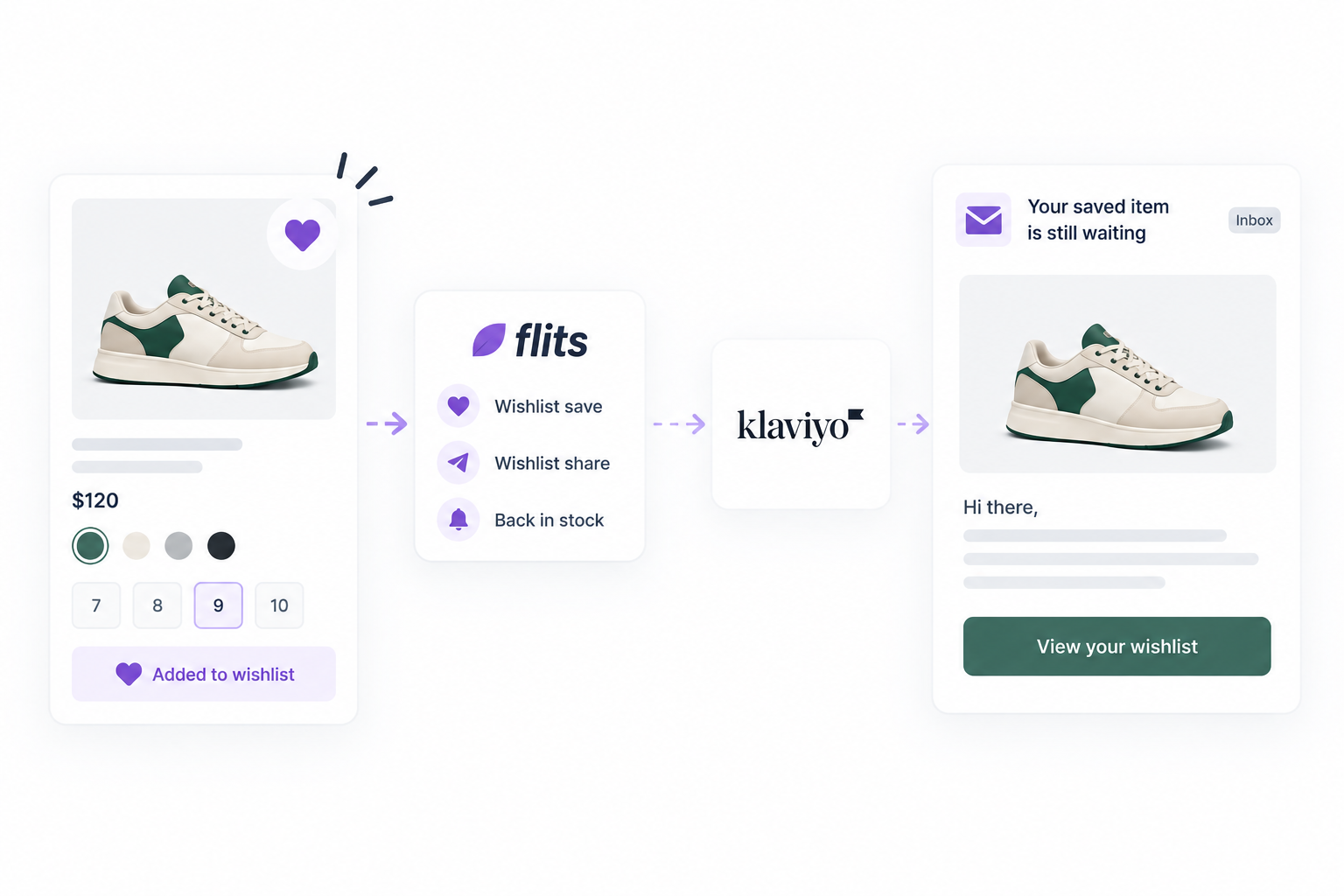
Raw wishlist data sitting inside a Shopify admin panel doesn't do much on its own. Its value multiplies once it's connected to an email or marketing platform that can act on it. Flits syncs wishlist saves, shares, and back-in-stock triggers to Klaviyo as structured customer events, which lets a merchant build flows around specific saved products rather than sending generic promotional blasts to an entire list. A message built around the exact item a customer saved performs meaningfully differently than a storewide discount code competing for attention in an already crowded inbox, because it's responding to a signal the customer actually gave you rather than guessing at what they might want.
3. Wishlist analytics as a merchandising signal
Individual wishlist saves are useful one customer at a time, but aggregated across your full customer base, they become a merchandising tool. A product that gets saved heavily but rarely purchased is telling you something specific, whether that's a pricing objection, an unclear product page, or genuine demand waiting for a restock or a sale. Reviewing wishlist analytics regularly, most-saved products, wishlist-driven sales, and conversion rates from saved items, gives a merchant a real-time read on demand that standard sales reporting only shows you after the fact.
Common Mistakes That Waste Wishlist Intent Data
A wishlist that's technically installed but poorly configured collects far less usable intent data than it should.
Also Read: Shopify Wishlist Best Practices: Turn Saves to Revenue
1. Forcing signup before saving
This is the most common and most costly mistake. Every account requirement placed between a visitor and the heart icon eliminates a share of the people who would otherwise have signaled interest, and that lost data can't be recovered later. If usage rates are already naturally low, adding unnecessary friction on top of that only shrinks the sample further.
2. Never following up on saved items
A wishlist with no connected email flow and no back-in-stock alerts is just a static list a customer might check on their own initiative, which most won't. The entire value of capturing intent data comes from acting on it, and a wishlist that only stores information without triggering any follow-up is capturing signal it never uses.
3. Treating the wishlist as a static feature instead of a data source
Many merchants install a wishlist app once and never look at the underlying data again. The real value builds over time, as saved-item trends reveal which products generate quiet, sustained interest that standard sales reports don't surface on their own. A wishlist reviewed only at setup and then ignored is a missed opportunity sitting quietly in the admin panel.
Also Read: Reasons Why Not Offering A Wishlist Is A Bad Idea
Bringing It Together
A wishlist is one of the few features on a Shopify store that captures customer intent directly, in the customer's own words, rather than inferring it from ambiguous behavior. The usage numbers won't rival your overall traffic, and any guide that implies otherwise is skipping an important part of the picture. What a well-built wishlist gives you instead is a small but genuinely high-quality stream of declared intent, precise down to the exact product variant, that can be acted on through back-in-stock alerts, targeted email flows, and merchandising decisions most stores never get to make with confidence.
Flits brings guest wishlisting, variant-level saving, sharing, analytics, and a direct Klaviyo sync together in a single Shopify app, for $19 a month with no feature restrictions and no pricing that climbs as your store grows. For a merchant trying to capture and actually use customer intent rather than just collecting it, that's a complete foundation to build from.
FAQs
What is customer intent data in ecommerce?
It's information that reveals what a shopper wants and how seriously they're considering a purchase, ranging from declared preferences like wishlist saves to behavioral signals like page visits and, ultimately, transactional data from completed purchases.
Is a wishlist better than an add-to-cart for measuring intent?
They measure different things. Add-to-cart tends to signal near-term purchase intent, while a wishlist save often reflects considered, longer-horizon interest, so both are useful but call for different follow-up strategies.
Why is wishlist usage typically so low?
Across the ecommerce industry, only about 1-3% of visitors typically use a wishlist feature, largely because it requires a deliberate action many casual browsers never take, and because some apps add unnecessary friction like mandatory account creation.
Does a wishlist still matter if usage rates are that low?
Yes, because the value isn't in volume. The customers who do use it tend to convert at meaningfully higher rates and provide precise, actionable data that's hard to get from other on-site signals.
How does Flits help turn wishlist data into actual revenue?
Flits connects wishlist activity to Klaviyo as structured customer events and supports back-in-stock alerts, so saved intent triggers automatic, targeted follow-up instead of sitting unused in the admin panel.