WC Wishlist Club lands well in early-stage reviews. The entry price is low, the support team is responsive, and the core wishlist (saves, guest access, share features, basic email reminders) works without significant friction. For a store in its first few months of testing whether a wishlist drives meaningful return traffic, it's a reasonable starting point.
The picture changes as the store grows and the wishlist becomes commercially important. The features that matter most at that stage, Klaviyo integration to pipe wishlist intent into email flows, notification volume that scales with traffic, visual control that matches a developed brand identity, sit behind WC Wishlist Club's most expensive plan. The Enterprise tier at $24.99/month unlocks Klaviyo, Mailchimp, custom design, and headless support. Everything below it is a version of the product that's functional but incomplete for a store running a serious retention program.
Several merchants have also noted that installation requires adding code to theme files directly, not through Shopify's native app block system. When Shopify themes update, which they do regularly, that code can disappear. Getting it back means contacting support each time. It's a manageable inconvenience when it happens once. It becomes a recurring operational drag over time.
If one of these friction points is what brought you here, the nine alternatives below cover the full range of what's available. Each is reviewed with enough depth to make the comparison straightforward.
Here are the alternatives to WC wishlist club that we will be comparing in this blog:
- Flits Wishlist: Best overall WC Wishlist Club alternative for Shopify
- Swym Wishlist Plus: Best for stores that need enterprise-grade analytics and demand forecasting
- Growave: Best for replacing wishlist, loyalty, and reviews with one platform
- Swish (Wishlist King): Best for stores where Klaviyo, GA4, and Meta need to work from day one
- SE Wishlist Engine: Best for wishlist email recovery without a Klaviyo dependency
- Hulk Wishlist & Favorites: Best for stores where customers need to manage multiple separate wishlists
- Wishify (Zooomy): Best for stores prioritising fast setup at a low cost
- MST: Wishlist + Marketing Flow: Best for lightweight campaign automation built directly into the wishlist
- Wishlist Hero: A budget entry point with a reliability track record to consider carefully
WC Wishlist Club alternatives at a glance
Why Shopify merchants are switching from WC Wishlist Club
WC Wishlist Club has strong reviews, an accessible price point, and a support team that merchants consistently describe as responsive. It's not a failing product. The case for switching is about where the product's structure places the features that matter most as a store scales.
Reason #1: Klaviyo sits behind the highest-tier plan
Klaviyo is the email platform that the majority of growth-stage Shopify merchants are already using. When a customer saves a product to their wishlist, that intent signal is most valuable when it flows into Klaviyo as a customer event, where it can trigger a back-in-stock flow, contribute to a segment, or feed into a re-engagement campaign based on what the shopper has actually saved.
In WC Wishlist Club's plan structure, that connection requires the Enterprise plan at $24.99/month. Merchants on the Basic, Pro, or Advance plans, which covers most of the installed base, are running a wishlist whose intent data has no path into their primary email marketing platform. The alerts that do fire go through WC Wishlist Club's own email layer, which doesn't have access to the customer segments, suppression lists, or automation logic already built inside Klaviyo. Two systems, two sets of email activity, no shared customer view.
For a store whose Klaviyo flows are a core part of its retention strategy, paying $24.99/month to connect them to wishlist data is a significant jump from where WC Wishlist Club starts. Several alternatives on this list include Klaviyo integration from their standard paid plans at a lower price.
Reason #2: Notification volume caps limit email recovery at scale
WC Wishlist Club's plans are structured in part around the number of email notifications that can be sent per month. The Advance plan covers 5,000 notifications. Beyond that, the Enterprise plan handles higher volume. For stores with modest wishlist traffic, these limits don't create problems. For stores where the wishlist is actively used, where hundreds of customers have saved products across dozens of product lines, the notification ceiling gets reached faster than the plan cost would suggest.
When a plan's notification cap is hit, alerts stop going out. Customers whose wishlisted products have come back into stock, or whose saved items have dropped in price, don't receive the email they opted into when they saved that product. The commercial impact is direct: back-in-stock and price drop emails are among the highest-converting messages any wishlist generates, and a notification cap is a hard ceiling on how much of that revenue the app can recover.
Reason #3: Installation involves code added directly to theme files
Setting up WC Wishlist Club typically requires inserting code into Shopify theme files to place wishlist buttons on product pages and collection pages. This isn't unique to WC Wishlist Club, several older wishlist apps share this pattern, but it creates a recurring maintenance problem that merchants often don't anticipate at installation.
When a Shopify theme updates, those manually added code snippets can disappear. The wishlist buttons stop appearing, customers can no longer save products, and the store is running a broken feature until the merchant notices and contacts support to get the code reinstalled. For merchants who've already experienced this cycle once, it's a reason to look for apps that use Shopify's native Theme App Extension system, which places wishlist functionality through Shopify's own block mechanism and survives theme updates without manual intervention.
Reason #4: Design control and visual customisation are Enterprise-level features
Custom design, meaningful control over how the wishlist looks, where elements appear, and how closely the experience matches the rest of the storefront, is listed as an Enterprise plan feature in WC Wishlist Club's plan structure. Merchants on lower tiers have a limited set of configuration options. For stores with established brand standards and specific ideas about how the wishlist button, page, and email should look, this creates a ceiling that can only be cleared by moving to the most expensive plan.
This is relevant for any store that has invested in visual consistency across its Shopify theme. A wishlist that looks different from everything else - different button style, different typography, different colour usage - signals to customers that it's an add-on rather than part of the store. The experience gap is small on a basic storefront but becomes visible on any store with developed design standards.
9 best WC Wishlist Club alternatives for Shopify
Let’s take an in-depth look and analyze which WC Wishlist Club alternative is best for your Shopify business:
1. Flits Wishlist
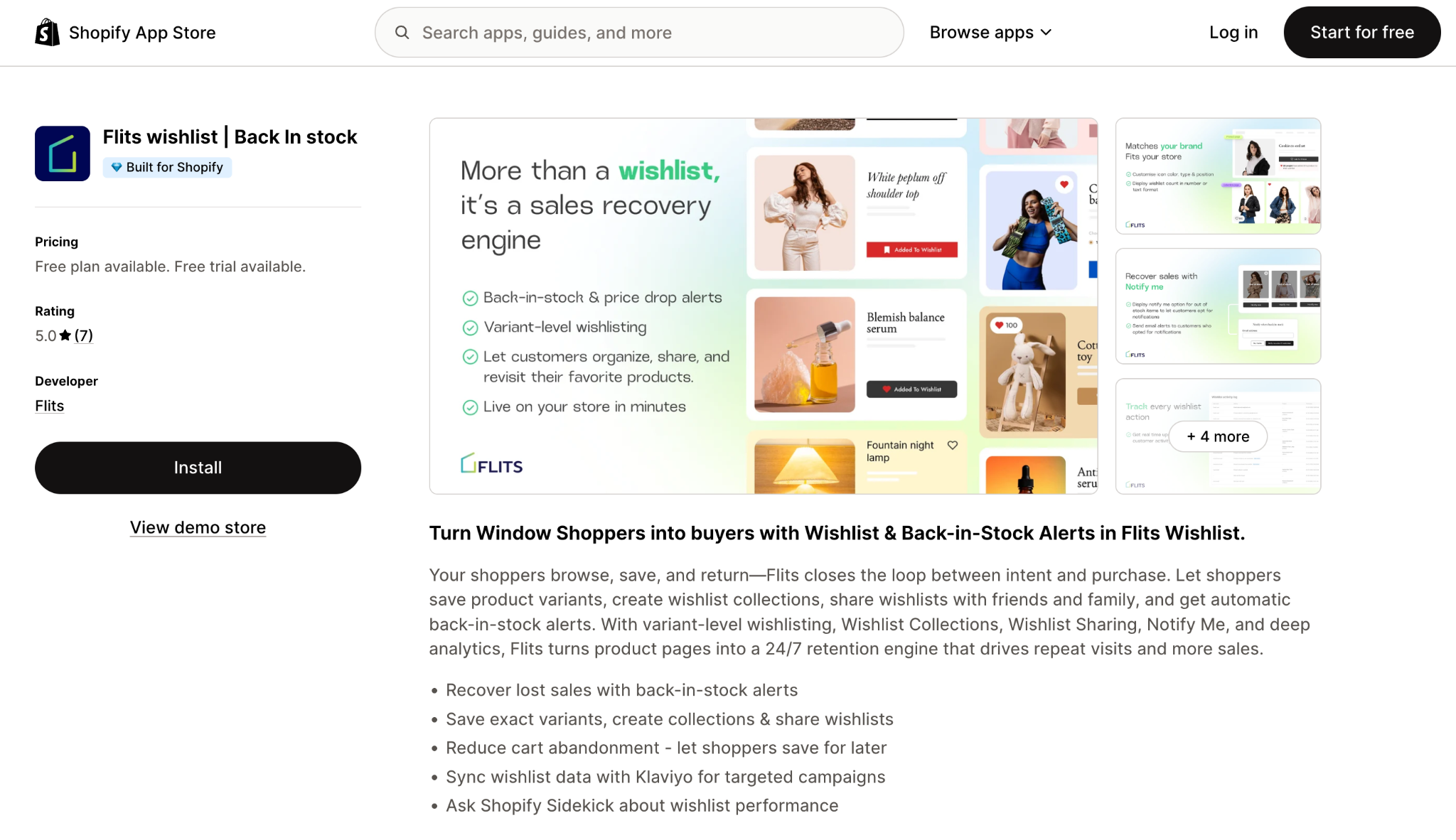
The four issues that send merchants looking for a WC Wishlist Club alternative are each worth addressing directly, because Flits was built in a way that resolves all of them without requiring a separate decision for each one.
On Klaviyo: the integration is included in the $19/month Unlimited plan. There's no Enterprise tier above it. Every wishlist save, back-in-stock trigger, and variant-level intent signal flows into Klaviyo as a structured customer event from day one on the paid plan. A customer who saved a cashmere coat in medium grey is a different Klaviyo segment from a customer who saved three items across different categories. Flits passes that distinction to Klaviyo as a named event. Your existing flows can act on it. That's the difference between a Klaviyo integration that does something and one that exists on paper.

On notification limits: there are none. Back-in-stock alerts go out every time a product returns to stock, to every customer who saved it, regardless of how many alerts that amounts to in a given month. As wishlist activity grows with the store's traffic, the alert volume grows with it. The plan cost stays the same. The features don't hit a ceiling.

On theme file code: Flits uses Shopify's native Theme App Extension system. Wishlist buttons are placed through Shopify's own block mechanism, not through manually inserted code snippets in theme files. When themes update, the buttons stay. No support call required to reinstall code after a theme version change. This is a structural difference in how the app is built, not a configuration preference.

On design: the product includes an AI-generated wishlist page and flow builder. When you install Flits, the AI reads your store's existing theme and produces a wishlist experience matched to it (colours, typography, button style, and page layout all aligned with what your store already looks like). This isn't a template selection or a basic colour picker. It's the wishlist arriving already designed to fit the storefront it's joining. For merchants who've invested in visual consistency, this removes the gap that wishlist apps typically create between the product and the rest of the store.
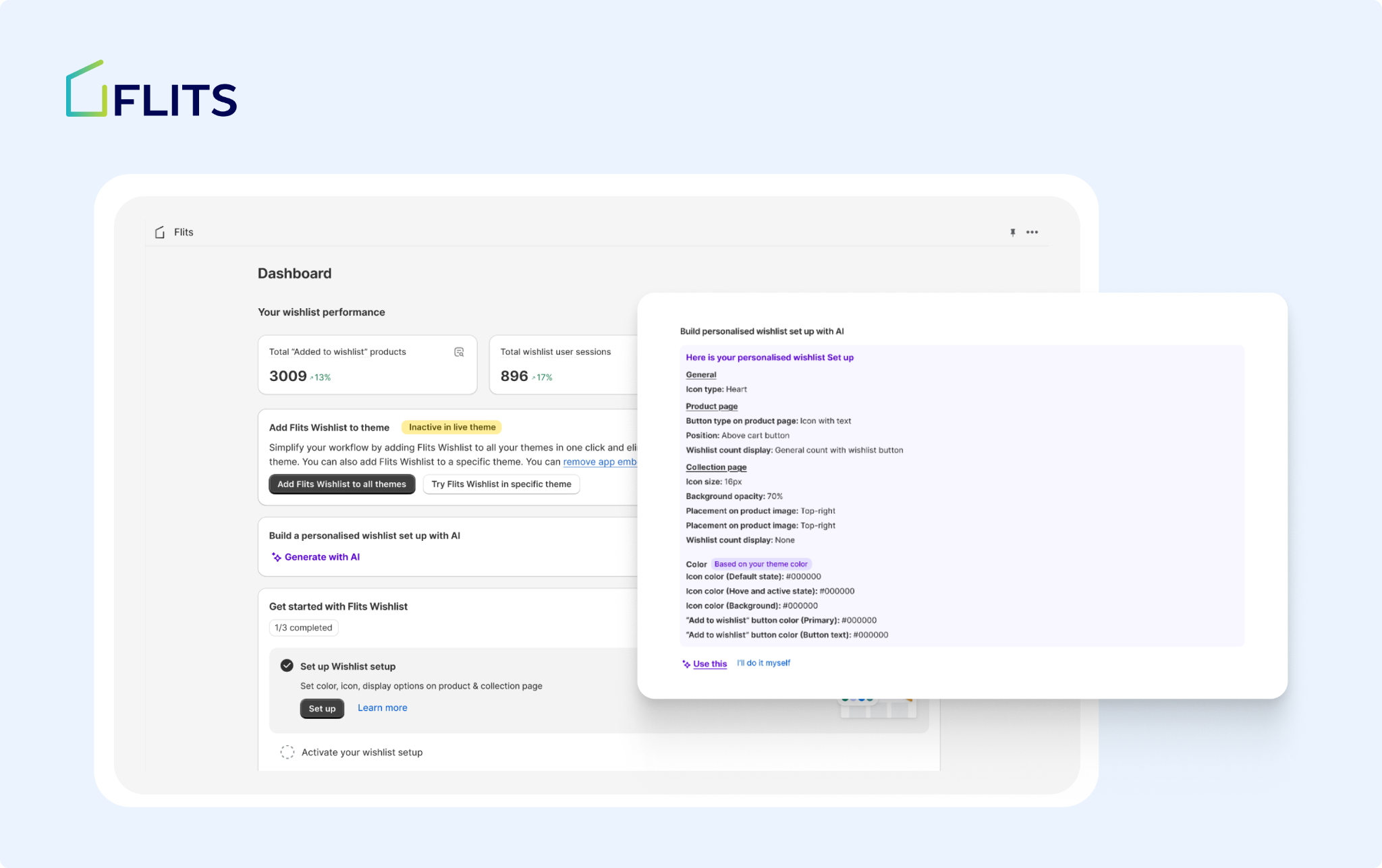
The product depth that follows is what the rest of the merchant experience looks like. Wishlist buttons appear on product pages, collection pages, the customer account page, the mini account drawer, and a dedicated wishlist page accessible from the header. Customers save at the variant level (the specific size, colour, or style they selected, not just the product page) which means the back-in-stock alert that fires later references the exact item the customer wanted.
Wishlist Share lets customers distribute their saved list via link or social media. Wishlist Collections let customers organise saved products into named groups, which reduces the friction of returning to a wishlist when the shopper has been saving across categories over multiple sessions.
Analytics inside the admin gives merchants the data to act on: which products carry the most wishlist intent, which have converted to purchases, how many customers are actively using the wishlist, and per-customer timelines showing what each shopper has saved and when. Merchandising decisions, stock planning, and campaign targeting all become more grounded when this data is available and cross-referenced against what Klaviyo knows about the same customer.

Migration from WC Wishlist Club is a supported process. Merchants export their wishlist data as a CSV, share it with the Flits team, and the import is handled on the Flits side. Customer saved products survive the transition.
Key features
- Klaviyo integration included at $19/month, wishlist events sync as structured customer events with no plan jump required
- AI-generated wishlist page and flow builder matching your store's existing theme
- Theme App Extension deployment; no theme file code, no maintenance after theme updates
- No notification limits - back-in-stock alerts fire for every eligible customer every time
- Guest wishlist on the paid plan with no item caps
- Back-in-stock email alerts built into the product, no external automation required
- Wishlist Share via link and social media
- Wishlist Collections for customer-organised saved product groups
- Variant-level saving across all wishlist placements
- Analytics covering top-saved products, wishlist-attributed revenue, and per-customer timelines
- Managed migration from WC Wishlist Club via CSV handled by the Flits team
Pros
- Klaviyo included at $19/month, five dollars less per month than WC Wishlist Club's Enterprise plan, with a complete product rather than just an integration unlock
- No notification caps at any plan level. Alerts scale with actual wishlist activity
- Theme App Extension deployment eliminates recurring code maintenance after theme updates
- AI builder produces a matched wishlist design without Enterprise-tier custom design access
- Nine years of Shopify operating history behind a product trusted by 5,000+ merchants
Cons
- Guest wishlist requires the paid plan. The free plan covers core wishlist functionality but not guest access
- Price drop alerts are on the roadmap and not yet live. Back-in-stock alerts are available now
Flits vs. WC Wishlist Club
WC Wishlist Club charges $24.99/month for Klaviyo access, caps notifications by plan, requires code in theme files that disappears on theme updates, and gates visual control behind the Enterprise plan. Flits includes Klaviyo at $19/month, has no notification caps, uses Theme App Extensions that survive updates, and delivers a design-matched wishlist from the AI builder on installation.
2. Swym Wishlist Plus
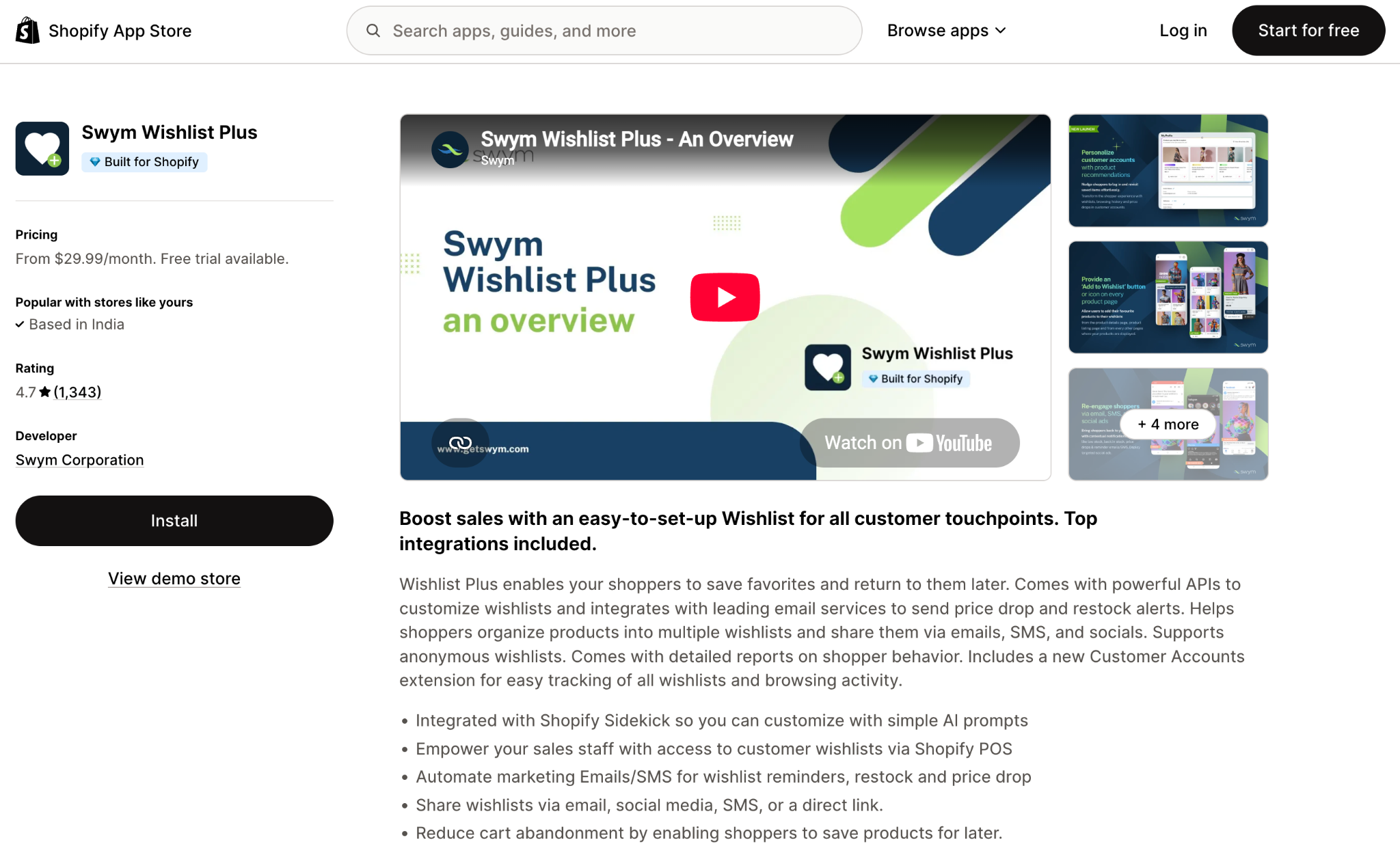
Swym's position in this comparison is straightforward: for stores where WC Wishlist Club's analytics have become too thin to support real merchandising and demand planning decisions, Swym's reporting at scale is the most detailed available on the Shopify App Store. At higher tiers, Swym surfaces cohort-level data, which customer segments are saving which products, how long after saving customers typically convert, which product categories have the highest wishlist-to-purchase rates, that informs stock decisions before problems happen rather than after.
Klaviyo integration is available at Swym's entry paid tier, which means merchants don't face WC Wishlist Club's Enterprise jump to connect wishlist intent to their email platform. Shopify Flow integration adds automation capability that operates independently of Klaviyo for merchants who prefer to keep their automation within Shopify's own ecosystem. The review base of over 2,100 reflects an installed product with a long operational track record across store sizes and industries.
The trade-off worth stating: Swym's free plan is limited enough that it functions more as a preview than a usable business tool. Guest wishlist and email alerts both require the paid plan. For merchants whose primary motivation for switching is cost sensitivity, Swym's entry pricing at $19.99/month is comparable to WC Wishlist Club's Enterprise plan, it resolves the Klaviyo access issue but doesn't reduce the monthly commitment.
Key features
- Klaviyo integration at the entry paid tier, not the top-tier plan
- Back-in-stock and price drop email alerts on paid plans
- Shopify Flow integration for automation within Shopify's ecosystem
- Cohort-level analytics and demand forecasting signals at higher tiers
- Multi-device wishlist sync across browser sessions, mobile, and desktop
- Headless commerce and custom storefront support
- Guest wishlist access on paid plans
Pros
- Analytics depth at scale exceeds any other alternative on this list
- Klaviyo access does not require the most expensive plan
- Shopify Flow integration keeps automation within Shopify for merchants who prefer that
- 2,100+ reviews across diverse store types validates reliability at scale
Cons
- Free plan is too limited for stores with real wishlist traffic
- Guest wishlist and email alerts both require paid plans
- Pricing at higher tiers can climb significantly as feature access expands
- No broader retention features beyond the wishlist product itself
Swym vs. WC Wishlist Club
WC Wishlist Club gates Klaviyo at $24.99/month. Swym includes it at $19.99/month with stronger analytics behind it. For a store whose primary frustration is the Klaviyo paywall and whose secondary need is better reporting, Swym resolves both. The analytics story is the upgrade; Klaviyo access is the immediate fix.
3. Growave
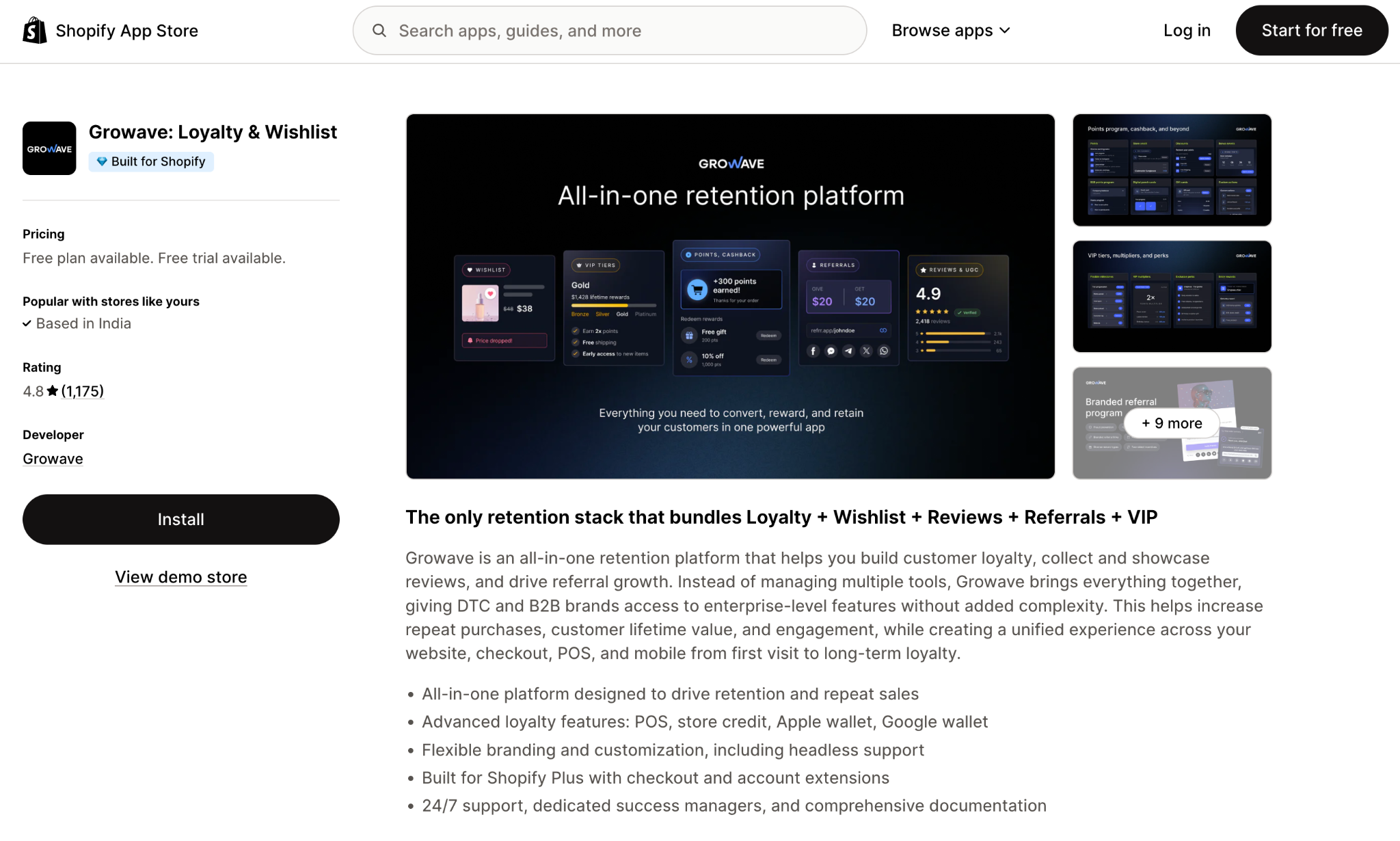
Most merchants running WC Wishlist Club are also paying for at least one other retention app, a loyalty platform, a reviews tool, and a referral program. Each of those sits in a separate admin, maintains a separate customer record, and bills separately every month. The integration between them, when it exists, is usually a one-way data push that doesn't create a shared understanding of who each customer is across touchpoints.
Growave is the answer to that compounding overhead. The platform manages wishlists, loyalty programs, product reviews, referrals, and social login from a single dashboard against a single customer record. A shopper who saves a product, purchases and earns points, then leaves a review represents a complete customer lifecycle event, and in Growave, that event is legible in full without switching between tools. The loyalty data informs what the wishlist reminder says. The review request references what the customer originally saved. The wishlist save contributes to their point balance.
Klaviyo integration is available across Growave's meaningful paid tiers, not just the top plan, which immediately improves on WC Wishlist Club's structure. For stores already running Klaviyo, wishlist and loyalty events from Growave flow into the same email platform, creating a unified customer profile rather than fragmented data across multiple sources.
The limitation that applies here, as it has in every blog in this series, is guest wishlist access. Growave does not support it on any plan. Customers need an account to save products. Stores with significant unauthenticated traffic need to weigh whether that cohort of lost intent is an acceptable trade for the consolidation benefit Growave provides.
Key features
- Wishlist with price change and back-in-stock email alerts
- Points-based loyalty with configurable earn rules, redemption, and expiry
- Product reviews supporting photo and video submissions
- Referral programs with custom reward conditions
- Social login and VIP tier segmentation
- Klaviyo integration across meaningful plan tiers
- Shared customer profile connecting wishlist, purchase, review, and referral data
Pros
- Replaces multiple standalone apps under one billing and one admin
- Shared customer record means loyalty, wishlist, and review data are connected rather than siloed
- Over 2,000 reviews reflecting stability across store types and traffic levels
- Free plan allows early testing before a monthly commitment
- Klaviyo accessible without the top-tier plan jump that WC Wishlist Club requires
Cons
- No guest wishlist support on any plan, a hard constraint for stores with significant unauthenticated traffic
- Individual feature depth is narrower than dedicated standalone tools
- Entry price of $9/month is higher than wishlist-only alternatives at the lower end of the market
Growave vs. WC Wishlist Club
WC Wishlist Club delivers a wishlist and back-in-stock functionality as a standalone product. Growave delivers those features plus loyalty, reviews, and referrals in a unified platform. For stores already managing multiple retention apps, Growave usually reduces total monthly cost while adding the connective data tissue between functions. For stores where guest wishlist is non-negotiable, Growave doesn't serve that need.
4. Swish (Wishlist King)
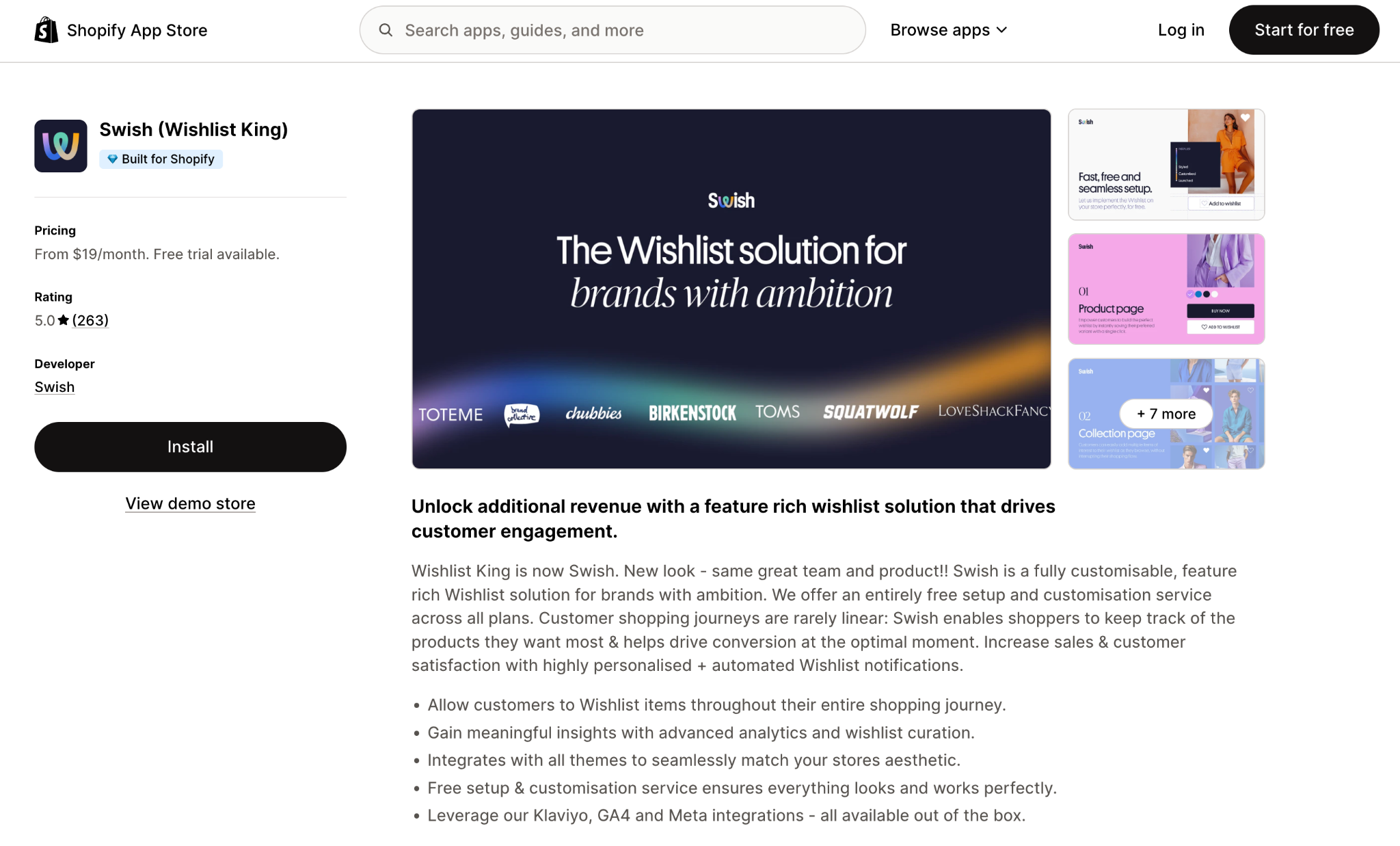
The integration picture is where Swish pulls ahead of WC Wishlist Club most directly. Klaviyo, Google Analytics 4, and Meta are all available across every Swish plan, from the first month of installation. There's no plan tier to reach before wishlist data starts flowing into the tools that drive paid retargeting, attribution tracking, and email segmentation. A merchant running a Meta campaign that targets customers who wishlisted specific products gets that audience immediately, not after upgrading.
For stores where paid social is a significant acquisition channel and audience building from wishlist intent is a strategy they've been trying to execute, this is a meaningful structural difference from WC Wishlist Club. WC Wishlist Club handles re-engagement primarily through email and Shopify Flow. Swish connects directly to Meta and GA4, which makes wishlist data useful for ad targeting and attribution in ways the WC Wishlist Club plan structure doesn't support below Enterprise.
The free setup and customisation service that Swish includes across all plans also addresses WC Wishlist Club's code installation friction directly. Rather than adding theme file snippets manually and maintaining them through theme updates, Swish's team handles the initial configuration as part of the plan. The result is a wishlist that's correctly placed in the theme from day one without the merchant having to manage theme code.
The pricing structure worth acknowledging: Swish has no free plan, and the monthly cost scales with your Shopify plan tier. Basic Shopify merchants pay $19/month. Standard Shopify merchants pay $29/month. Advanced Shopify merchants pay $49/month. The features are identical across tiers. For merchants on Shopify Advanced who find that pricing structure counterintuitive, paying more for identical features because of a Shopify billing tier, Flits at a flat $19/month regardless of Shopify plan is the more rational alternative.
Key features
- Klaviyo, GA4, and Meta integrations available on all plans, not gated by tier
- Free setup and customisation service across all plans, handling theme integration without code edits
- Guest wishlist support with optional email capture for non-authenticated shoppers
- Automated wishlist email reminders with customisable timing
- Full no-code UI customisation for buttons, icons, colours, and widget placement
- Shopify Plus support including headless and Hydrogen stack compatibility
Pros
- Meta and GA4 integrations available immediately, paid retargeting and attribution work from day one
- Free setup service removes the theme code installation overhead that WC Wishlist Club creates
- Most granular visual customisation of any app on this list
- 5/5 rating across a meaningful review base
Cons
- No free plan. Monthly billing starts on installation
- Pricing tied to Shopify plan tier, identical features cost more on higher Shopify plans
- No built-in retention features beyond the wishlist
Swish vs. WC Wishlist Club
WC Wishlist Club requires the Enterprise plan for Klaviyo, manual theme code installation for setup, and has no Meta or GA4 integration at any plan level. Swish includes all three integrations from the first plan, handles setup through a service rather than code edits, and delivers stronger UI customisation control. The monthly cost is comparable, but what that cost includes is meaningfully different.
5. SE Wishlist Engine
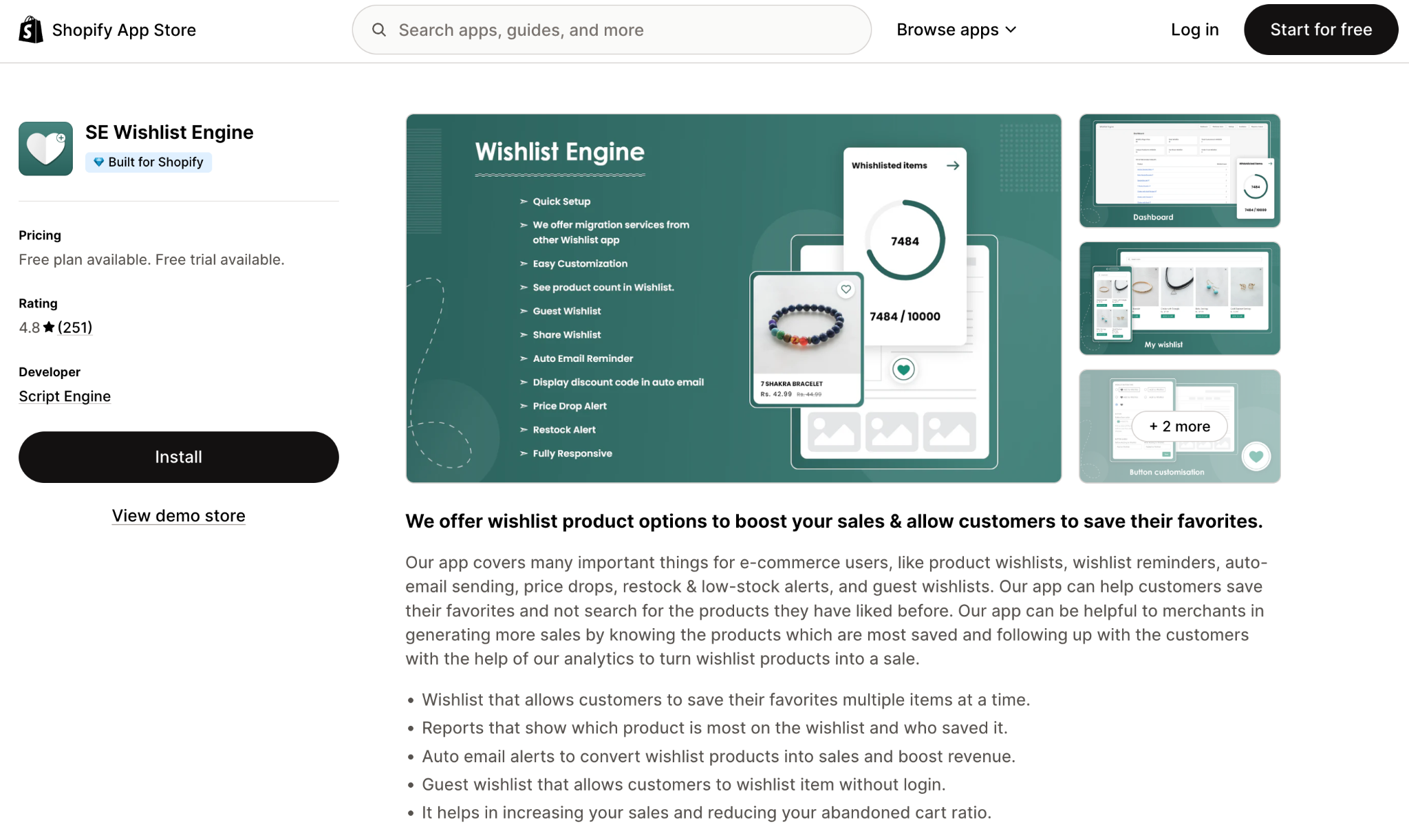
WC Wishlist Club's email recovery on plans below Enterprise routes through its own email layer, disconnected from Klaviyo. The alerts go out, but they're not informed by Klaviyo's suppression lists, frequency controls, or customer segments. A customer who's unsubscribed from your Klaviyo emails might still receive a wishlist alert from WC Wishlist Club, because the two systems don't share that information. That's an email deliverability and customer experience problem for stores running serious email programs.
SE Wishlist Engine operates its email recovery independently but with a more granular trigger architecture than WC Wishlist Club offers at comparable plan levels. Back-in-stock, price drop, and time-delayed abandonment reminders each have their own customisable email template, their own send logic, and their own campaign-level conversion analytics. The difference between a back-in-stock email and a price drop email isn't just the trigger - it's the copy, the urgency, and the subject line that converts. SE Wishlist Engine treats them as distinct campaign types rather than variations on a single template.
For merchants switching from WC Wishlist Club specifically because the Klaviyo wall is too expensive to clear but who still want email recovery to work properly, SE Wishlist Engine provides a coherent middle path. The recovery program operates without Klaviyo dependency. Guest wishlist works from the free plan without a plan upgrade. And the pricing stays at a fraction of WC Wishlist Club's Enterprise tier.
Key features
- Separate email template and send logic for back-in-stock, price drop, and abandonment triggers
- Per-trigger conversion analytics showing open rates, click rates, and attributed orders
- Guest wishlist with email capture on the free plan
- Direct add-to-cart shortcut embedded inside recovery emails
- Operates independently of any external email platform
- Optional Klaviyo connection for stores that want both systems working together
Pros
- More trigger granularity than WC Wishlist Club at comparable or lower pricing
- Recovery emails work without Klaviyo, no plan jump to make recovery functional
- Guest wishlist requires no paid plan, directly addressing one of WC Wishlist Club's free plan limitations
- Per-trigger analytics show which recovery type is generating actual purchases
Cons
- Narrower visual customisation than Swish or Flits
- No loyalty, account-level, or broader retention features
- Not suited for stores that need sophisticated attribution or merchandising analytics
SE Wishlist Engine vs. WC Wishlist Club
WC Wishlist Club's email recovery below the Enterprise plan is disconnected from Klaviyo and limited in trigger types. SE Wishlist Engine handles recovery with more granularity, at a lower price, without needing Klaviyo to function. For stores whose core need is better email recovery rather than platform integration, SE Wishlist Engine covers that territory more completely.
6. Hulk Wishlist & Favorites
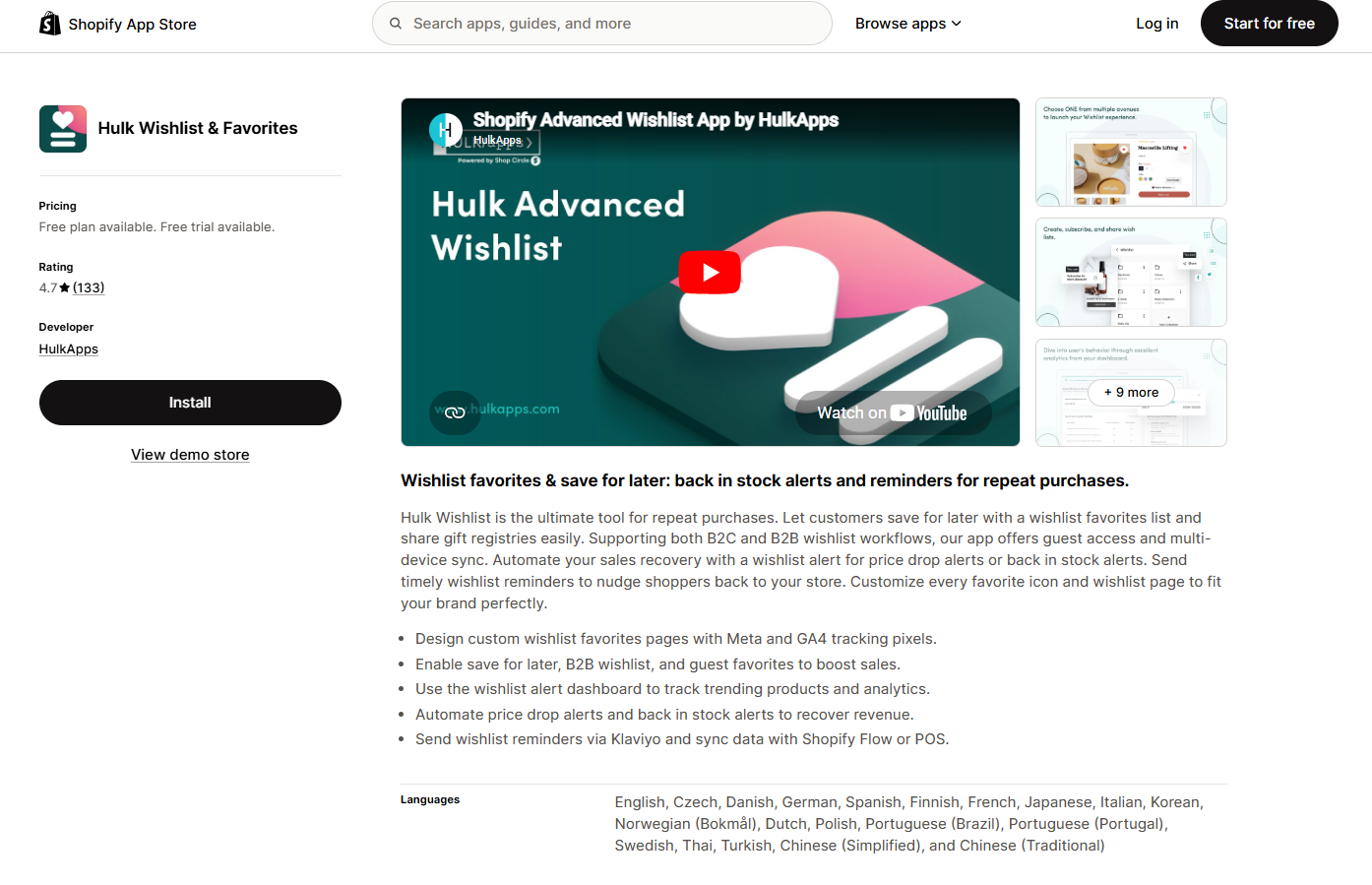
WC Wishlist Club gives each customer one wishlist. Every product they save goes into the same list, regardless of when they're planning to buy it, who it's for, or what occasion it's tied to. For stores with wide product ranges (fashion, home goods, gift-oriented stores) this single-list model creates a wishlist that becomes difficult for customers to use as the number of saved items grows.
Hulk resolves this by giving customers multiple named wishlists. A shopper planning holiday gifts can maintain a separate list from their personal favourites. A customer tracking items across different rooms of a home renovation can organise them without everything going into one undifferentiated pile. Multiple wishlists reflect how customers actually shop across different intentions and timelines, which keeps the wishlist actively useful rather than becoming a graveyard of products they lose track of.
There are no item limits on any Hulk plan. Customers can save as many products to as many lists as they choose without hitting a ceiling. This addresses the notification cap structure of WC Wishlist Club from a different angle: instead of limiting how many alerts go out, Hulk simply doesn't limit how much the wishlist can hold or how many lists exist.
The gap is email recovery. Hulk doesn't include built-in back-in-stock or price drop alerts. Stores that want email recovery from wishlist data need to connect Hulk to an external tool. For stores where the organisational flexibility of multiple wishlists is the primary need, that trade is worth making. For stores where email recovery drives real return traffic, it isn't.
Key features
- Unlimited named wishlists per customer for organising intent across occasions and timelines
- Unlimited saved products per wishlist on all plans with no item caps
- Guest wishlist support included
- Wishlist sharing via link for social distribution
- Add-to-cart shortcut directly from the wishlist page
- Admin overview of wishlist activity by product and by customer
Pros
- Multiple list types allow customers to organise intent in ways that match how they actually shop
- No item or list caps at any plan level, wishlist activity is unconstrained as traffic grows
- Works particularly well for fashion, home, registry-adjacent, and catalog-heavy store types
- Price point competitive with WC Wishlist Club's Basic plan while covering more structural ground
Cons
- No built-in email recovery alerts. Back-in-stock and price drop notifications require an external tool
- Smaller review base compared to established alternatives
- Analytics are basic and not suitable for data-driven campaign or merchandising decisions
Hulk vs. WC Wishlist Club
WC Wishlist Club provides one wishlist per customer with notification caps by plan. Hulk provides unlimited lists and unlimited saves with no caps. For stores where the structural limitation - one list, capped alerts - is the primary friction, Hulk's model is a fundamentally different answer.
7. Wishify (Zooomy)
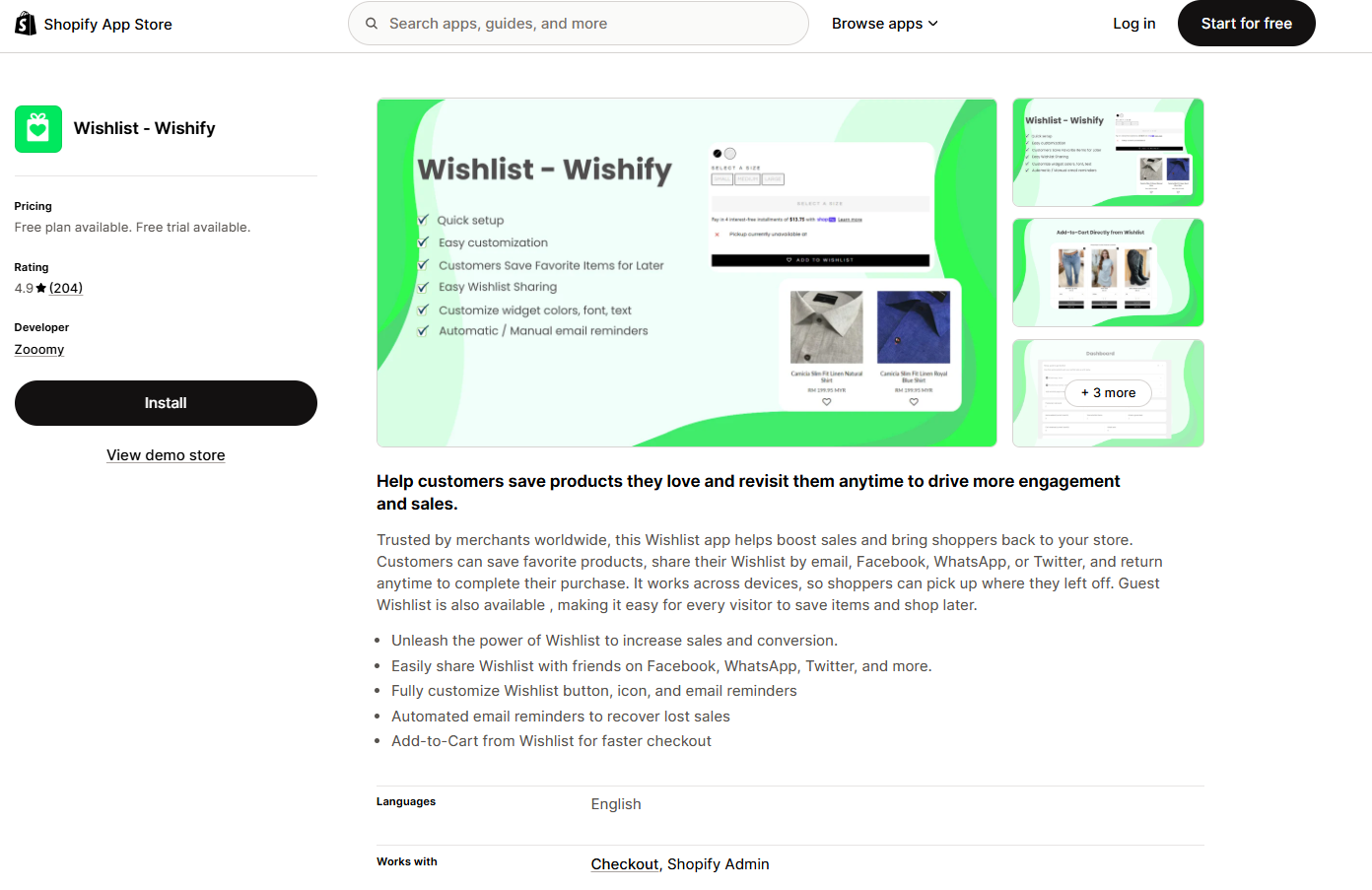
Wishify occupies a similar market position to WC Wishlist Club (accessible price, responsive support, core wishlist functionality that works reliably) but with one meaningful difference in the installation experience. Where WC Wishlist Club's setup involves adding code to theme files, Wishify's installation is generally more automatic, with the app detecting theme structure and placing wishlist buttons without requiring manual code insertion.
The review base across Wishify and WC Wishlist Club is comparable in positivity and tone. Both are well-supported products at the entry tier of the market. The reason Wishify appears as an alternative to WC Wishlist Club is practical: some merchants prefer Wishify's automated installation over WC Wishlist Club's code-based setup, and the Zooomy support team handles customisation requests directly when the automatic detection doesn't cover a specific placement.
The shared limitation is relevant here: Klaviyo in Wishify sits behind an even more expensive tier than WC Wishlist Club's Enterprise plan. For merchants looking for a lateral move that solves the installation friction without solving the Klaviyo problem, Wishify is that move. For merchants who want both resolved in one decision, Flits or Swym address both.
Key features
- Wishlist with guest support on the Professional plan
- Automated email reminders for saved products
- Social sharing via Facebook, WhatsApp, Twitter, and email
- Automatic theme detection for button placement
- Basic wishlist analytics
- Add-to-cart from wishlist page
Pros
- Installation is more automated than WC Wishlist Club's code-based setup
- Responsive support team that handles customisation via direct request
- Accessible price point comparable to WC Wishlist Club's entry tier
- High review rating reflecting consistent performance across theme types
Cons
- Guest wishlist locked behind the Professional paid plan, same structure as WC Wishlist Club
- Klaviyo integration sits behind a significantly higher-cost plan
- Analytics are limited and won't support data-driven decision-making
- No loyalty, reviews, or retention features beyond the wishlist
Wishify vs. WC Wishlist Club
Both apps occupy similar market positions. Wishify's installation is more automated. WC Wishlist Club's analytics are slightly more developed. Neither resolves the Klaviyo access problem for stores on standard plans. The decision between them is primarily about whether the installation method or the analytics layer matters more to the individual merchant.
8. MST: Wishlist + Marketing Flow
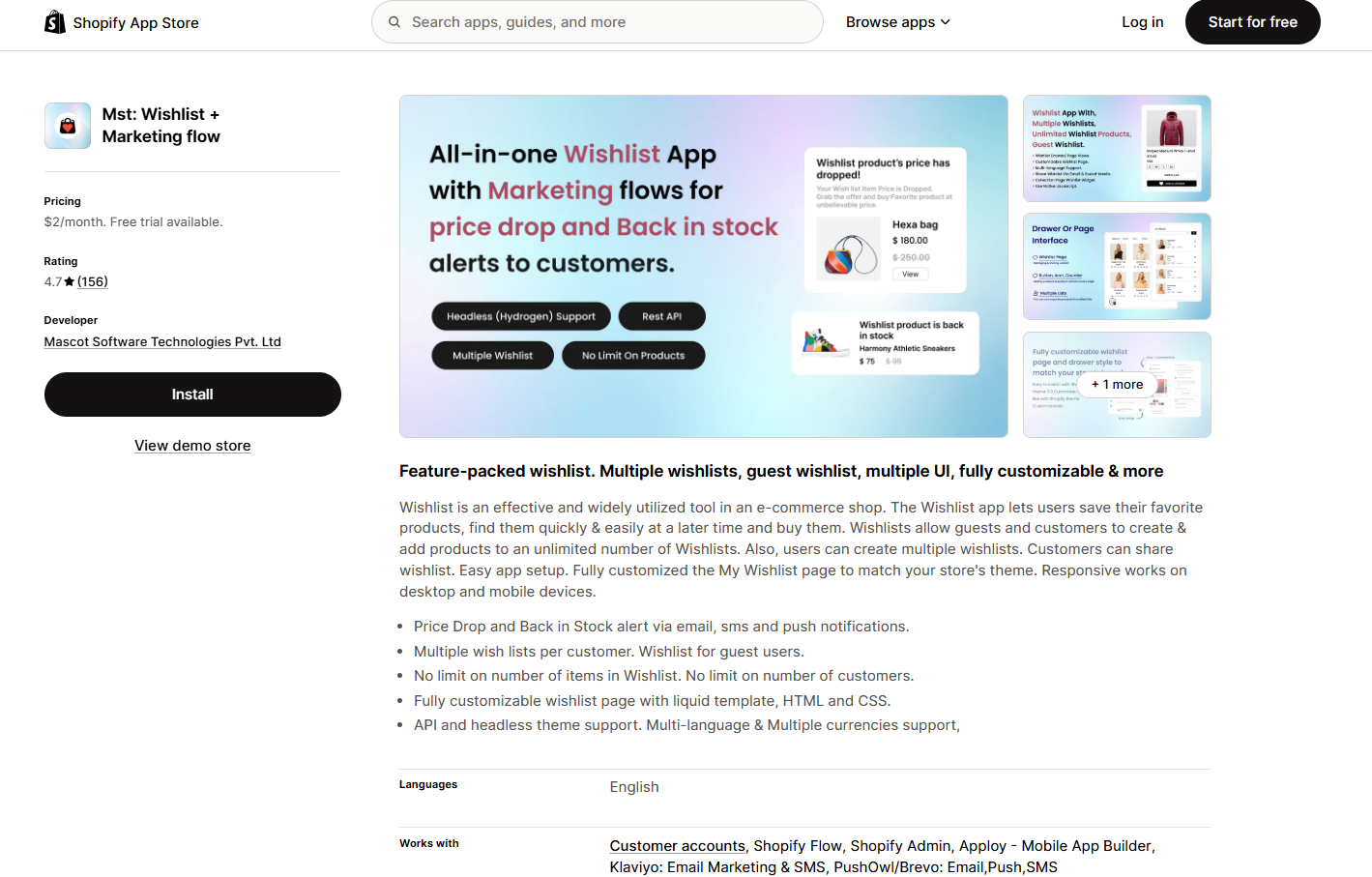
WC Wishlist Club's email layer, the alerts that go out when a product comes back in stock or drops in price, operates as a notification system. It tells customers that something happened to a product they saved. MST goes a step further by treating the wishlist as the trigger layer for a lightweight marketing program rather than a passive notification queue.
The practical difference is in what happens between the save event and the alert. In WC Wishlist Club, the system waits for a stock or price event and then notifies. In MST, the system can send a cart nudge email on a configurable delay after the save event regardless of whether anything changed on the product. It can send a re-engagement message to customers whose wishlists have gone dormant. It can send product recommendations based on category and tag patterns in what a customer has saved. These are campaign actions, not notifications, and they run without Klaviyo required.
For stores where Klaviyo is either not in the stack or not configured to handle wishlist-triggered flows, MST closes the gap between a passive notification app and a basic marketing automation tool. The flows are straightforward by design (not a replacement for a sophisticated email platform) but for stores running standard re-engagement programs, the internal campaign layer handles the core use cases without requiring a platform integration decision.
Key features
- Automated back-in-stock and price drop alerts included from the first paid tier
- Cart nudge emails sent on a configurable delay after the save event
- Re-engagement campaigns for customers with dormant wishlist activity
- Product recommendations based on saved product patterns
- Guest wishlist across all plan levels
- Campaign performance analytics within the app admin
Pros
- Campaign automation is internal; no Klaviyo required for wishlist-triggered marketing
- Guest wishlist available without a plan upgrade
- Cart nudge and re-engagement flows operate beyond simple transactional alerts
- Price entry point lower than WC Wishlist Club's Advance plan with comparable or superior email functionality
Cons
- Marketing flows are basic. Complex multi-step sequences or conditional branching requires a dedicated platform
- Newer app with fewer reviews than established alternatives
- Attribution analytics don't support revenue-level analysis of campaign contribution
MST vs. WC Wishlist Club
WC Wishlist Club's email marketing capability below the Enterprise plan is limited to notification-style alerts through its own layer, disconnected from Klaviyo. MST includes campaign automation (nudges, re-engagement, recommendations) at a lower price without requiring Klaviyo. For stores where wishlist emails need to do more than notify, MST covers that territory more affordably.
9. Wishlist Hero
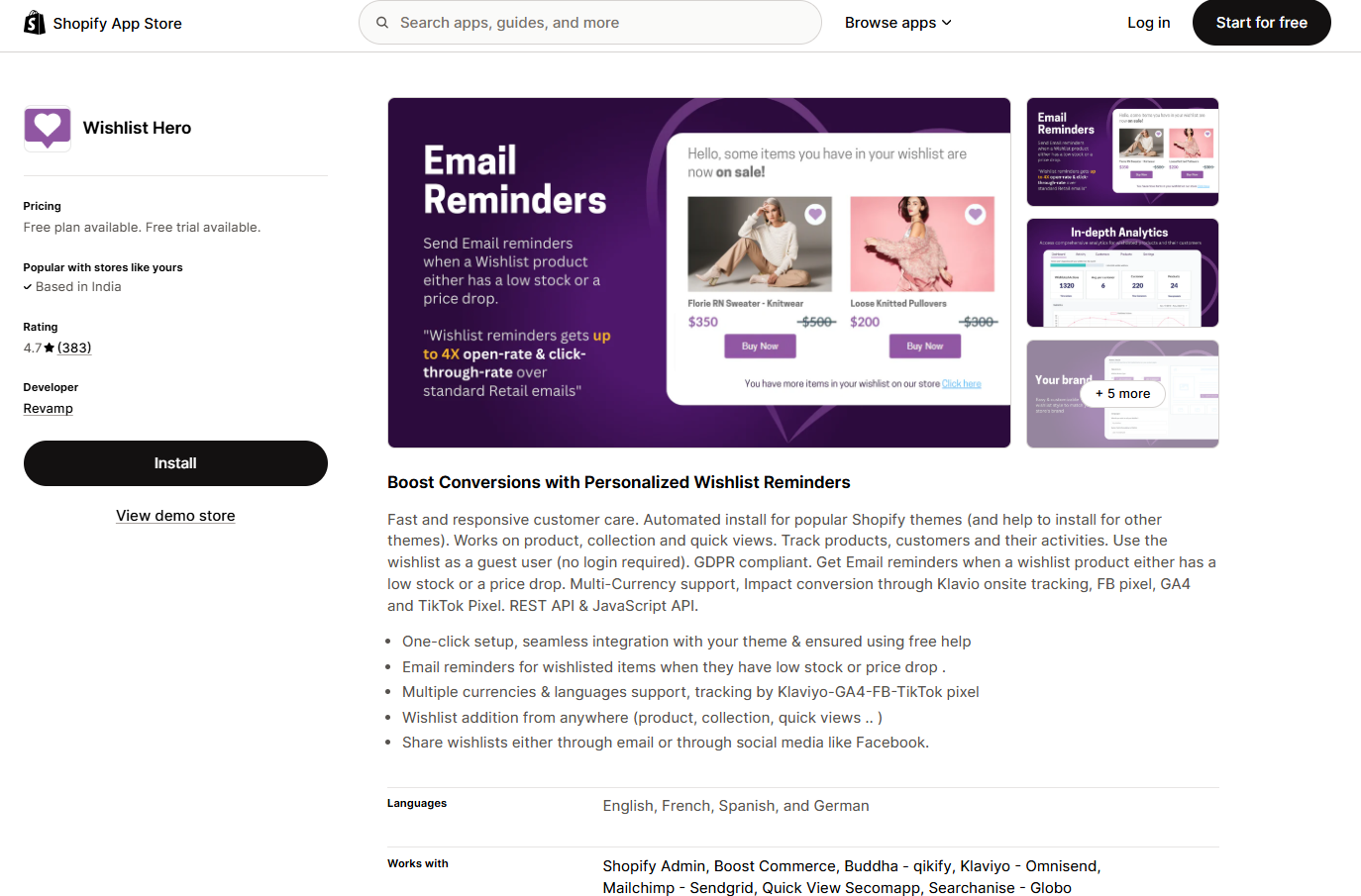
Wishlist Hero appears at the end of this list for the same reason it appears at the end of every list in this series: the pricing is the most accessible, and the Klaviyo integration is available at a lower plan cost than WC Wishlist Club requires. For merchants who are switching primarily because of WC Wishlist Club's $24.99/month Enterprise requirement for Klaviyo, Wishlist Hero technically solves that problem at a fraction of the cost.
The context that shapes this recommendation is the same as it's always been. Recent Shopify App Store reviews document the app entering redirect loops in the admin, wishlist functionality stopping without warning in production, and support response times that some merchants have described as weeks rather than hours. A French merchant running the app for three years documented losing all wishlist access for their customer base after the app stopped loading correctly. An Estonian merchant found residual code in their theme after uninstalling, requiring developer time to clean up.
Wishlist Hero can serve a specific purpose: testing whether a Klaviyo-connected wishlist generates meaningful engagement for a store that isn't yet sure the feature is worth a higher investment. The cost is low enough to justify that experiment. If the experiment succeeds and the wishlist is generating real return visits and conversions, moving to Flits, Swym, or Swish gives those results a more stable foundation to run on.
Key features
- Klaviyo integration on paid plans at a lower cost threshold than WC Wishlist Club
- Back-in-stock and price drop email alerts
- Guest wishlist support on paid plans
- Multi-currency support for international store configurations
- GDPR-compliant email capture for guest wishlist users
- Social sharing and dedicated wishlist page
Pros
- Klaviyo integration available without the $24.99/month Enterprise jump WC Wishlist Club requires
- Multi-currency support built in for international stores
- Lowest cost combination of Klaviyo access and wishlist functionality on this list
Cons
- Documented reliability issues across multiple independent Shopify App Store reviews
- Support response times that have been described as weeks in some cases
- Residual theme code after uninstallation documented by multiple merchants
- Not recommended as a long-term tool for any store where the wishlist drives commercial outcomes
Wishlist Hero vs. WC Wishlist Club
WC Wishlist Club is more reliable. Wishlist Hero has Klaviyo at a lower price. If reliability is the priority, WC Wishlist Club is the better foundation. If the Klaviyo paywall is the problem and the budget doesn't allow for Flits or Swym, Wishlist Hero solves that specific issue with the reliability caveat stated plainly.
Final verdict: Which WC Wishlist Club alternative should you choose?
WC Wishlist Club is a serviceable wishlist for a store in its early stages. The limitations that become friction points at scale, Klaviyo behind the Enterprise plan, notification caps, code in theme files, design control gated by tier, don't matter much when the wishlist is new and traffic is modest. They start mattering when the wishlist becomes a working part of the retention strategy.
For stores that need Klaviyo connected without a $24.99/month commitment, Flits includes it at $19/month with no notification caps and a full product behind it. For stores where analytics depth is the primary driver for switching, both Flits and Swym provide the most detailed reporting available in the wishlist category. For stores replacing multiple retention apps at once, Growave consolidates wishlist, loyalty, and reviews under one roof. For stores that need Klaviyo, GA4, and Meta all working from the start without theme code overhead, Flits and Swish handles the integration breadth and setup differently. For stores where email recovery is the goal but Klaviyo isn't in the stack yet, SE Wishlist Engine runs recovery internally at a lower cost. For stores where customers need to organise intent across multiple separate lists, Flits and Hulk gives them that structure without plan-based limits.
Across all of these use cases, the argument that holds most consistently is the one for Flits. The Klaviyo integration doesn't require an Enterprise plan. The notification caps don't exist. The wishlist is deployed through Theme App Extensions rather than theme file code. The AI builder produces a design-matched experience without a custom design tier. And the $19/month Unlimited plan includes all of it, with pricing that stays flat regardless of how the store grows.
Try Flits Wishlist on the Shopify App Store
Frequently asked questions
Why does WC Wishlist Club require the Enterprise plan for Klaviyo?
WC Wishlist Club's Klaviyo and Mailchimp integrations are features of the Enterprise plan, priced at $24.99/month. Merchants on the Basic, Pro, or Advance plans run wishlist email alerts through WC Wishlist Club's own email layer, which is not connected to Klaviyo's customer data, segments, or suppression lists.
Does WC Wishlist Club's installation affect my Shopify theme?
Yes. Setting up WC Wishlist Club typically requires adding code snippets directly into Shopify theme files to place wishlist buttons on product and collection pages. When themes update, this code can be overwritten, requiring reinstallation. Apps that use Shopify's Theme App Extension system — including Flits, avoid this by placing functionality through Shopify's own block mechanism, which survives theme updates.
Which alternative includes Klaviyo without a high-tier plan?
Flits includes Klaviyo at its $19/month Unlimited plan. Swym includes Klaviyo from its entry paid tier at $19.99/month. Swish includes Klaviyo across all plans. Growave includes Klaviyo on meaningful paid tiers. All four resolve the access issue that WC Wishlist Club creates by gating Klaviyo at $24.99/month.
What happens when WC Wishlist Club hits its notification cap?
When a plan's notification limit is reached for the month, email alerts stop being sent. Customers who wishlisted products that have come back into stock or dropped in price do not receive notifications until the next billing period begins. This is a silent failure, merchants typically discover it when reviewing analytics and noticing that alert-to-conversion numbers have dropped unexpectedly.
Can I migrate customer wishlist data from WC Wishlist Club to Flits?
Yes. Flits supports a managed migration process from WC Wishlist Club and most other wishlist apps. You export your wishlist data as a CSV and share it with the Flits support team. They handle the import, and customer saved products are preserved through the transition with no data loss.
Is there a free alternative to WC Wishlist Club that includes guest wishlist access?
SE Wishlist Engine and Hulk Wishlist & Favorites both include guest wishlist on their free plans. Flits offers a free plan with core wishlist functionality, though guest wishlist requires the $19/month Unlimited plan. WC Wishlist Club also includes guest wishlist on some versions of its free or lower-tier plans, though the feature depth at that level is limited.