Wishify gets installed for one of two reasons: the price is accessible and the setup is fast. For a new store testing whether a wishlist moves the needle, those are good enough reasons to start. The product works within the limits it sets for itself, and Zooomy's support team responds quickly when something needs adjusting.
The problem surfaces later, when the store's wishlist program starts to matter commercially and Wishify's plan structure starts getting in the way. The free plan caps at 100 wishlist items per month across the entire store. Guest wishlist access isn't included until the first paid tier. Klaviyo integration, for merchants who want wishlist saves to feed into email flows, sits behind a plan that costs significantly more than the entry point. Analytics and automation that go beyond basic email reminders require further upgrades.
For stores where the wishlist is a live part of a retention strategy, these are structural limitations that compound over time. This guide covers nine alternatives that don't have those ceilings, with enough depth on each to make the decision clear.
Here's the full list:
- Flits Wishlist: Best overall Wishify alternative for Shopify
- Growave: Best for stores building a connected retention ecosystem
- SE Wishlist Engine: Best for trigger-based wishlist email recovery
- Swym Wishlist Plus: Best for large stores needing headless and enterprise support
- Swish (Wishlist King): Best for brand-matched, visually precise wishlist experiences
- Hulk Wishlist & Favorites: Best for customers who curate across multiple lists
- WC Wishlist Club: Best for stores wanting more at the same price point as Wishify Pro
- MST: Wishlist + Marketing Flow: Best for basic wishlist-triggered campaign automation
- Wishlist Hero: A budget option with known limitations
Wishify alternatives at a glance
Why Shopify merchants are switching from Wishify
Wishify's reviews are positive. The support team is genuinely responsive and the installation experience is smooth. The reasons merchants leave aren't about the product breaking, they're about hitting plan ceilings that the free plan and the entry-level Professional plan don't warn you about upfront.
1. The free plan is a trial, not a product
Wishify's free plan caps at 100 wishlist items per month, total, across the entire store. That's not 100 items per customer. It's 100 wishlist save events for the entire merchant account in a calendar month. For a store with even modest traffic and a few dozen customers saving products, this ceiling is hit in the first week. Once the cap is reached, the wishlist stops accepting new saves. Customers who try to save a product find that nothing happens and most of them don't report that to the merchant. They just stop.
The practical effect is that the free plan is better understood as a setup preview than a working business tool. Guest wishlist access isn't available on the free plan either, which means the two things merchants most commonly want from a free tier, testing with real customer behavior and capturing saves from shoppers who haven't logged in, are both absent.
2. Guest wishlist is a paid feature, not a free one
Guest wishlist access requires the Professional Plan at $5.99/month. This catches merchants who installed Wishify expecting to capture intent from all their shoppers, including those who browse without creating an account. For many Shopify stores, guest shoppers represent the majority of traffic. A wishlist that only works for logged-in customers is a wishlist that's invisible to a large share of the audience it's meant to serve.
This isn't a minor pricing nuance, it changes what the product actually does at the entry level. Stores that discover this after installation, after they've customized the widget and promoted the wishlist feature in their store, face a choice between upgrading immediately or accepting that their wishlist is functionally limited from day one.
3. Klaviyo integration lives far up the plan structure
For stores running Klaviyo, wishlist data is most useful when it flows into email flows as structured customer events. That's the mechanism that lets you send a back-in-stock alert at the right moment, segment customers by what they've saved, or build a re-engagement campaign around products with high wishlist intent.
In Wishify's plan structure, Klaviyo integration is not available on the free plan or the Professional Plan. It sits behind a significantly higher pricing tier. Merchants who want wishlist data to feed their Klaviyo flows face a price jump that's disproportionate to the rest of Wishify's feature set, essentially paying for a premium tier primarily to access an integration that most competing apps include as standard.
Wishlist item caps create silent failures as stores grow
Beyond the free plan's 100-item monthly limit, paid plans continue to enforce caps: 1,000 items per month on the Professional Plan and 3,000 on the Premium Plan. For a store where wishlist usage scales with traffic, as it should when the wishlist is working, these caps become operational limits rather than pricing tiers.
The failure mode is quiet. There's no customer-facing error message when the cap is reached. Saves stop recording, but the wishlist button still appears. Merchants reviewing their wishlist data notice the numbers plateau unexpectedly. The wishlist appears to be underperforming, but the actual issue is that the plan ceiling has been hit and the tool has silently stopped collecting. Growing into these ceilings isn't a sign of a problem, it's a sign that the wishlist is doing its job. The plan structure shouldn't punish that.
Also Read: The Complete Guide to Shopify Wishlist for Merchants
9 best Wishify alternatives for Shopify
Here an in-depth analysis that we did of the best Wishify alternatives for Shopify stores and why you should pick them over Wishify.
1. Flits Wishlist
Wishify's core problem is that its plan structure puts limits on the wishlist at every tier (items, features, integrations) and those limits appear exactly when the wishlist starts doing meaningful work. Flits was built without those ceilings.
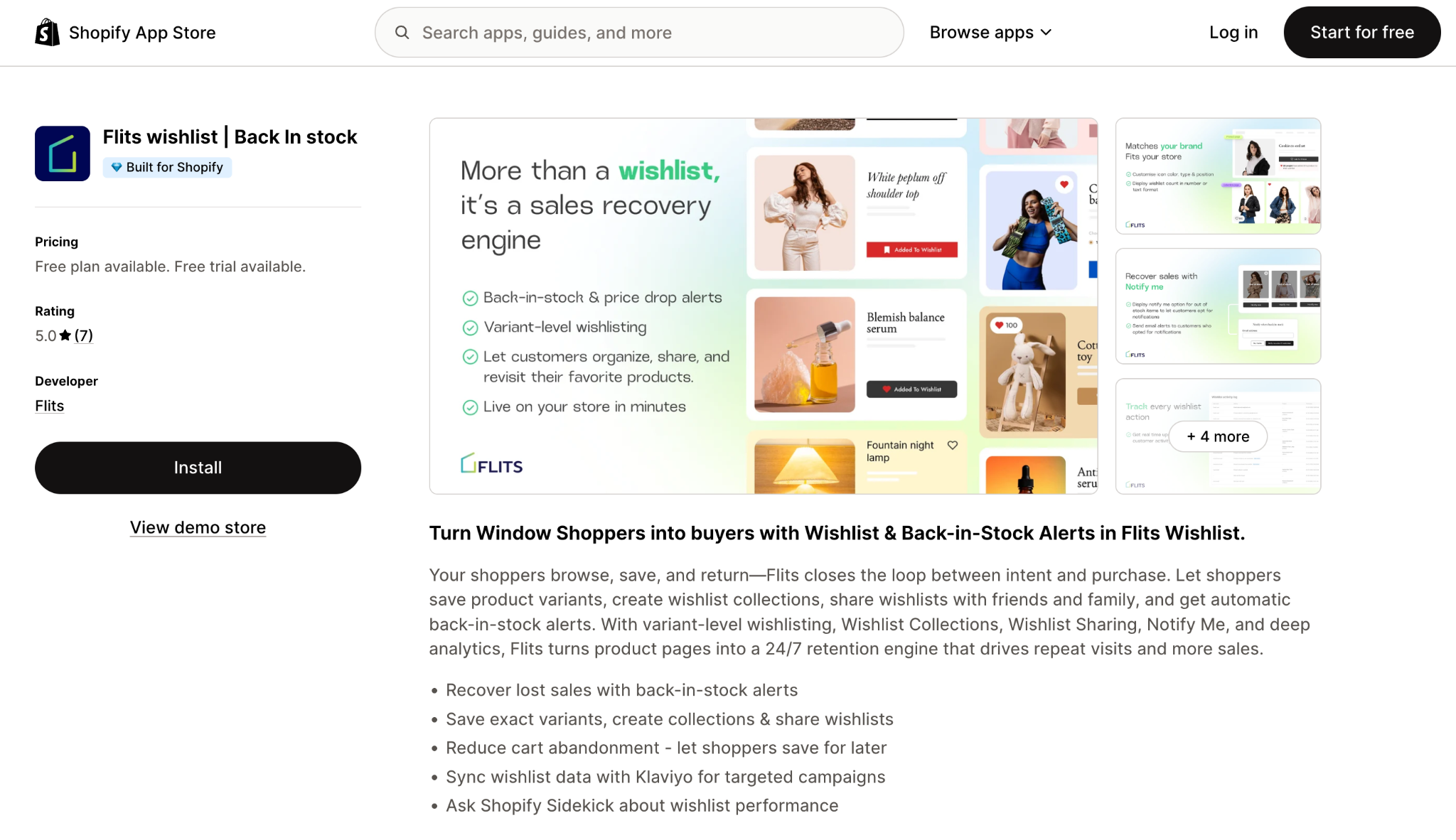
There are no wishlist item caps. Klaviyo integration is included at the $19/month Unlimited plan, not locked behind a higher tier. Guest wishlist access is on the paid plan, which is straightforward and transparent. The Unlimited plan is a complete product, not a set of unlockable tiers.

That structural difference matters from the moment of installation, but the product depth that comes after it is what makes Flits the strongest alternative on this list.
Flits has been building for Shopify merchants for over nine years. When you're evaluating a wishlist app, that length of operating history answers a specific category of question: the edge cases, the theme compatibility issues, the conflicts with adjacent apps, these are problems that a nine-year-old product has already encountered and resolved across thousands of merchant accounts. You're not an early adopter. You're installing something that 5,000+ merchants across 100 countries have already validated.

Setup begins with an AI-generated wishlist page and flow builder. Rather than manually placing buttons and configuring the wishlist layout, Flits reads your store's existing theme and produces a matched wishlist experience. The button placement, the dedicated wishlist page design, the visual alignment with your storefront, all of it is handled by the AI before you make a single configuration decision. For merchants who've spent time establishing a consistent brand aesthetic, this means the wishlist arrives looking like it belongs, not like it was added from a third-party catalog.
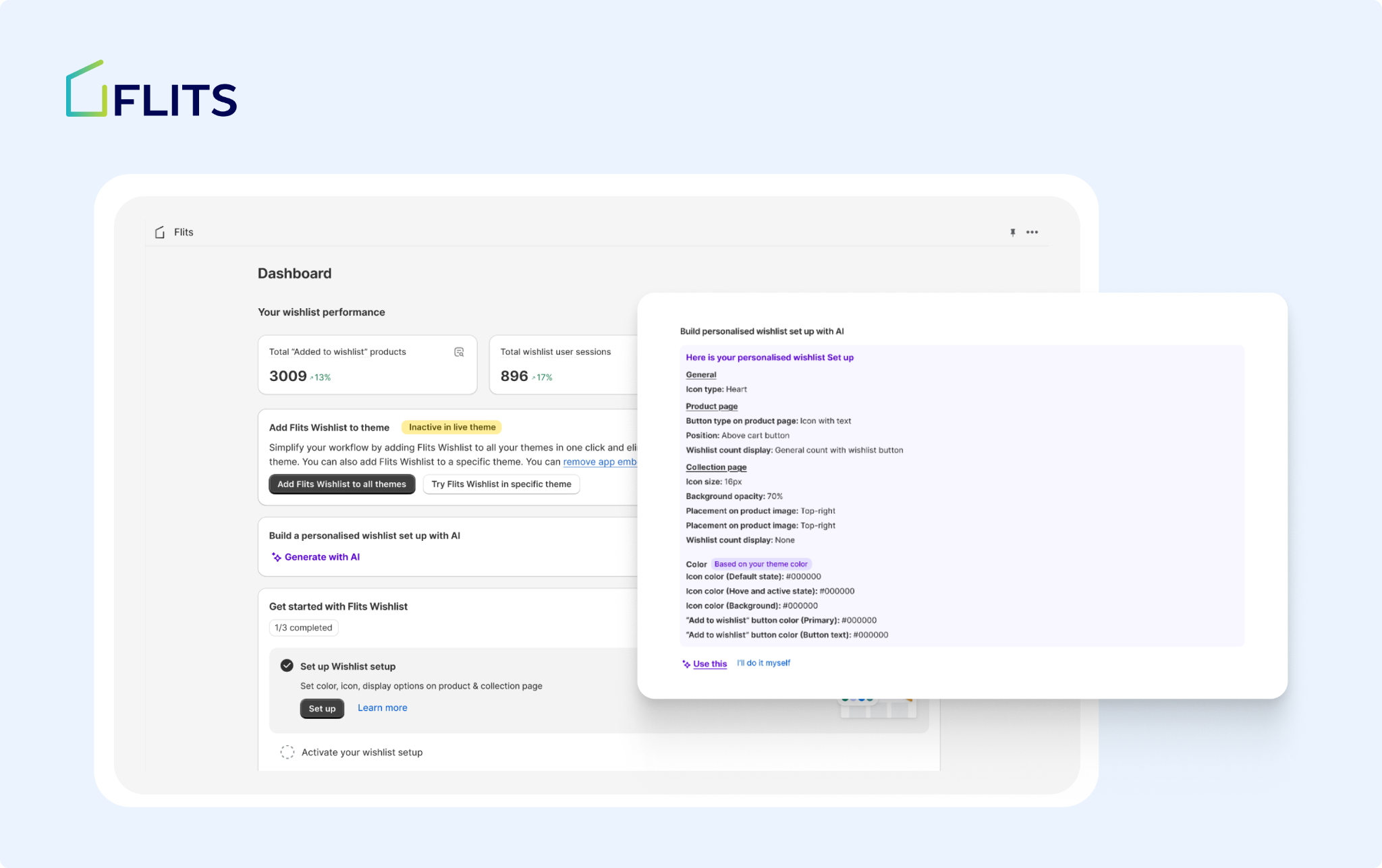
The coverage is comprehensive. Wishlist buttons appear on product pages, collection pages, the customer account page, and the mini account drawer. A dedicated wishlist page sits in the header. Product variant saving works at the level of the specific size, color, or style a customer selects, not just the product page, which means the data you collect is the data customers actually care about. Wishlist Share lets shoppers distribute their saved products via link or social media. Wishlist Collections let customers organize what they've saved into named groups, which is useful for stores with wide product ranges where customers browse across categories across multiple sessions before making buying decisions.
When a product that's been wishlisted returns to stock, Flits fires a back-in-stock alert without any external configuration. There is no Klaviyo flow to build for this to happen. The alert is part of the product, triggered by inventory data, and sent at the moment the product is available again. That moment is commercially important: back-in-stock emails sent when the stock is actually there convert at significantly higher rates than those sent hours or days later.

For merchants running Klaviyo, the integration adds a layer that standalone wishlist apps rarely reach. Every wishlist action (a product saved, a variant pinned, a back-in-stock trigger) flows into Klaviyo as a named customer event. This lets you build Klaviyo flows against specific wishlist behaviors.

A customer who saved five products across two sessions without purchasing is a different segment from one who saved one product and came back the next day. Klaviyo can see that distinction and act on it. Wishify doesn't pass this kind of structured intent signal to Klaviyo even on its highest plan.
Analytics inside the Flits admin shows which products are attracting the most wishlist saves, which saves have converted to orders, how many customers are active on the wishlist, cart abandonments sourced to wishlist behavior, and per-customer activity timelines. This gives merchants data to act on in merchandising, stock decisions, and campaign targeting. Knowing that a specific product has 200 saves but a low conversion rate tells you something different from knowing it has 200 saves with a high conversion rate. Flits surfaces both.

Migration from Wishify is a supported process. You export your wishlist data as a CSV and share it with the Flits support team. They handle the import. The customers who saved products before the switch keep those items on the other side of the migration.
Key features
- AI-generated wishlist page and flow builder, matched to your store's existing theme
- Shopify Guest wishlist support on the paid plan, no item caps on any plan
- Back-in-stock email alerts built into the product, no external tool required
- Klaviyo integration: wishlist saves and triggers sync as structured customer events
- Wishlist Share via link and social media channels
- Wishlist Collections for customer-organized saved product groupings
- Variant-level saving: customers save the exact size, color, or style they select
- Wishlist placements across product pages, collection pages, customer account pages, the mini account drawer, and a dedicated header-accessible wishlist page
- Analytics covering top-saved products, wishlist-driven revenue, cart abandonment, and per-customer wishlist timelines
- Managed migration from Wishify via CSV, handled by the Flits team
Pros
- No wishlist item caps at any plan level. The product doesn't create ceilings as store traffic grows
- Klaviyo integration is included at $19/month. Not locked behind a higher tier
- Back-in-stock alerts work without building a Klaviyo flow or connecting an external tool
- AI builder produces a matched wishlist experience without manual configuration
- Nine years of Shopify operating history means reliability is demonstrated, not claimed
Cons
- Guest wishlist requires the paid plan. The free plan provides the core wishlist experience but not guest access
- Price drop alerts are on the product roadmap but are not yet live. Back-in-stock alerts are available now
Flits vs. Wishify
Wishify imposes item caps at every plan level, gates guest wishlist behind its first paid tier, and puts Klaviyo integration on a high-cost plan that most merchants won't reach. Flits has no item caps, includes Klaviyo at $19/month Unlimited, and provides back-in-stock alerts without requiring any external tool. The comparison isn't a close one for stores where the wishlist needs to function completely.
2. Growave
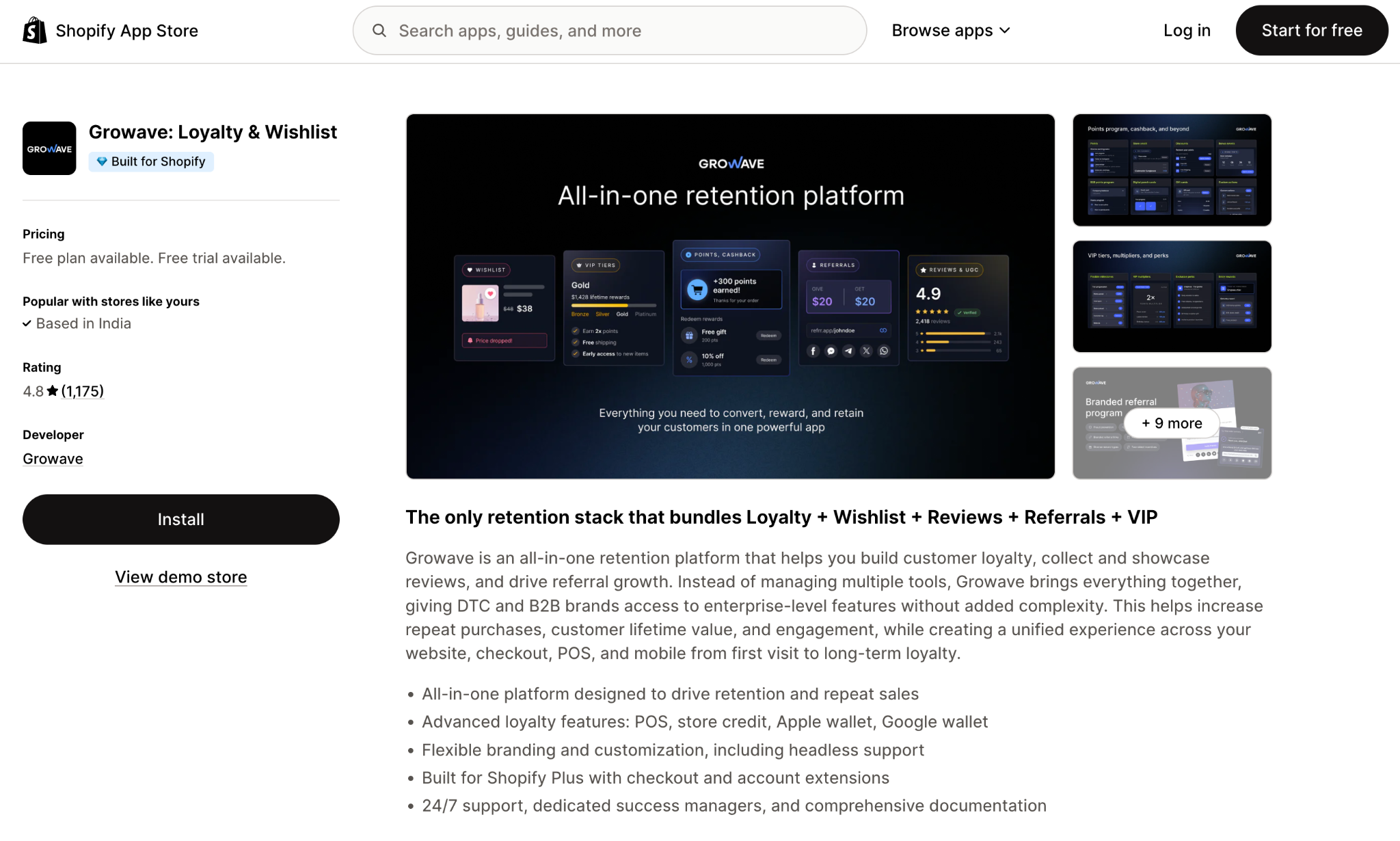
Merchants who outgrow Wishify often discover the same thing: the wishlist data they've been collecting exists in isolation. It doesn't connect to loyalty data. It doesn't inform review requests. It doesn't feed into referral campaigns. Each of those functions lives in a separate app, managed separately, billing separately, and sharing no information with the others. Growave was built as the alternative to that stack.
The platform handles wishlists, loyalty programs, product reviews, referral programs, and social login from one merchant dashboard. The shared customer profile is the structural advantage: a shopper who saves a product, earns points on a purchase, and leaves a review after delivery is tracked as one continuous record rather than three separate entries across three systems. The wishlist save informs what loyalty nudge to send. The purchase feeds the review request. The review request references the product the customer originally saved. That continuity is difficult to recreate when the tools are separate.
The wishlist component works properly on its own. Email alerts for price changes and restocks fire based on wishlist activity. Analytics covers what customers are saving and when. The limitation that matters most is guest wishlist access: Growave does not support it on any plan. Customers need an account to save products. For stores with significant guest traffic, that's a cohort of purchase intent that the wishlist never captures, regardless of the plan.
Also Read: Capture Customer Intent With Flits Wishlist
The calculus for choosing Growave is consolidation. If your store is paying for a wishlist app, a loyalty app, and a reviews platform separately, Growave almost certainly reduces the total cost while adding the connective tissue between them. If the wishlist is the only thing you need and guest access is important, a dedicated wishlist tool is the better fit.
Key features
- Wishlist with price change and back-in-stock email alerts
- Points-based loyalty program with configurable earning rules and redemption options
- Product reviews supporting photo and video submissions
- Referral program with customizable reward structures and conditions
- Social login via Google and Facebook
- VIP tier programs for segmenting high-value customers
- Shared customer profile connecting all retention data points
Pros
- One platform replacing multiple standalone apps and their associated integration overhead
- Loyalty, wishlist, and review data lives in the same customer record
- Over 2,000 reviews with consistently strong ratings, reflecting operational stability at scale
- Free plan available to validate engagement before committing to a paid tier
Cons
- No guest wishlist support at any plan level. Stores with significant guest traffic lose that intent signal entirely
- Individual features are less configurable than purpose-built standalone tools
- The bundled approach costs more than dedicated wishlist-only apps if the wishlist is the only requirement
Growave vs. Wishify
Wishify offers guest wishlist on its Professional Plan. Growave doesn't offer it on any plan. On the other hand, Growave replaces multiple apps that most merchants running Wishify are also paying for separately, and the shared customer data across loyalty and wishlist creates segmentation capability that isolated tools can't match. The right choice depends on whether consolidation is the goal or whether guest wishlist access is non-negotiable.
3. SE Wishlist Engine
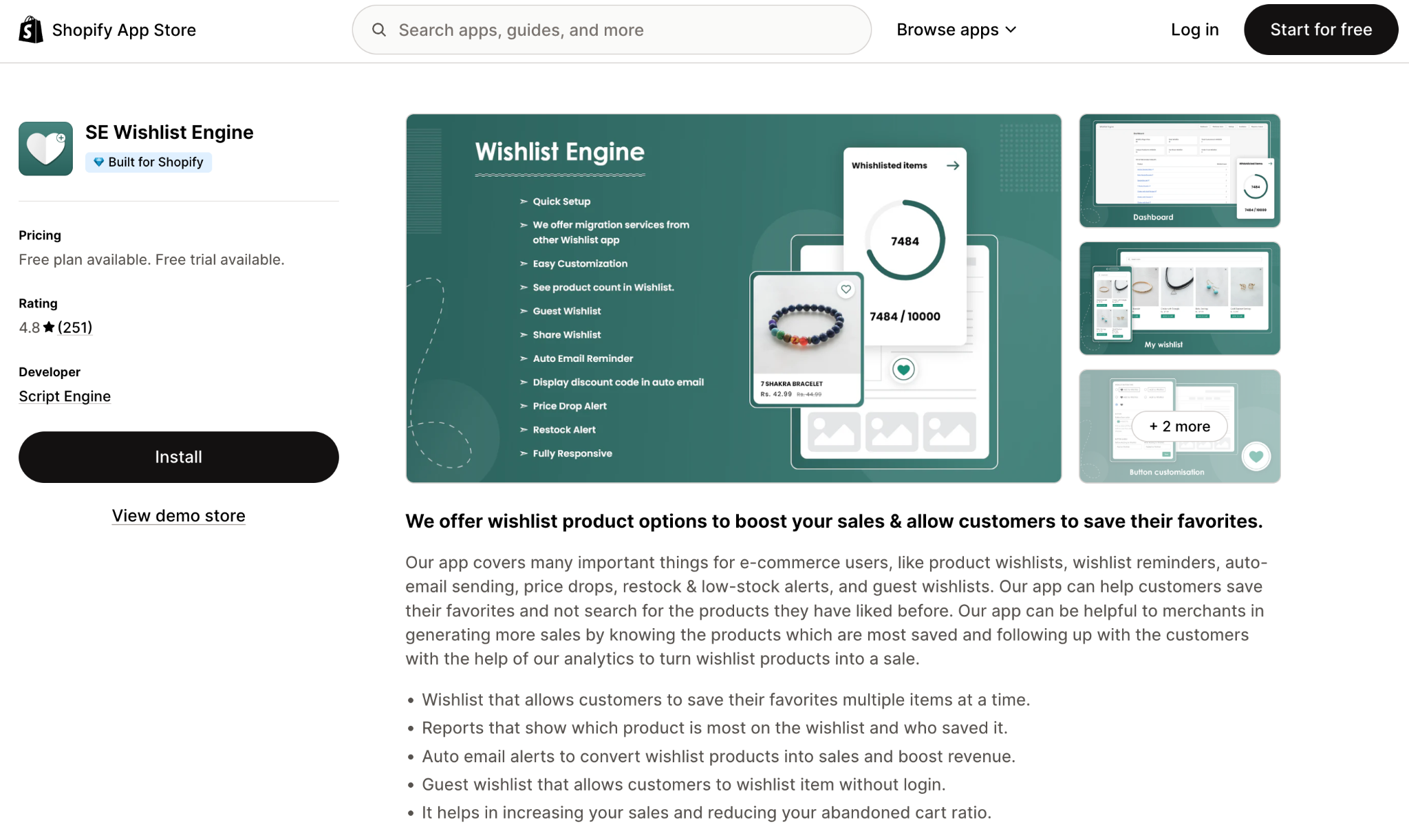
The argument Wishify makes for email recovery is that automated reminder emails can be sent to customers who saved products but didn't purchase. That's true, but what Wishify doesn't make clear is that meaningful email recovery, including back-in-stock and price drop triggers, requires reaching the higher-cost plans. SE Wishlist Engine builds email recovery into the product from the first paid tier, with more granular trigger types and better template control than Wishify offers at comparable pricing.
The architecture is built around recovery events rather than passive reminders. Back-in-stock notifications fire when inventory returns. Price drop alerts send when a saved product goes on sale. Abandonment reminders go out on a configurable delay when a customer hasn't returned to their wishlist. Each trigger type has its own template, and the conversion analytics at the campaign level shows which recovery type is generating actual purchases, not just opens.
For stores switching from Wishify specifically because Klaviyo integration is locked behind the most expensive plan, SE Wishlist Engine provides a middle path. Email recovery operates entirely within the app. Klaviyo isn't required. Merchants who haven't invested in a full email marketing platform still get automated, trigger-based recovery without an additional tool in the stack.
Guest wishlist support is included, and the free plan is genuinely functional for stores validating whether recovery emails drive meaningful return visits before committing to a paid tier.
Key features
- Automated email recovery covering back-in-stock, price drops, and time-delayed abandonment reminders
- Guest wishlist with optional email capture for non-authenticated shoppers
- Per-trigger customizable email templates with subject line and body control
- Conversion analytics tracking open rates, click rates, and orders attributed to recovery emails
- Direct add-to-cart shortcut embedded inside recovery emails to reduce friction to purchase
- Operates independently of Klaviyo for all core recovery functions
Pros
- Email recovery is the design priority. More trigger granularity than Wishify at comparable or lower plan cost
- Guest wishlist works without the paywall Wishify creates at the Professional Plan
- Klaviyo-free operation makes it accessible for stores without a dedicated email platform
- Free plan covers enough to test recovery email engagement before upgrading
Cons
- Visual customization options are narrower than Swish or Flits
- No loyalty data, account-level integration, or broader retention features
- Not suited for stores that want analytics depth beyond email campaign metrics
SE Wishlist Engine vs. Wishify
Wishify's email recovery requires a higher plan to access meaningfully. SE Wishlist Engine provides back-in-stock, price drop, and abandonment recovery without a Klaviyo dependency and at a lower plan cost. For stores where email recovery is the primary reason for installing a wishlist app, SE Wishlist Engine closes the gap that Wishify's plan structure leaves open.
4. Swym Wishlist Plus
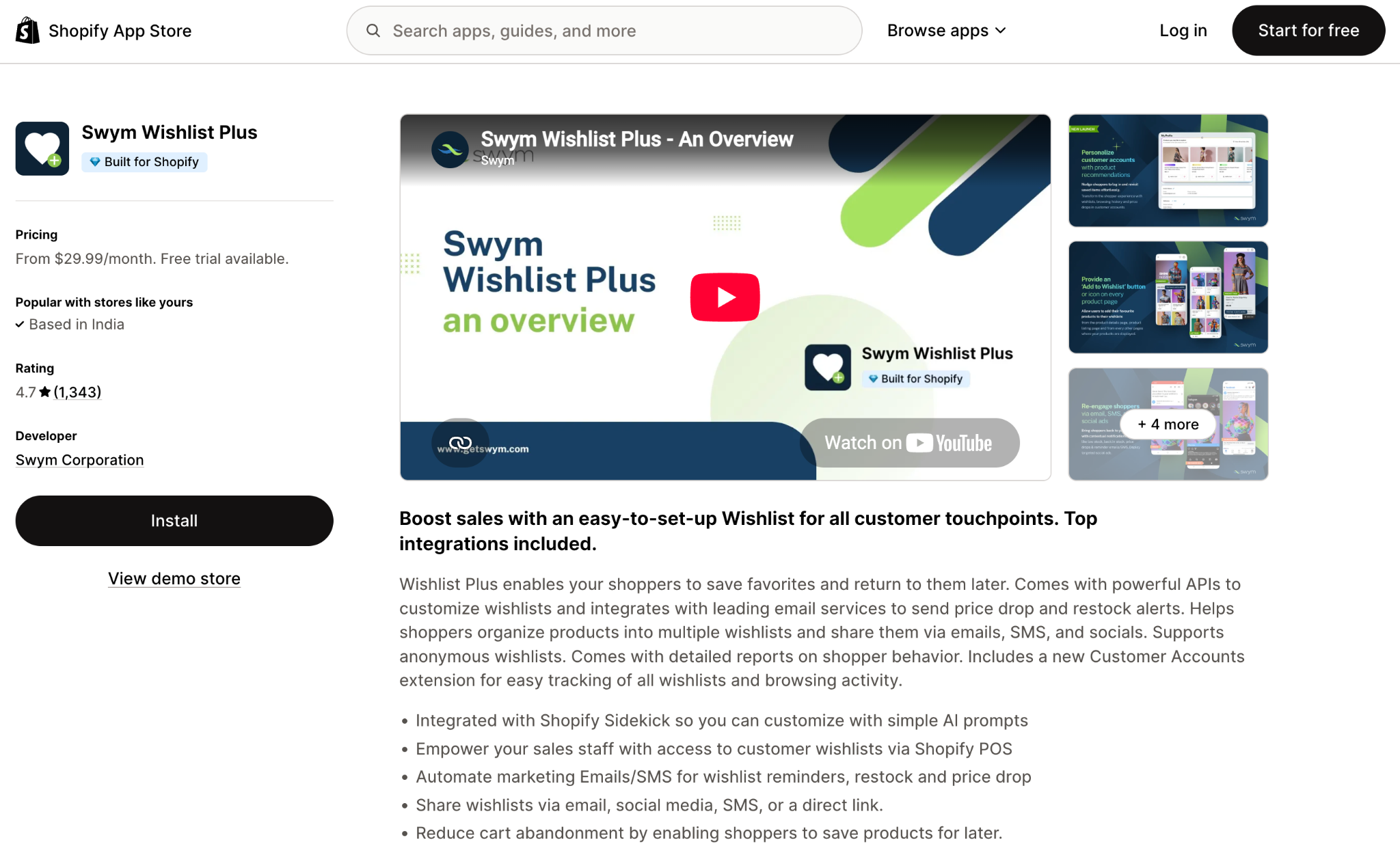
Swym operates at a different scale from Wishify in every meaningful dimension. The installed base exceeds 2,100 reviews, which is ten times Wishify's review count. The analytics at higher tiers include cohort-level reporting, demand forecasting signals drawn from wishlist data, and Shopify Flow integration that lets merchants automate responses to wishlist events without writing logic manually. For stores running custom storefronts or headless implementations, Swym provides explicit support that most wishlist apps don't offer.
The trade-off is the pricing structure. Guest wishlist access and email alerts both require the $19.99/month plan. The free tier is available but restrictive in ways that won't serve stores with active wishlist traffic. For merchants switching from Wishify because of feature depth or scale requirements, Swym offers a credible upgrade. For merchants switching because of Wishify's plan-based limitations, they should note that Swym has its own tiered structure with features distributed across plans.
Klaviyo integration is available at the entry paid tier, which is a meaningful improvement over Wishify, where the equivalent capability sits behind a significantly higher cost. The depth of what flows into Klaviyo is also stronger at scale: cohort data, demand signals, and wishlisted-but-not-purchased segmentation all reach Klaviyo as structured events.
Key features
- Guest wishlist on paid plans
- Back-in-stock and price drop email alerts on paid plans
- Shopify Flow integration for custom automation logic without manual coding
- Advanced analytics with demand forecasting signals at higher tiers
- Multi-device wishlist sync across browser, mobile, and desktop
- Headless commerce and custom storefront support
- Klaviyo integration available from the entry paid tier
Pros
- The largest installed base in the Shopify wishlist category by review count
- Demand forecasting and cohort analytics at scale are stronger than any alternative on this list
- Shopify Flow integration allows wishlist-triggered automation without Klaviyo
- Headless and custom storefront support for merchants with complex frontend architectures
Cons
- Guest wishlist and email alerts both require the paid plan, similar to Wishify's structure
- Pricing climbs significantly as feature access and plan tier increase
- No broader retention features beyond the wishlist product
- The analytics depth that justifies the higher tiers is most relevant for merchants at genuine scale
Swym vs. Wishify
Wishify caps wishlist item counts and gates Klaviyo behind a high-cost plan. Swym removes item caps and includes Klaviyo at its entry paid tier. For stores whose primary frustration with Wishify is the item limits and the Klaviyo paywall, Swym resolves both. For stores sensitive to pricing structure, Swym's tiered model has its own feature gates that are worth mapping before committing.
5. Swish (Wishlist King)
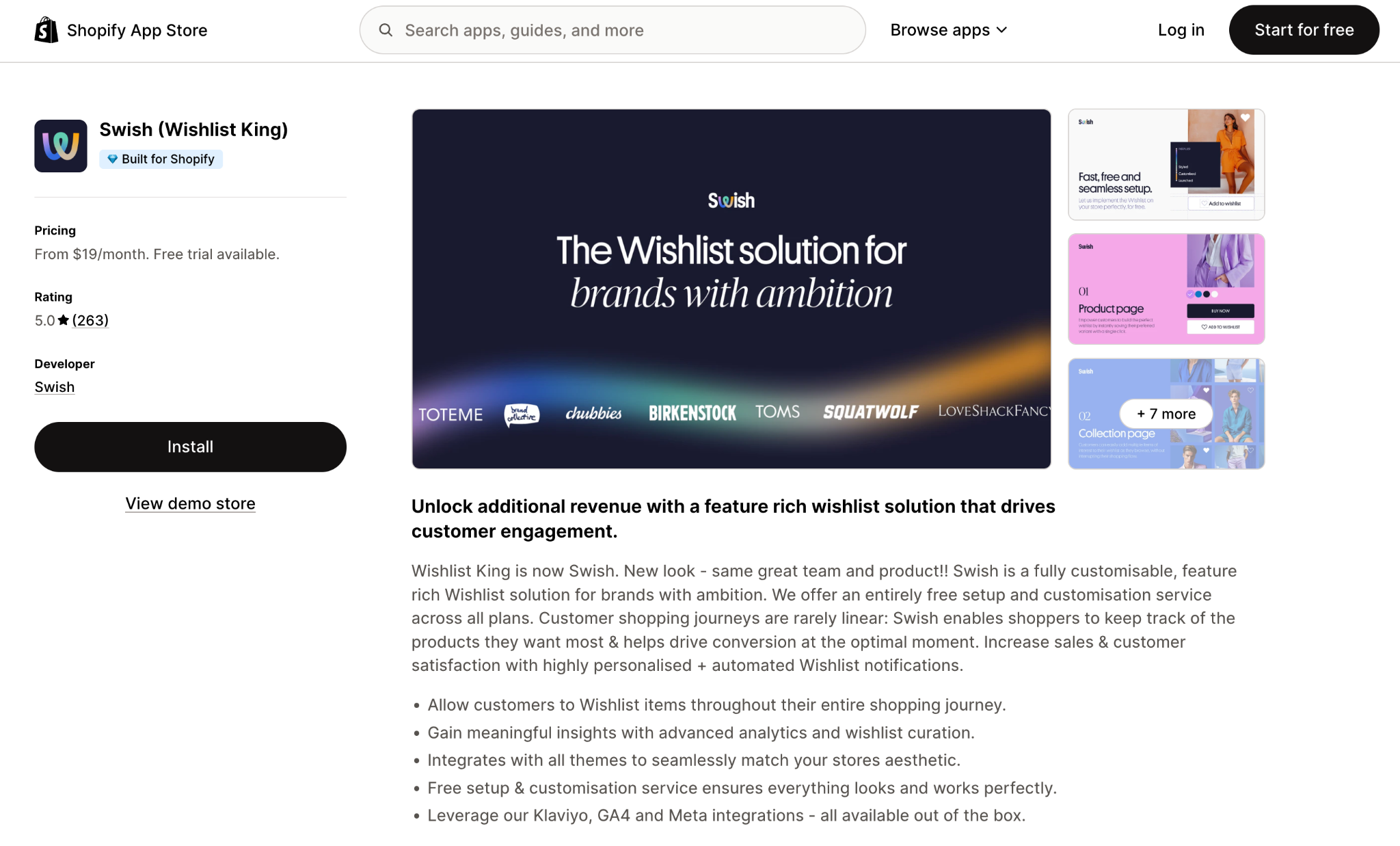
Swish was built for merchants who have strong, specific ideas about how their wishlist should look and are not willing to compromise on visual precision to get a product that otherwise works well. The design system is more configurable than any other app on this list – typography, color, button style, icon style, spacing, and widget placement can all be adjusted without touching code. For heavily branded storefronts where visual consistency is a commercial priority, this level of control is meaningful.
The free setup and customization service across all plans is a genuine differentiator: a member of the Swish team handles initial configuration and theme integration, which removes the setup friction that merchants sometimes encounter with apps that expect the merchant to figure it out. GA4, Klaviyo, and Meta integrations are all included without a tier jump. Analytics covers product-level wishlist data and behavioral trends.
The significant qualification in this context is pricing. Swish has no free plan, and its pricing is tied to the Shopify plan tier rather than usage. Basic Shopify merchants pay $19/month. Standard Shopify merchants pay $29/month. Advanced Shopify merchants pay $49/month. The features are identical across tiers. The price difference reflects which Shopify plan the merchant is subscribed to, not any change in what Swish provides. Merchants who've upgraded their Shopify plan for unrelated reasons find their Swish bill increases without any corresponding change in what they receive.
Key features
- Comprehensive no-code UI customization across every wishlist element
- Free setup and customization service included across all paid plans
- Guest wishlist support with optional email capture
- Automated email reminders for saved products
- Klaviyo, GA4, and Meta integrations available at all plan levels
- Analytics covering product-level wishlist data and behavioral trends
- Shopify Plus support including headless and Hydrogen implementations
Pros
- Most precise visual customization of any app on this list
- Free setup service across all plans removes the configuration burden from the merchant
- Klaviyo, GA4, and Meta integrations come standard without requiring a tier upgrade
- 5/5 rating across a meaningful review base reflects consistent execution
Cons
- No free plan. Monthly billing starts from day one of installation
- Pricing scales with Shopify plan tier, not with feature usage or the value the app delivers
- Advanced Shopify merchants pay $49/month for identical features that Basic merchants receive at $19/month
Swish vs. Wishify
Wishify has a free plan and lower entry pricing. Swish has superior customization, better integrations, and no item caps. For a store where visual control and Klaviyo integration are the priorities and the higher price is acceptable, Swish is the more complete product. For stores already on Shopify Advanced where Swish's $49/month feels disproportionate, Flits delivers comparable feature depth at $19/month regardless of Shopify plan.
6. Hulk Wishlist & Favorites
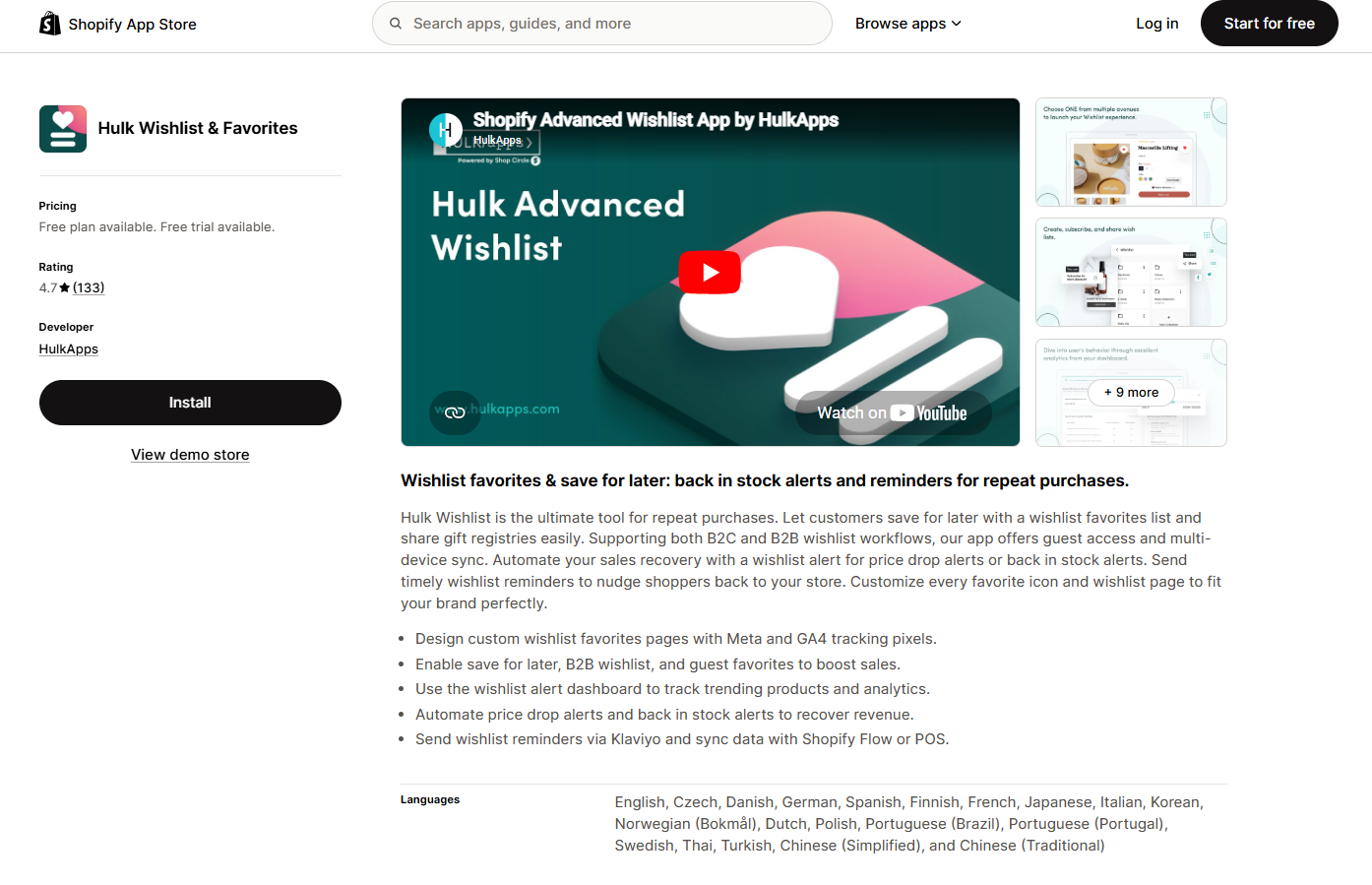
Most wishlist apps assume a single use case: a customer saves products in one list and returns to buy them. Hulk is built around the recognition that shoppers organize intent differently. A customer planning holiday gifts has different saved items from their personal wish list, which is different again from products they're tracking for a specific occasion. Hulk lets customers create as many separate wishlists as they want, name each one, and manage them independently.
For stores selling across categories where customers have multiple distinct buying intentions. Fashion stores with separate occasion lists, home goods stores with room-by-room collections, gift-oriented stores where customers track what different recipients might want. This multi-list structure reflects how customers actually shop rather than forcing all intent into a single undifferentiated pile.
There are no item limits on any plan, which addresses Wishify's most significant structural limitation directly. A customer saving 200 products across five different lists faces no ceiling. The store faces no cap on total saves. Hulk removes the counting mechanism entirely and lets wishlist activity grow with actual engagement.
The gap is email recovery. Hulk doesn't include built-in alerts for back-in-stock events or price drops. For stores where email recovery from wishlist saves is a primary commercial goal, Hulk requires connecting to an external tool. For stores where the organizational structure of the wishlist matters more than the alert layer, Hulk offers something the other apps on this list don't.
Key features
- Unlimited wishlists per customer with custom naming
- Unlimited saved products per wishlist with no monthly item caps
- Guest wishlist support across plans
- Wishlist sharing via link for social distribution
- Add-to-cart shortcut directly from the wishlist page
- Clean admin overview showing wishlist activity by product and customer
Pros
- No item caps at any plan level. Wishlist activity is not constrained by plan ceilings
- Multiple list types reflect real customer intent patterns across different purchase timelines
- Works well for fashion, home goods, registry-adjacent, and catalog-heavy store types
- Lower price point than Wishify's Professional Plan while covering more functional ground
Cons
- No built-in email alerts for back-in-stock or price drops. Recovery requires an external tool
- Smaller review base compared to established alternatives
- Analytics are basic. Not designed for data-driven merchandising decisions
Hulk vs. Wishify
Wishify caps wishlist items per month and gates guest access behind a paid plan. Hulk removes both limitations and adds multiple Shopify wishlist types. For stores where Wishify's item ceilings were the primary source of frustration, Hulk resolves that completely. For stores where Klaviyo integration and email recovery are the priority, Hulk doesn't replace those capabilities.
7. WC Wishlist Club
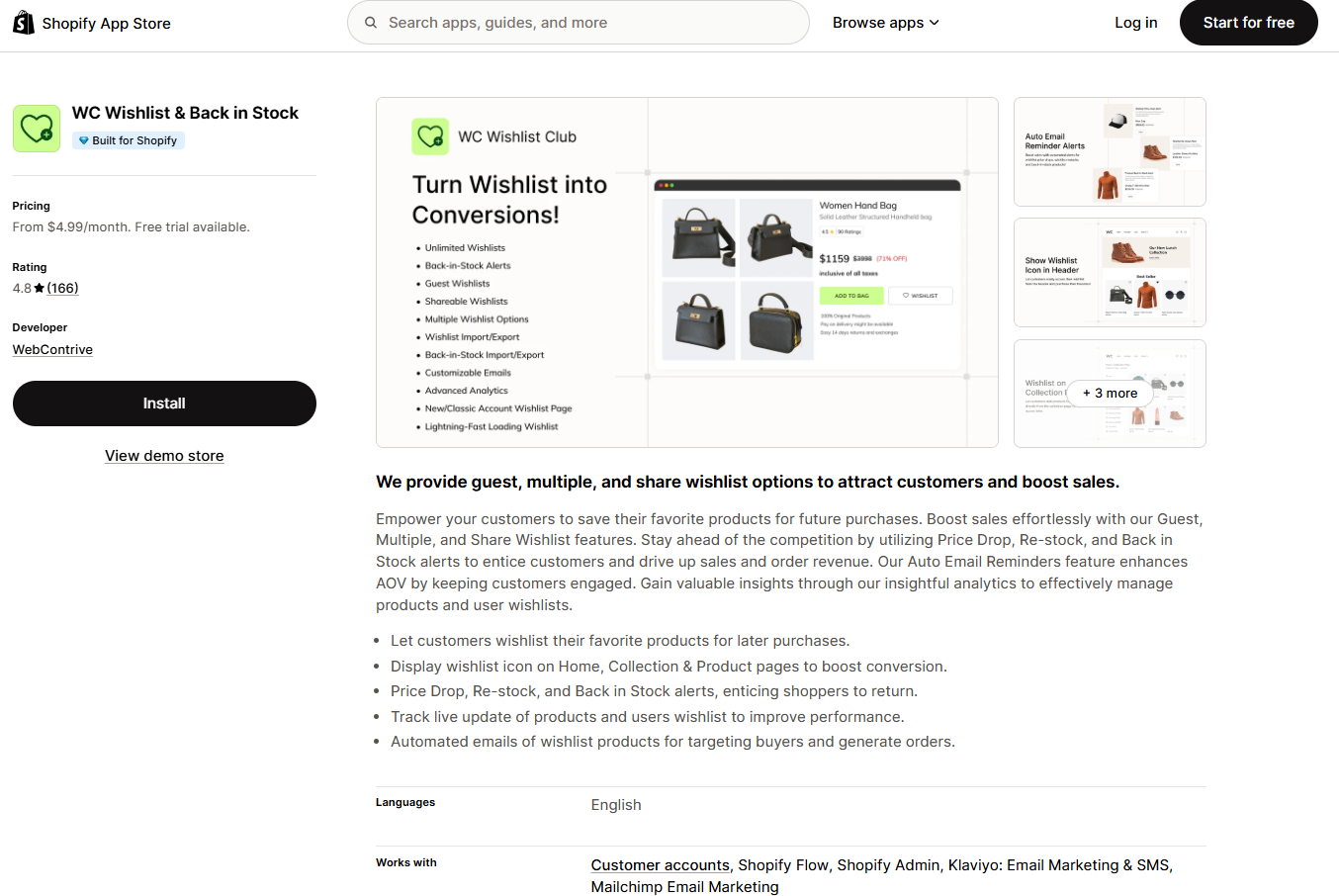
Wishify's Professional Plan costs $5.99/month and delivers guest wishlist access, collection page widgets, wishlist sharing, and basic customization. WC Wishlist Club's paid plan starts at $2.99/month and covers the same core feature set. For a merchant evaluating what they're getting per dollar at the entry paid tier, WC Wishlist Club consistently provides more coverage for less cost.
The free plan is also more genuinely usable than Wishify's. Where Wishify caps the free plan at 100 wishlist saves per month, enough to test the product but not to run it as a real business feature, WC Wishlist Club's free plan covers the basic wishlist experience without item limits that create silent failures as traffic grows.
Guest wishlist access is available without the plan paywall that Wishify creates. Email reminder alerts work at the first paid tier. The product is appropriately scoped for where it sits in the market: it doesn't try to be the most feature-complete wishlist solution, and the things it does cover work reliably across a range of store types and traffic levels.
The limitation to acknowledge is depth. WC Wishlist Club doesn't offer Klaviyo integration, doesn't provide analytics suitable for merchandising decisions, and doesn't include any loyalty or retention features beyond the wishlist itself. For stores in early growth stages where validating wishlist engagement is the goal, it's a clean starting point. For stores at scale where data and integration depth matter, it's a step toward a more complete tool rather than the destination.
Key features
- Guest wishlist support included from the free plan
- Email reminder alerts for saved products on the paid tier
- Basic analytics showing saved product counts and activity patterns
- Social sharing for customer wishlists
- Add-to-cart shortcut from the wishlist page
- Clean merchant admin with clear configuration
Pros
- Lower paid plan cost than Wishify's Professional Plan while covering equivalent core features
- Guest wishlist available without a plan upgrade
- Free plan has no item caps, unlike Wishify's 100-item monthly ceiling
- Stable performance across a range of Shopify themes and store configurations
Cons
- No Klaviyo integration or external email platform connection
- Analytics are too basic for segment-level decisions or merchandising work
- Not suitable as a long-term tool for stores with meaningful wishlist traffic and active email programs
WC Wishlist Club vs. Wishify
At a lower price point than Wishify's Professional Plan, WC Wishlist Club includes guest wishlist access, email reminders, and no item caps. The feature depth is similar. For stores where price is the primary concern and the item ceilings were the source of frustration, WC Wishlist Club is a lateral move that removes the walls at a lower monthly cost.
8. MST: Wishlist + Marketing Flow
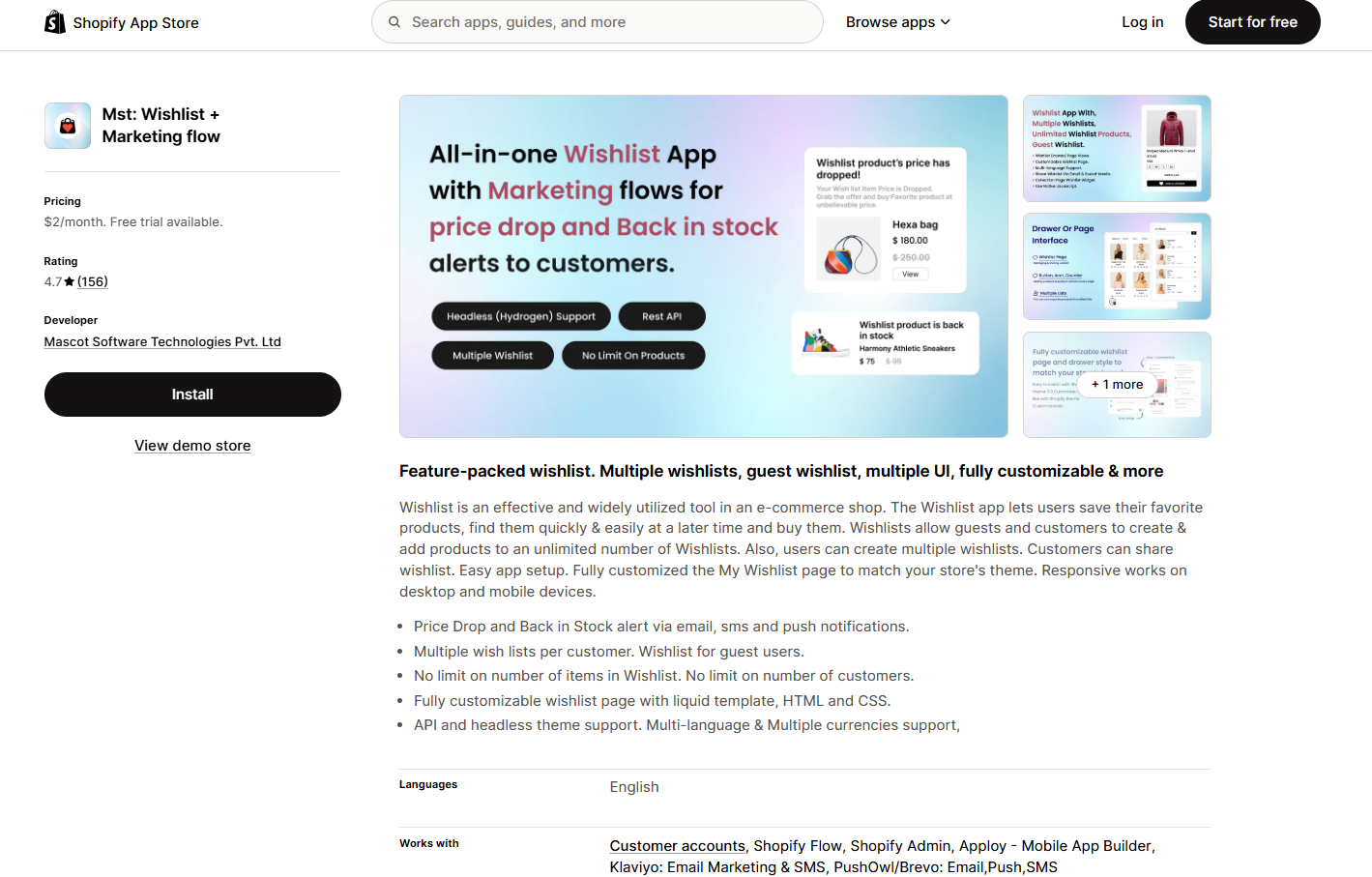
Where most wishlist apps treat email as a notification mechanism, a single alert that a product is back in stock alerts or on sale, MST treats the wishlist as a trigger layer for a lightweight marketing program. Products saved but not purchased can receive cart nudge emails on a configurable schedule. Customers who haven't returned to their wishlist within a set window can receive re-engagement messages referencing what they saved. Product recommendations based on wishlist activity can be sent as a standalone campaign rather than a one-time transactional alert.
None of these flows require an external platform to operate. They're built into the product and configured within the MST admin. For merchants who want wishlist-informed outreach to customers without the investment of configuring Klaviyo flows or building a marketing automation stack, MST provides a usable middle layer between a basic wishlist and a sophisticated email platform.
The comparison with Wishify is direct on one key point: Wishify's email automation at any meaningful level requires upgrading to higher-cost plans and, for Klaviyo integration specifically, reaching a tier that most Wishify merchants never access. MST includes its campaign layer from earlier in the plan structure, at pricing that's comparable to what Wishify charges for simpler functionality.
The honest ceiling to state: MST's marketing flows are straightforward. Merchants running multi-step sequences, building conditional branching logic, or managing large-scale campaign programs will need a dedicated email platform. MST is not a replacement for that. It's an improvement on the basic notification layer that Wishify offers at its standard tiers.
Key features
- Wishlist with guest support across all plans
- Automated back-in-stock and price drop email alerts included in the product
- Cart nudge emails for saved products not purchased within a configurable window
- Re-engagement campaigns targeting customers with dormant wishlist activity
- Product recommendations based on saved item patterns
- Campaign performance analytics within the MST admin
Pros
- Campaign automation is built into the product. No Klaviyo or external platform required for core functions
- Guest wishlist available without the plan upgrade Wishify requires
- Marketing flows are accessible at lower plan cost than Wishify's equivalent capability
- Wishlist-triggered campaigns go beyond single transactional alerts
Cons
- Marketing flows are basic and not suitable for complex multi-step automation
- Newer app with fewer reviews than established alternatives on this list
- Attribution analytics don't support deep analysis of campaign contribution to revenue
MST vs. Wishify
Wishify's email automation requires higher-cost plans and Klaviyo for anything beyond basic reminders. MST includes campaign automation within the product at a comparable price to Wishify's Professional Plan. For merchants who want more from their wishlist emails than Wishify currently provides without investing in Klaviyo, MST covers that ground more affordably.
9. Wishlist Hero
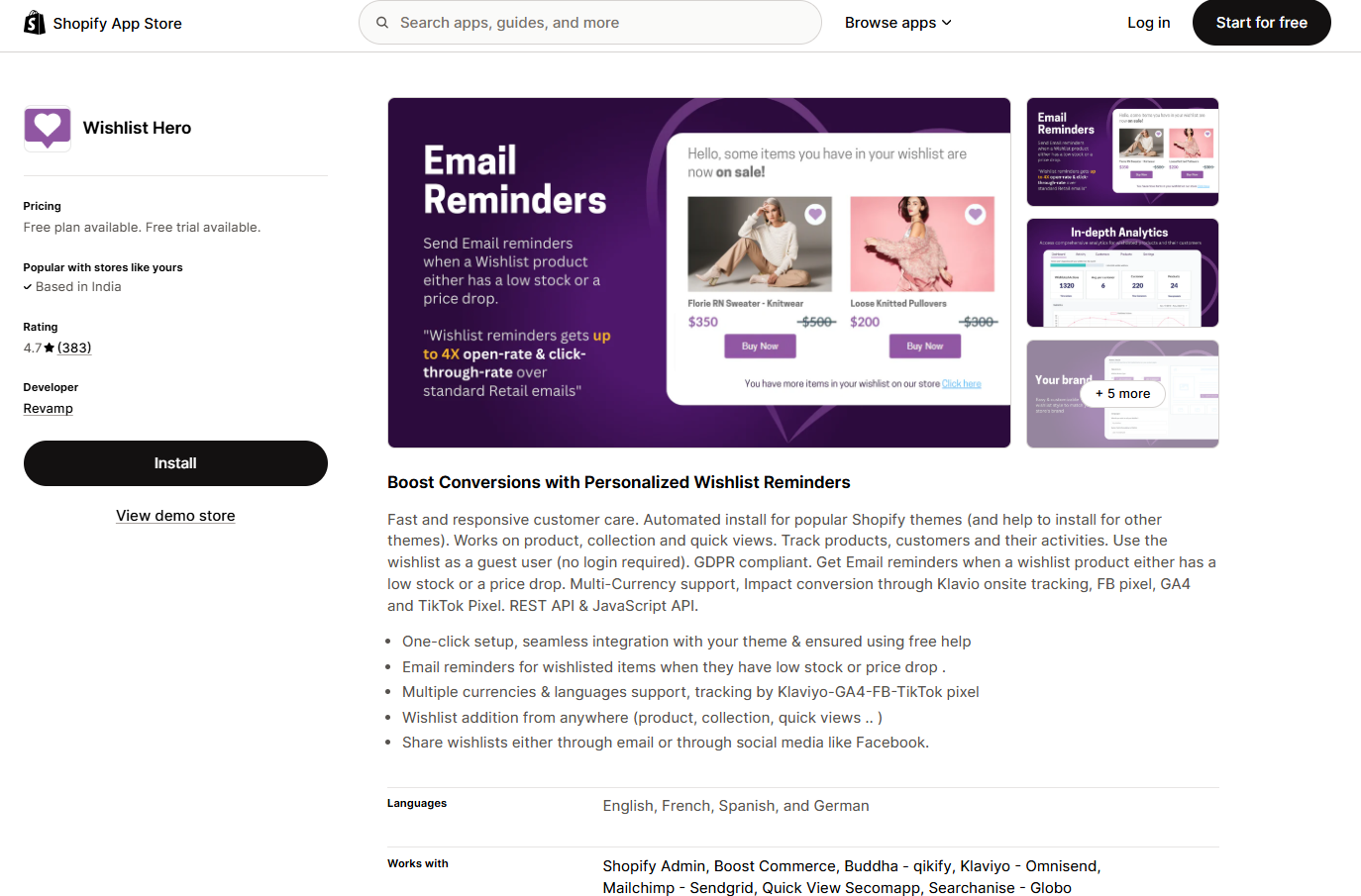
Wishlist Hero appears in most Shopify wishlist comparisons and is worth addressing plainly. The pricing is at the low end of the market, the feature list covers the essentials, and Klaviyo integration is available on paid plans at a lower cost threshold than Wishify demands for the same capability. For a merchant switching from Wishify specifically because Klaviyo was inaccessible on their current plan, Wishlist Hero resolves that problem at a lower price.
The context that matters here is reliability. Recent Shopify App Store reviews document the app generating redirect loops in the admin, wishlist functionality breaking in production without warning, and support response times measured in weeks rather than hours. One merchant who used the app for over a year described losing all customer wishlist data visibility when the app stopped loading the admin panel correctly. A merchant in Estonia flagged residual code left in the theme after uninstallation, requiring developer intervention to clean up.
Wishlist Hero can serve as a test installation for a store exploring whether wishlist functionality generates meaningful engagement at all. The cost is low enough to justify a limited experiment. For any store where the wishlist is a live part of the retention strategy, where customers are actively saving products, where email recovery is driving return visits, where the data matters, the documented reliability pattern makes it difficult to recommend with confidence.
Key features
- Guest wishlist support on paid plans
- Back-in-stock and price drop email alerts
- Multi-currency support for stores with international customer bases
- GDPR-compliant email capture for guest wishlist users
- Klaviyo integration on paid plans
- Social sharing and dedicated wishlist page
Pros
- Klaviyo integration available at a lower price threshold than Wishify
- Multi-currency support for international stores is built in
- GDPR-compliant guest email capture is included
- Lowest price floor of any app on this list with email integration
Cons
- Documented reliability issues across multiple independent merchant reviews, including total admin access failures
- Support response times that have been described as weeks in some cases
- Residual code reported in themes after uninstallation
- Not recommended as a primary tool for stores where the wishlist drives commercial outcomes
Wishlist Hero vs. Wishify
Wishify's reliability record is solid. Wishlist Hero's is not. The trade-off Wishlist Hero offers, Klaviyo at a lower cost, comes with a reliability risk that Wishify doesn't carry. For merchants who need Klaviyo integration at lower cost without the reliability concerns, Flits delivers that at $19/month with no item caps and a nine-year operating track record.
Final verdict: Which Wishify alternative should you choose?
Wishify works for what it is: a simple, well-supported wishlist at a low entry price. The reasons to leave it are specific, not general. Item caps that create silent failures as traffic grows. Guest wishlist locked behind a paid plan that catches merchants off guard after launch. Klaviyo integration that lives at a price point most Wishify merchants never reach. A product scope that ends at the wishlist and doesn't grow with a store's retention strategy.
If your store is hitting the item caps and you primarily want a cleaner list structure, Hulk removes those ceilings and adds multi-list support. If email recovery without Klaviyo is the main requirement, SE Wishlist Engine provides more granular trigger types at comparable pricing. If you're consolidating multiple retention apps, Growave replaces loyalty, reviews, and wishlist under one roof. If visual precision and full-stack integrations are the priority and the pricing structure is acceptable, Swish delivers the most configurable wishlist experience available.
For everything else, for stores where the wishlist needs to function completely without ceilings, where Klaviyo integration shouldn't require a separate pricing decision, where back-in-stock alerts need to work without external configuration, and where a nine-year track record matters more than a low entry price, Flits is the clearest alternative to Wishify.
The $19/month Unlimited plan is the complete product. No item caps. No tier above it with additional features. No separate pricing decision for Klaviyo. An AI builder that replaces manual setup. A migration process handled by the Flits team. And pricing that stays flat whether your store is processing 10 orders a month or 10,000.
Try Flits Wishlist on the Shopify App Store
Frequently asked questions
Why does Wishify cap wishlist items on every plan?
Wishify's plans are structured around monthly wishlist item counts: 100 on the free plan, 1,000 on Professional, and 3,000 on Premium. When a store reaches its plan's item ceiling, new saves stop being recorded. There's no customer-facing error, the wishlist button still appears, but saves aren't captured. Most merchants discover this when reviewing wishlist data and noticing that the numbers have unexpectedly plateaued.
Does Wishify include Klaviyo integration on its standard plans?
No. Klaviyo integration in Wishify sits behind a significantly higher-cost plan tier that most merchants on the standard Professional or Premium plans won't access. Apps like Flits, Swish, and Swym include Klaviyo integration at their standard paid tiers.
Which Wishify alternative has no item caps?
Flits Wishlist, Growave, SE Wishlist Engine, Swym Wishlist Plus, Swish, Hulk, WC Wishlist Club, and MST all have no monthly wishlist item limits. The cap is a Wishify-specific structure that doesn't apply to the alternatives on this list.
Is guest wishlist available on Wishify's free plan?
No. Guest wishlist access in Wishify requires the Professional Plan at $5.99/month. Several alternatives on this list, including SE Wishlist Engine, Hulk, WC Wishlist Club, and Wishify, include guest wishlist on free plans or at lower-cost paid tiers.
Can I migrate my wishlist data from Wishify to Flits?
Yes. Flits supports migration from most wishlist apps including Wishify. You export your wishlist data as a CSV and share it with the Flits support team, who handle the import. Customer saved products are preserved through the migration, and no data is lost in the process.
Which alternative is right if I also need loyalty and reviews?
Growave is the clearest choice for stores wanting wishlist, loyalty, and reviews managed within one platform. The shared customer profile across all three functions creates segmentation data that no combination of standalone apps can fully replicate.