A lost sale happens at more than one point, and each one looks different: a shopper who never came back to browse, someone who saved a product and forgot about it, someone else who reached checkout and stopped at the last step. Most stores treat all of it as a single "abandoned" bucket and respond with one generic recovery email. That approach misses most of the opportunity, because each leak point needs a different kind of follow-up, and a static cart can only see one of them.
A wishlist changes what's recoverable because it captures intent earlier than a cart does and keeps that signal alive long enough to act on. This guide walks through where Shopify stores actually lose sales, what a wishlist recovers at each point and what it can't, and a worked estimate for putting a number on what recovery is actually worth to your store.
Key Takeaways
- Sales get lost at multiple distinct points, not one; treating them the same way with a single recovery email wastes the intent signal a wishlist could capture instead (Baymard Institute, 2025).
- Back-in-stock emails convert at 6.72%, well above every other automated flow type measured in the same dataset, including cart abandonment at 1.72% (Omnisend, May 2026).
- Forced account creation before a shopper can save anything is a well-documented reason shoppers leave, and a guest-accessible wishlist removes that barrier at the point where the signal would otherwise be lost entirely (Baymard Institute, 2025).
- A simple recovery-value estimate, built from your own save volume and average order value, turns "wishlists help recover sales" from a vague claim into a number worth acting on.
- A wishlist recovers sales a cart-based save can't reach, because it survives past the session and can trigger its own event-driven follow-up instead of riding along inside a generic abandoned-cart flow.
Where Shopify Stores Actually Lose Sales
Not every lost sale looks the same, and lumping them together is why a lot of recovery efforts underperform. Four distinct points are worth naming separately, because each one calls for a different response.
1. Browse and Leave
A shopper views a product page and closes the tab without saving or adding anything. This is the weakest signal and the hardest to act on, since there's often no reliable way to identify or reach that shopper again by name.
A wishlist can't recover this leak point directly, since there's nothing to save yet, but it changes how many shoppers fall into this bucket in the first place. Every browse-and-leave that instead ends in a save moves a shopper out of the hardest-to-reach category and into one a store can actually follow up on. That's a placement and visibility problem more than a marketing one: a wishlist icon buried in a dropdown menu or missing from the product page itself gets skipped by exactly the shoppers who would have used it if it were one click away. Retargeting ads and on-site "recently viewed" modules are the closest thing to a direct answer for the shoppers who never save anything at all, but they work off browsing behavior broadly rather than a specific product a shopper chose, which is a meaningfully weaker signal to build a message around.
2. Save and Forget
A shopper adds a product to a wishlist or cart-based save, then never returns on their own. The intent was real enough to act on, but nothing follows up. This is the leak point a wishlist is built to close, provided it's actually connected to a marketing platform.
3. Reach Checkout and Stop
A shopper adds to cart, starts checkout, and abandons before completing it. Baymard Institute puts the average abandonment rate at this stage at 70.22%, drawn from a running analysis of more than 50 separate abandonment studies.
Extra costs at checkout and forced account creation are two of the most commonly cited reasons. The account-creation friction specifically overlaps with the wishlist problem: a shopper unwilling to create an account at checkout was likely just as unwilling to create one earlier, at the save stage, if that's what a store's wishlist required.
4. Buy Once and Never Come Back
The sale itself wasn't lost, but the relationship was. This is a separate, longer-horizon leak, and it's the one recovery efforts tend to overlook: a shopper you successfully win back through a wishlist reminder or a back-in-stock alert isn't just one recovered order. They're a customer who now has a reason to check your store again before starting a fresh search somewhere else next time, which is a cheaper sale to make than the first one was.
The practical version of this: a wishlist doesn't stop mattering once a shopper checks out. Items a customer saved but didn't buy in this order are exactly what a post-purchase or win-back flow should surface next, rather than a generic "here's what's new" email. A shopper who bought a jacket and still has a pair of boots sitting in their wishlist is telling you what the next email should be about, and that data disappears the moment a store treats the wishlist as a pre-purchase tool only, clearing or ignoring it once an order comes in.
Flits' use case on recovering lost sales with wishlisted product reminders walks through this specific leak point, "save and forget," in more implementation detail than this guide covers.
Why a Wishlist Recovers What a Cart Can't
A cart-based save and a wishlist are not doing the same job, even when a store's UI blurs the line between them. The difference matters specifically for recovery.
A cart-based save typically lives inside a browser session or an account, so it usually inherits whatever recovery a store already has for cart abandonment as a whole. It doesn't get its own distinct trigger; it just rides along. A wishlist, when it's built correctly, does three things a cart save generally doesn't: it survives past the session, it works for guests without demanding an account first, and it can fire its own event, separate from a generic abandoned-cart flow, tied to exactly what was saved.
That guest-access piece closes a real gap. Shoppers who abandon mid-checkout name forced account creation as a reason often enough that Baymard's research treats it as one of the top cited causes (Baymard Institute, updated September 2025). A wishlist that also demands an account before a first save asks for the same commitment at an even earlier point in the relationship, when the shopper has even less reason to agree to it.
Flits builds its wishlist as guest-accessible on the paid Unlimited plan, specifically to avoid recreating that same barrier one step earlier in the funnel. Flits' guide on converting guest wishlist users to signed-up customers covers how that conversion happens later, once trust is established rather than demanded upfront.
The Highest-Converting Recovery Trigger: Back in Stock
Among the flow types stores commonly run, back-in-stock alerts convert at a rate that stands well above the rest, and it's not close.
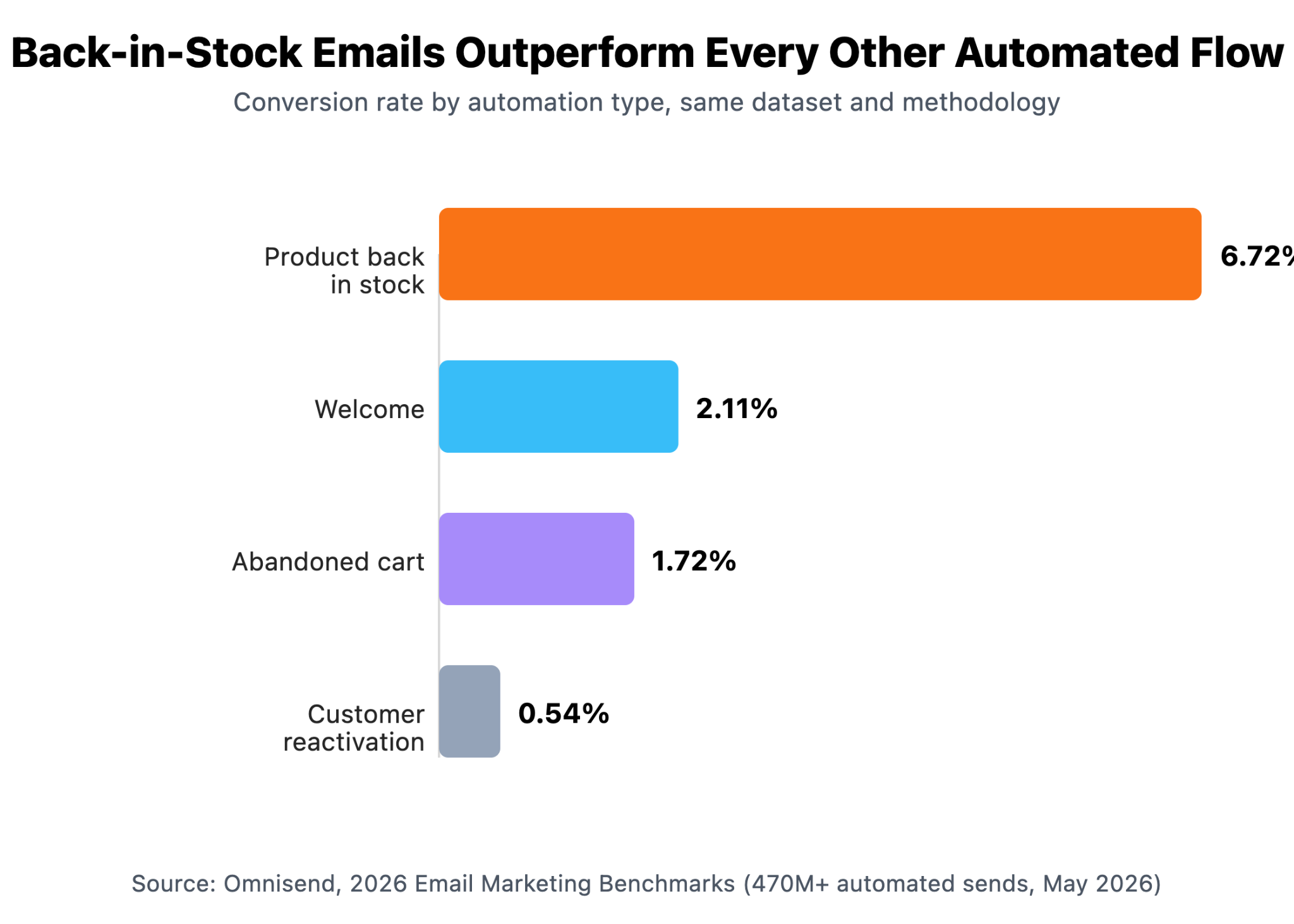
The mechanism behind that gap is simple: the shopper already asked to be told. A back-in-stock alert isn't an interruption; it's answering a question the shopper raised themselves when they saved an out-of-stock item. That's a fundamentally different relationship to the message than a cold reactivation email or even a standard cart abandonment nudge, and the conversion data reflects it.
Despite that conversion advantage, most stores never turn this trigger on at all. Among the merchant sends Omnisend's benchmark data covers, back-in-stock automation was used by only a small fraction of brands in 2025, even though it was the single highest-converting flow type available to them. That gap is closer to an oversight than a deliberate tradeoff; the feature is usually just never wired up.
This only works if the underlying wishlist data is structured enough to know which specific variant, size, or color a shopper wanted, and to fire the moment that exact item is back, not just the general product. Flits ships back-in-stock alerts as a built-in, live feature, tracked at the variant level rather than the product level, with no separate tool or Zapier-style connection required to wire it up. Flits' back-in-stock feature launch covers the setup.
Price-drop alerts are a related idea merchants often ask about, but that capability sits on Flits' roadmap rather than being available today. Any recovery sequence built now should lean on restock triggers specifically.
Estimating What Recovery Is Actually Worth to Your Store
The formula: monthly wishlist saves × estimated recovery rate × average order value = estimated monthly recovered revenue.
Say a store sees 800 wishlist saves a month, a $65 average order value, and a conservative 8% recovery rate on saved items, meaning roughly 8 in 100 saved products eventually convert through some combination of reminder emails and back-in-stock alerts. That's 64 recovered orders a month, worth about $4,160 in revenue that a cart-only setup would likely have missed entirely, since a cart-based save without its own trigger tends to convert closer to the low single digits once the session that created it is gone.
The 8% figure above is a deliberately conservative placeholder, not a benchmark to expect automatically. Two things move it in either direction for a specific store: how relevant the follow-up actually is, since a generic "you have saved items" email converts far below a variant-specific back-in-stock alert, and how long the store waits before sending the first touch.
Pull your own wishlist save count and your own average order value, plug in a conservative starting estimate like 5-10%, and treat the result as a floor worth testing against, not a guarantee. Flits' wishlist analytics guide covers where to find the save-volume number inside your own store's data once you're ready to run this calculation for real.
Turning the Signal Into an Actual Recovery System
Capturing the intent signal and acting on it are two separate steps, and a lot of stores only manage the first one.
The wishlist itself only captures what a shopper wanted. Recovering the sale depends on what happens next: whether that save reaches an email or SMS platform as a structured, product-level event, and whether the follow-up is specific enough to feel like a genuine nudge rather than a mass send. Flits connects directly to Klaviyo, syncing every save and back-in-stock trigger as a real customer event, which means a recovery flow can target exactly what a shopper saved instead of sending the same message to everyone who touched the site (Flits' Klaviyo integration covers the connection in more detail).
Segmentation matters here too. A shopper who saved a $40 item and one who saved a $400 item are unlikely to respond to the same message, and a wishlist that only reports "someone saved something" can't support that split. Flits' guide to using wishlists for retargeting campaigns goes further into building segmented recovery campaigns once the underlying event data is in place.
Most stores that never see meaningful recovery revenue aren't missing the wishlist feature itself. They're missing the connection between the wishlist and the platform that would actually act on it, which is a narrower, more fixable problem than it first appears. The hidden cost of not offering a wishlist covers what that gap costs beyond recovery specifically, if you're still weighing whether to add the feature at all.
How Do You Know a Sale Was Actually Recovered?
Why Open and Click Rates Aren't Enough
Open rate and click rate tell you whether an email got attention, and most email platforms surface both by default for any flow you build. Neither one tells you whether the resulting order would have happened anyway. Recovery specifically needs an order-level answer: which purchases can be traced back to a wishlist trigger, not just which emails performed well.
Tagging the Checkout Link
The practical way to check this without custom development: tag the checkout link inside each wishlist-triggered email or SMS with a distinct UTM parameter or discount code scoped to that flow, separate from the codes used in general campaigns. Most Shopify analytics setups and every major email platform can then report revenue against that specific tag, giving a real number instead of an assumption.
Checking Your Platform's Attribution Window
Compare that tagged figure against your platform's own attribution window too. Klaviyo, for example, generally credits a flow for orders placed within a set window after the triggering email. A sale that closes a week after a back-in-stock alert may or may not show up as "recovered" depending on how that window is configured, so it's worth checking the setting rather than assuming it matches your own sales cycle.
Give the first month of tracking room to settle before treating it as a verdict. A recovery flow that looks weak early on is often a targeting or timing problem, such as a message going out too generically or too late, rather than proof the mechanism doesn't work. Once the tagged number is in, the recovery-value estimate from earlier in this guide becomes something to check your actual setup against, not just a planning exercise.
The Bottom Line
Lost sales aren't a single problem, and treating every one the same way, with one generic recovery email, is why so much of that value never comes back. A wishlist earns its place specifically because it captures the "saved and forgot" signal earlier than a cart does, keeps that signal alive for a guest as well as a logged-in customer, and can trigger the highest-converting recovery event available, a back-in-stock alert, the moment it's actually relevant again.
Run the recovery-value estimate against your own numbers before assuming the opportunity is small. For most stores with any meaningful save volume, it isn't.
Frequently Asked Questions
How does a wishlist actually recover a lost sale, mechanically?
It captures a specific product-level signal at the moment a shopper shows interest but doesn't buy, then reconnects that signal to the shopper later through a triggered event: a reminder, a back-in-stock alert, or a returning-customer flow. A cart that resets or a session that expires loses that signal; a wishlist tied to the shopper's identity keeps it.
What's the single highest-converting recovery trigger?
Back-in-stock alerts, based on available benchmark data. They convert well above every other automated flow type because the shopper already asked to be notified, rather than being interrupted by an unsolicited message.
Do I need a big catalog or high traffic for wishlist recovery to be worth building?
It scales down fine. A small store with a handful of saves a week still recovers real revenue from a working sequence. What matters more is whether the wishlist data actually reaches your email or SMS platform as a structured, product-level event, not the store's size.
Can save for later in the cart do the same recovery job as a wishlist?
Only partially. A cart-based save is usually tied to a session or device, and it rarely has a dedicated trigger of its own beyond a general abandoned-cart email. A persistent, guest-friendly wishlist survives longer and can fire a specific, event-driven follow-up, like a back-in-stock alert, that a cart save typically can't.