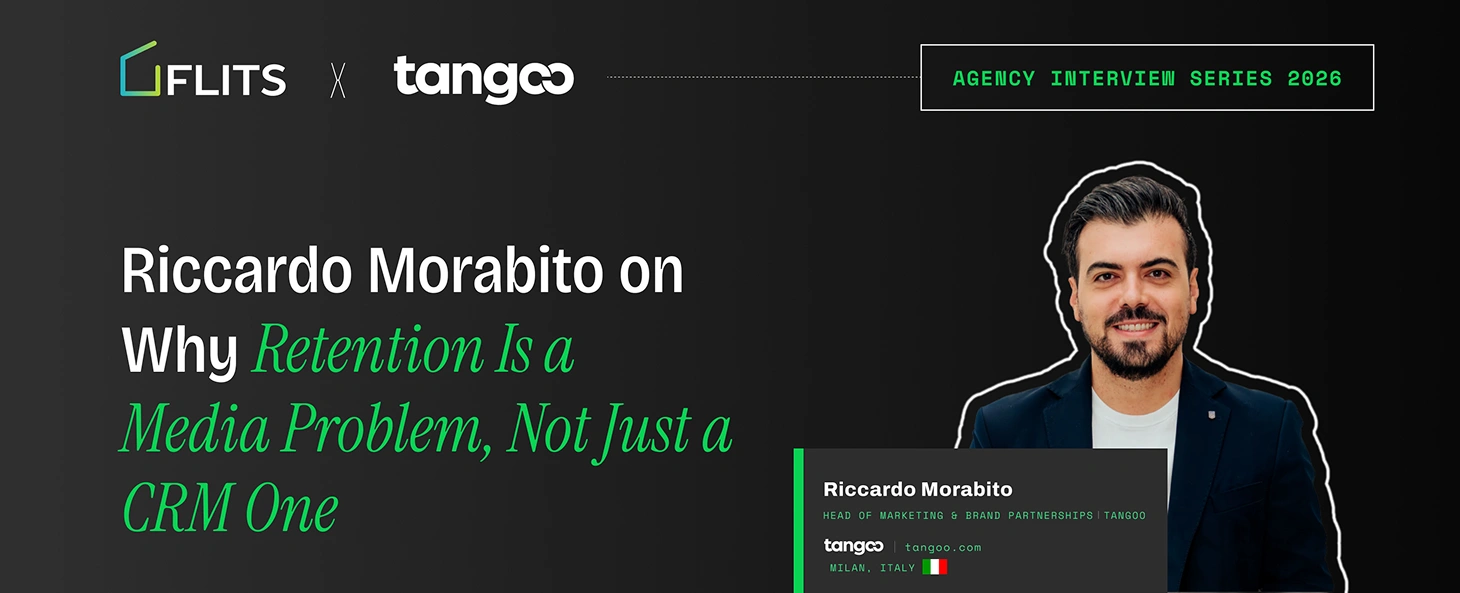
“This is not your typical agency” installment of the series.
For this one, in our Agency Interview Series, Linh from Flits’ team sat down with Riccardo Morabito, Head of Marketing & Brand Partnerships at Tangoo, a Milan-based media and ad tech company running campaigns across London, Milan, and the rest of Europe.
Here's what he told us.
1. Tell us a bit about Tangoo, what you focus on, and what kind of industries or merchants you typically work with.
When we asked Riccardo to introduce Tangoo, the first thing he did was correct the premise. "We are not an agency," he said. "We are a media ad tech company. We operate as an independent partner and media trading specialist."
That distinction shapes everything else he told us. Tangoo works across display, video, connected TV, digital out-of-home, audio, and in-app inventory. Riccardo was specific that the company serves brand advertisers and growth-stage ecommerce merchants directly, as well as agencies themselves as partners.
Their pitch centers on giving clients full visibility into their own data, transparency into where ads actually run, and targeting that doesn't depend on cookies.
On the industry side, he named ecommerce, retail, beauty, fashion, travel, fintech, and hospitality as the main verticals Tangoo works in, whether that means driving foot traffic to physical retail through geo-targeted digital out-of-home, capturing high-intent shoppers across connected TV, or scaling acquisition globally.
As Riccardo put it, the mission is to make sure every euro, dollar, or pound spent on programmatic delivers measurable incremental ROI.
It's a genuinely different lens on retention than the CRM and loyalty playbooks we've covered from Skyrocket and Glaze Digital, and Riccardo leaned into that contrast rather than away from it.
2. How do you typically approach retention for your clients, especially after the first purchase?
Riccardo’s starting point was that CRM and email are necessary but incomplete. As he put it, brands that rely only on owned channels “only reach a fraction of the customer’s daily digital touch points.”
Tangoo's answer is what he called omnichannel continuous engagement, built around precision cross-device retargeting.
In practice, that means building privacy-compliant, first-party data cohorts once a customer converts, then reaching those customers across what Riccardo described as premium environments. Tangoo has an in-house creative team dedicated to this stage, producing what he called dynamic creative optimization, or DCO, tailored to where a customer sits in the post-purchase lifecycle.
For merchants selling higher-value physical goods, he described a version of this that syncs digital ad data with CDP data to re-engage past buyers in high-footfall physical locations. The idea, as he described it, is that showing up in both the digital and physical world reinforces brand recall and supports higher second-purchase rates.
What Riccardo described is Tangoo's approach to keeping customers engaged once that first purchase happens, built on the retargeting, cohorts, and creative work above rather than a specific claim about isolating a repeat buyer from someone newly acquired by the same campaign.
Either way, it's a genuinely different way of thinking about post-purchase engagement than the CRM and loyalty tactics we usually hear about in this series.
3. How are you seeing AI change the way brands handle retention and re-engagement right now?
This is where Riccardo's answer diverged most from what we've heard elsewhere in the series. Tangoo operates on the demand-side platform side of programmatic, so his take on AI comes from a different angle than the CRM-focused guests we've talked to.
Here’s the line that stood out most: "AI is fundamentally shifting retention from a reactive re-engagement to predictive journey orchestration."
He pointed to two specific things Tangoo is doing to act on that shift.
The first is predictive modeling layered onto DSP machine learning, used to estimate churn risk, next-best-action, and timing, rather than treating all past customer behavior the same way. He was clear that this doesn’t run unsupervised: “everything is under human control…we have to check every action,” given the scale of the campaigns Tangoo manages for clients.
The second is AI-driven dynamic creative scaling, generating hundreds of creative variations in real time, tailored to things like local weather, page context, or browsing behavior, without a matching jump in production budget. Like the predictive modeling, this still runs through Tangoo’s creative team before anything goes live.
4. Is there a client project that stands out to you, one you're especially proud of?
Riccardo landed on a campaign for a high-growth travel and lifestyle brand looking to maximize market share during a major industry trade show and the holiday booking window.
The strategy was what he called an omnichannel programmatic blueprint built on physical-to-digital amplification: digital out-of-home and geo-fencing at high-traffic transit points, including airports and metro stations near the event venue, paired with mobile and connected TV sequential retargeting aimed specifically at people who'd been physically present in those geo-fenced zones.
The results he shared:
- A 75% increase in brand search queries during and after the campaign
- A 250% lift in engagement rate, which Riccardo attributed to the contextually personalized creative
- 3x higher reach among the target audience compared to traditional display
Those numbers speak to search, engagement, and reach during the campaign itself, a strong demonstration of what physical-to-digital targeting can do when it's built as a single connected strategy rather than separate channels running in parallel.
5. Looking ahead, what's one thing you'd tell Shopify merchants to start doing now?
Riccardo's closing advice doubled as a bit of a challenge to how most ecommerce brands currently spend their marketing budget: "Stop relying exclusively on the Meta and Google duopoly for customer acquisition and retention."
His reasoning wasn't that brands should abandon those channels, but that leaning on them exclusively is getting harder to justify. Acquisition costs on social keep fluctuating, and ad fatigue is at an all-time high.
His advice was twofold. First, look into what he called non-standard programmatic inventory, connected TV and programmatic audio in particular. Both, he said, are now realistically within reach for mid-market ecommerce brands, not just large corporations.
Second, get first-party data ready to be used programmatically. That means structuring Shopify customer data so it can feed into a demand-side platform, preparing for a cookieless environment, and building lookalike audiences from that first-party data.
What This Tells Us
- Retention conversations in this series have mostly lived in the CRM and loyalty world. Riccardo's answers were a reminder that paid media and programmatic are part of the same conversation, not a separate one.
- The mechanics he described, cross-device retargeting, first-party cohorts, DCO tied to lifecycle stage, are worth understanding even if you're not ready to act on them yet.
- His closing point is hard to argue with regardless of channel: depending entirely on two platforms for acquisition and retention is a riskier bet than it used to be.
Are you a Shopify agency working on retention for your clients?
The Flits Agency Interview Series is open. If you're working on retention and have something worth saying, we're all ears.