.webp)
TL;DR
BFCM 2026 rewards three things: shoppers who come back after the sale, shoppers who find you in the first place, and revenue that doesn't quietly leak out through chargebacks. Build your stack around three jobs.
Introduction
Every Shopify merchant runs roughly the same BFCM playbook: drive traffic, cut prices hard, hope the site holds. That playbook wins the weekend. It rarely wins the year.
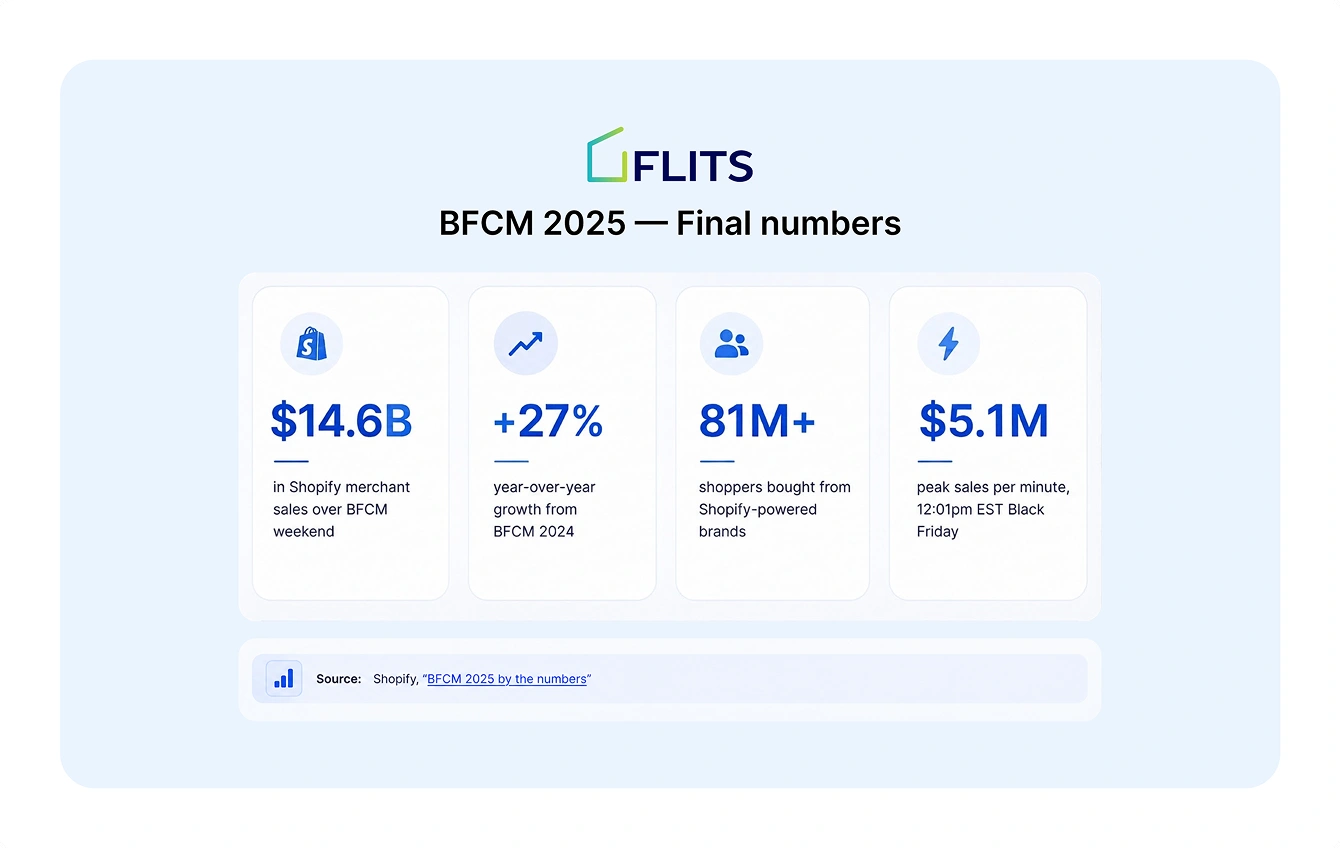
Shopify merchants generated record-breaking $14.6 billion in Black Friday Cyber Monday sales last year, up 27% from the year before, with more than 81 million shoppers checking out at a peak rate of $5.1 million a minute.
That volume is the easy part now. Shopify solved traffic. What separates the merchants who grow from the ones who just survive is what happens to that traffic once it lands: does it convert, does it get found in the first place, does it come back, and does it actually stay in the bank once it arrives?
This guide organizes the 10 best Shopify apps that matter most for BFCM 2026 into three jobs rather than one long list: keeping customers (Retention), getting found by new ones (Visibility), and protecting the revenue you've already earned (Fraud Protection).
We pulled this from Shopify App Store data, category leaders, and the patterns our own team tracks building for merchants year-round, so treat this as the working version of a best-of list rather than the recycled one.
Why BFCM 2026 is a different game than last year
A handful of numbers should shape how you build your stack this year.
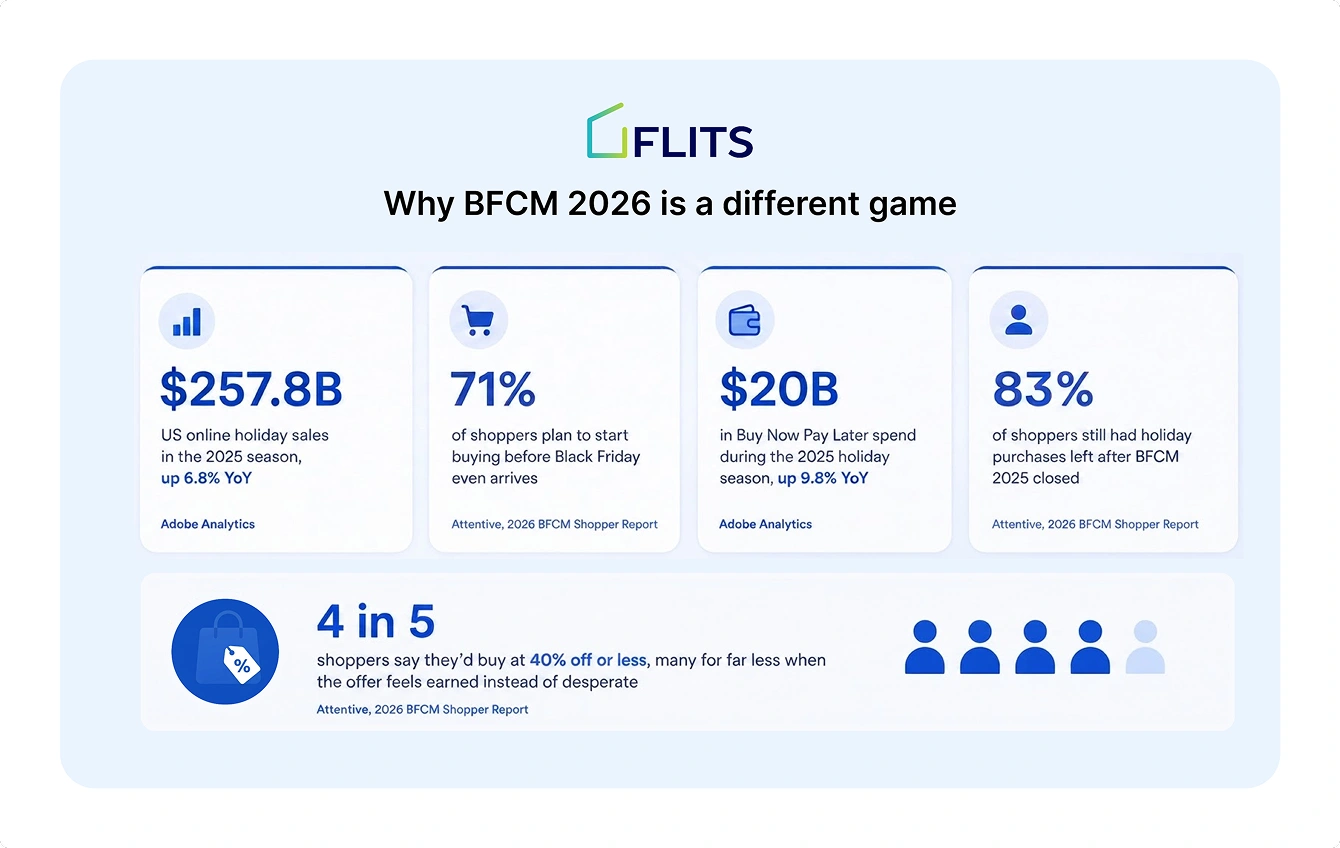
- US online holiday sales hit a record $257.8 billion in the 2025 season, up 6.8% year over year.
- 71% of shoppers say they'll start buying before Black Friday even arrives, and 46% plan to start before November begins. BFCM is a season now, not just a weekend.
- Buy Now Pay Later spend tied to the 2025 holiday season hit $20 billion, up 9.8% year over year. Shoppers are stretching budgets.
- 83% of shoppers still had holiday purchases left to make after BFCM 2025 closed, and 40% had "lots" left, which makes December a second wave rather than a cooldown.
- Four out of five shoppers say they would buy at 40% or less, and plenty convert for far less when they feel the offer is earned.
Map your app stack to the customer decision-making process, not a features list
Most BFCM app roundups only dump tools into a category list. That misses the actual psychology at play. Every shopper who lands on your store during BFCM is moving through the same customer decision-making process they’d use for any purchase, just compressed into a shorter window because everyone else is racing to be the cheapest at the same time. Build your stack around that journey, and you stop guessing.
1. Need Recognition
An ad, a friend’s recommendation, or an AI overview citing your brand triggers the want. SEO and AEO decide whether you’re even in the running here.
2. Information Search
The shopper opens three more tabs. Reviews, ratings, and fast, findable product content do the heavy lifting.
3. Evaluation of Alternatives
Bundles, personalization, and clear value framing win or lose the comparison against whoever else is open in that browser.
4. Purchase Decision
Checkout speed and trust signals turn “add to cart” into a complete order. Cart abandonment kills more BFCM revenue than any competitor ever will.
5. Post-Purchase Behavior
The stage most merchants under-invest in, and the one that decides whether BFCM was a one-off spike or the start of a real relationship. This is where retention lives and dies (for most brands), and where the actual profit sits.
Most merchants stack their whole budget against stages one through four and treat stage five as an afterthought. That’s the equivalent of throwing a great party and never getting anyone’s number on the way out. The apps mentioned below are grouped so you can build coverage across the full journey and not just the loud first half of it.
The Top 11 Shopify Apps for BFCM 2026
1. Klaviyo: Email Marketing & SMS
Klaviyo remains the standard for BFCM segmentation because it treats the season as a full funnel instead of one blast. Flow builders and predictive send-time let a merchant separate VIP account holders, wishlist browsers, and one-time buyers into different messaging tracks, which matters given how many shoppers are already planning purchases before November begins.
2. Wiser AI ‑ Upsell & Cross-Sell
Wiser AI lifts average order value by matching shoppers with frequently bought together and recently viewed products across the homepage, cart, and post-purchase flow. It’s a retention play as much as an AOV one – the right recommendation at the right moment teaches a shopper that a store understands them, which is worth more long-term than a blanket markdown.
3. Flits Loyalty Program
Flits handles the stage most merchants leave until it's too late: getting a BFCM buyer to come back. VIP Tiers give shoppers a branded VIP account where status, points, and perks live in one place, while wishlist data and store credit turn browsing and returns into signals a merchant can act on instead of lost revenue. It's the retention layer that gives a shopper a reason to return that has nothing to do with another markdown. See our BFCM 2026 retention strategy hub for the full playbook.
4. Return Prime: Return & Exchange
Returns spike hard in the week after the big BFCM weekend. Return Prime turns that moment into a second chance instead of a lost sale, routing refunds toward exchanges and store credit through a branded, self-service portal that doesn’t dump the load on a support inbox already buried in holiday tickets.
5. Judge.me
During the evaluation stage of the customer decision-making process, a shopper is comparing a store against every other tab open on their phone. Reviews are the best trust shortcut available. Judge.me ‘s unlimited photo and video review collection, synced with Google, Meta, and TikTok, means reviews gathered months earlier keep earning their keep the moment BFCM traffic spikes.
6. SearchPie: SEO, Speed & Schema
Google’s growing reliance on structured data for AI overviews has made schema and AEO readiness a real ranking factor, not a nice-to-have option. SearchPie bundles technical SEO audits, JSON-LD schema, image compression, and an AI answer engine checklist, which is the exact combination that keeps a store visible whether a shopper is scrolling Google or asking an AI assistant which store to buy from.
7. GemPages Landing Page Builder
A generic collection page doesn’t sell a 48-hour flash deal. GemPages lets a marketing team build campaign-specific, CRO-focused landing pages without waiting on developer bandwidth, which matters enormously in a season where teaming beats perfection.
8. Easy Subscriptions App
BFCM buyers are the highest-intent traffic a store sees all year, and most of them never come back as a second sale. Easy Subscription App turns that one-time purchase into recurring revenue without adding friction merchants don't have time to manage during peak season. A self-service customer portal lets shoppers pause, skip, or swap products on their own, while flexible billing cycles mean a merchant can launch weekly, monthly, or custom subscription plans in minutes instead of a multi-week build. It's the layer that makes a BFCM sale the first of many, not the last one.
9. Hextom: Countdown Timer Bar
Scarcity works only when it’s honest. Sitewide, product, and cart countdown timers give hesitant shoppers the nudge to move from “maybe later” to “buy now”, which matters more given how much comparison shopping happens before a BFCM purchase actually closes.
10. Searchanise Search & Filter
Site search shortens the information-search stage of the decision-making process directly. AI-powered search and filtering helps a shopper find the right product fast, even under the traffic spikes that make a slow or clunky search bar a real conversion killer during peak weekends.
11.Chargeflow Prevent Chargebacks
Winning the sale means nothing if it gets clawed back three weeks later. Chargeback volume climbs after every BFCM, driven by fraud, buyer’s remorse, and simple confusion over descriptor names on a statement.
Chargeflow automates the dispute and recovery process on a success-fee model, meaning there’s no upfront cost to plug a leak that otherwise quietly eats into December numbers. Before finalizing any budget for the big weekend, it’s worth running the true cost of unmanaged chargebacks through a profit margin calculator alongside ad spend and shipping costs. Fraud protection rarely gets its own line item, but it behaves exactly like one.
Frequently Asked Questions
1. What is the best Shopify app for BFCM 2026?
No one tool is best for BFCM. A strong stack always needs a mix of tools working together.
2. Which Shopify apps help most with customer retention after BFCM?
Apps like Klaviyo, Flits, and Return Prime make the post-BFCM experience significantly more frictionless.
3. Do I need a different app stack for BFCM than the rest of the year?
Not entirely. The strongest approach layers BFCM-specific tools, like countdown timers and campaign landing pages, on top of a retention foundation that runs all year. Apps installed only for the weekend and deleted in December are the ones least likely to compound into 2027. Our BFCM ebook for Shopify merchants breaks down which parts of your stack should stay year-round
4. What role does AEO play in a Shopify BFCM marketing strategy?
As AI overviews and assistants increasingly summarize product and brand comparisons before a shopper ever clicks through, schema markup and clearly structured content directly influence whether a store gets cited. SEO gets a store ranked, while AEO gets it quoted.
Bottom Line
BFCM 2026 will reward merchants who stop treating the weekend as an isolated event and start treating it as the loudest moment inside a much longer customer decision-making process.
- Win the awareness stage with SEO and AEO.
- Win the evaluation stage with reviews and smart recommendations.
- Win the purchase decision with fast, low-friction checkout.
- Protect what’s already earned with fraud prevention tools built for the post-BFCM chargeback wave.
- Win the stage almost everyone else forgets, the one where a shopper becomes a VIP account holder instead of a one-time order number, with a retention engine like Flits underneath it all.
Retain customers without tanking profit margins. That’s the strategy, and it’s the difference between a BFCM that spikes and a BFCM that compounds.