Learn how Shopify brands increase Average Order Value using loyalty points, tiered rewards, free shipping thresholds, and redemption rules with Flits.
Average Order Value is one of those metrics everyone nods at in meetings and then quietly ignores while chasing traffic. More ads, more reach, more spend. Meanwhile, the customers already on your site are telling you exactly how to increase AOV. All you have to do is listen.
Industry research shows that upselling and cross-selling can lift e-commerce AOV by 10–30%. Loyalty programs amplify this effect by rewarding higher spend rather than pushing discounts. Analysis of over 2,000 loyalty programs shows an average AOV uplift of 13–14%, with top performers reaching 75%.
Simply put, AOV grows when customers feel rewarded for spending a little more, not pushed into it. This is where loyalty programs earn their keep. When loyalty is built directly into the customer account experience, the impact compounds.
This guide breaks down 10 proven AOV strategies and shows how leading brands execute them using Flits loyalty program, from simple loyalty setups to more advanced, custom configurations.
What Is AOV and Why It Matters More Than You Think
Average Order Value is simple math. It measures how much customers spend each time they place an order. It is calculated by dividing total revenue by the total number of orders.
Simple, right? But its impact is anything but simple.
That single number influences almost every growth decision a brand makes. Higher AOV means each visit has more revenue potential. It also means customer acquisition costs become easier to absorb over time.
The part most brands miss, though, is that AOV is not only about pricing or bundles. Increasing AOV means giving customers a reason to think beyond a single product and invest in building a better cart.
A loyalty program does that for you. It offers customers rewards for building a high-value cart. When rewards are tied to visible progress, customers naturally look for ways to unlock more value in the same order. These moments shape purchasing habits, leading to higher order values and more consistent repeat buying over time.
Why Traditional Discounting Lowers AOV and Margins
Discount-led pricing shapes buying behavior. Customers get used to scanning for savings first and deciding how much to spend later. Before you know it, the pattern is created, carts stop growing, purchases become cautious, and urgency replaces curiosity. And your AOV takes the brunt of it.
Loyalty rewards shift this mindset. Points, store credits, and benefits accumulate through action. Customers see value building up rather than disappearing at checkout. This makes spending feel more purposeful, especially when more rewards mean greater benefits.
That difference is why loyalty program AOV strategies tend to outperform repeated discount cycles.
How to Increase AOV with Flits Shopify Loyalty Program
Flits loyalty points program approaches AOV growth by making rewards visible and actionable across the customer journey. The loyalty program is embedded directly into customer accounts, on-site widgets, and checkout moments, where decisions are already being made.
Instead of relying on reminders through email alone, Flits keeps rewards present on the site itself. Customers see what they earn, what they can redeem, and what comes next, all in real time, in one place.
This visibility creates momentum, which is key to improving AOV organically.
10 Loyalty-Led Strategies to Increase AOV
Most brands launch their loyalty programs with points, redemption thresholds, and free shipping incentives, then layer bundles, category boosts, and urgency-driven rewards as data comes in.
Here are 10 proven and repeatable ways to improve AOV with the Shopify loyalty program.
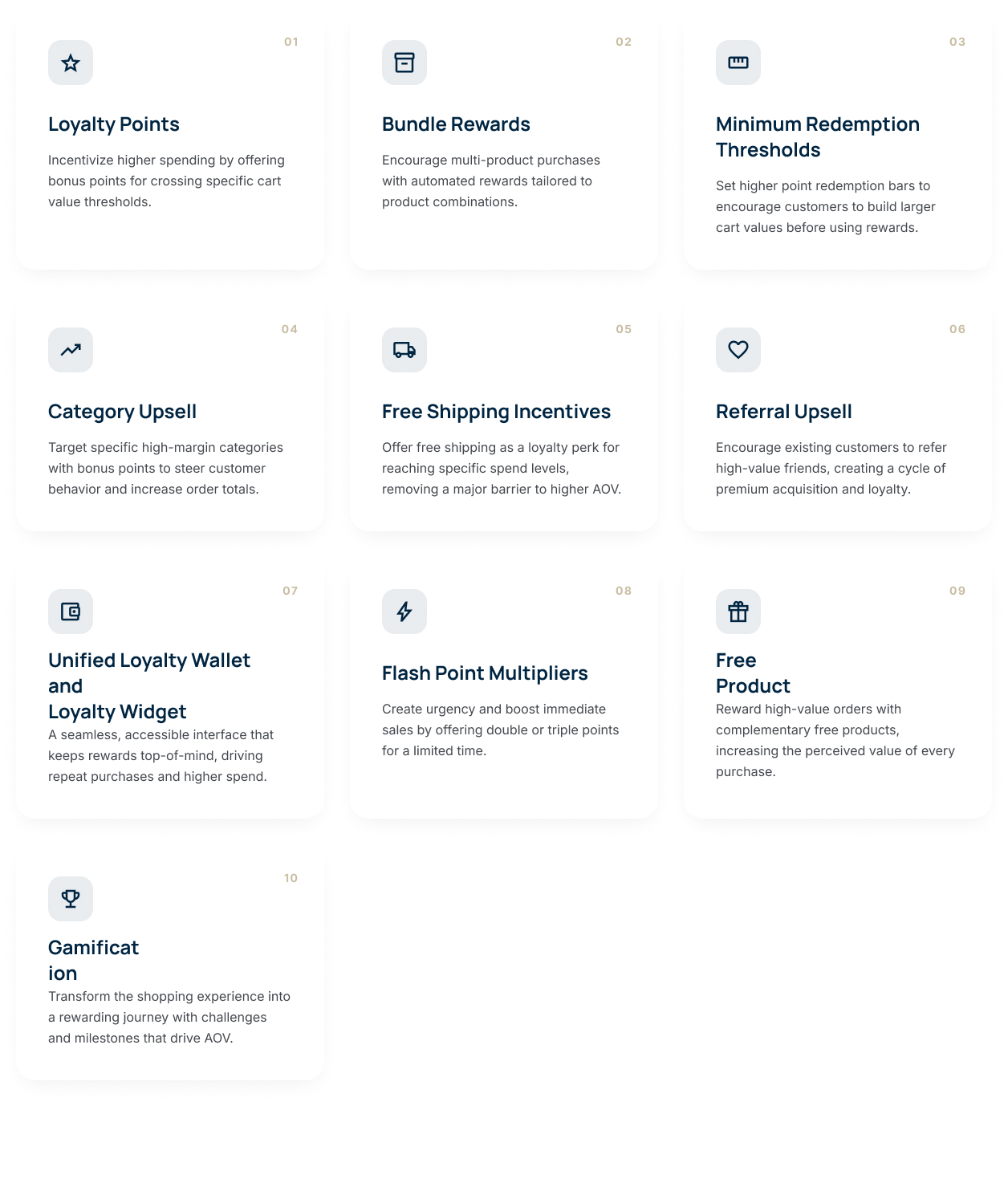
1. Reward Higher Spend With Visible Loyalty Points
- The strategy: Customers spend more when they can clearly see the value they are earning. When loyalty points are tied directly to order value and made visible throughout the journey, customers stop thinking in terms of single products and start thinking in terms of “what else makes this worth it.”
- How Flits enables this: Flits allows brands to award loyalty points based on spend and surface them across customer accounts and on-site touchpoints, so rewards feel tangible rather than abstract.
- How leading brands execute this: The Mom Store kept earned points constantly visible inside customer accounts and positioned them as future value rather than instant discounts. Returning customers intentionally added items to make their accumulated points feel meaningful, consistently lifting average order values over time.
2. Encourage Cart Building With Bundle-Based Rewards
- The strategy: Bundles reduce decision fatigue and encourage customers to think in combinations rather than individual items. When rewards are tied to completing a set, customers naturally add more to their cart without feeling upsold.
- How Flits enables this: Flits supports reward logic that can be applied to multiple products or grouped purchases, allowing brands to incentivize complete carts rather than single-item buys.
- How leading brands execute this: Blabliblu rewarded customers for purchasing any three items from a gift set, pairing the reward value with a short redemption window. Customers responded by building fuller carts in one section, increasing AOV without relying on discounts.
3. Use Redemption Thresholds to Encourage Larger Carts
- The strategy: Customers rarely redeem rewards the moment they earn them. When redemption requires reaching a meaningful threshold, customers naturally adjust cart size to unlock value. This shifts behavior from single-item purchases to deliberate cart building.
- How Flits enables this: Flits allows brands to define when and how loyalty points can be redeemed, giving merchants control over reward timing and cart-value influence.
- How leading brands execute this: Arata and DuckDuckBaby applied more nuanced redemption logic where points become usable only after delivery and return validation. This approach protected margins while teaching customers that higher-value orders unlock more worthwhile rewards.
4. Drive Strategic Upsells With Category-Based Rewards
- The strategy: Not all products contribute equally to growth. By offering higher rewards on specific categories, brands can gently guide customers toward higher-value or priority items without changing pricing.
- How Flits enables this: Flits allows reward percentages to be adjusted based on product tags or categories, automatically calculating loyalty earnings at checkout.
- How leading brands execute this: SuperDokan used category-based reward logic to highlight priority products. Customers gravitated toward more rewarding categories during browsing, subtly reshaping cart composition and improving AOV while maintaining margins.
5. Turn Free Shipping Into an Earned Milestone
- The strategy: Free shipping is most effective when it feels earned, not automatic. Customers are often willing to add one more item to avoid “wasting” an opportunity to unlock it.
- How Flits enables this: Flits supports redemption rules that link free shipping to loyalty points or minimum cart values, making it part of the loyalty journey rather than a blanket promotion.
- How leading brands execute this: Brands observed that customers holding unused points were more likely to increase cart size to unlock free shipping in a single order, gradually training themselves to shop with thresholds in mind.
6. Referrals Upsell
- The strategy: First orders set the tone for lifetime value. Referral programs that reward meaningful spend encourage referred customers to explore more and place stronger initial orders.
- How Flits enables this: Flits allows brands to tie referral rewards to minimum spend conditions, aligning acquisition with higher-quality purchases.
- How leading brands execute this: Brands using spend-linked referral rewards found that referral customers built larger first carts, knowing their purchase unlocked value for both themselves and the referrer.
7. Keep Rewards Visible Across Touchpoints
- The strategy: When rewards are fragmented across channels, their impact weakens. A unified loyalty experience encourages customers to consolidate purchases and build higher-value carts, wherever they shop.
- How Flits enables this: Flits centralizes loyalty data within customer accounts and on-site loyalty widgets, keeping rewards visible during browsing and checkout.
- How leading brands execute this: Palmonas synced loyalty points across online stores, physical locations, QR-based actions, and its mobile app. Customers used a single loyalty wallet everywhere, leading them to combine purchases instead of splitting them across channels.
8. Create Urgency With Limited-Time Point Multipliers
- The strategy: Short bursts of urgency push customers to maximize value while they can. When higher spend earns extra rewards for a limited time, customers are more likely to increase their cart size at the moment.
- How Flits enables this: Flits supports temporary earning rules that allow brands to boost point accumulation during events or campaigns like Black Friday or holiday sales.
- How leading brands execute this: During seasonal sales, brands offered bonus points on higher-value orders. Customers who were already planning to purchase increased cart size to take full advantage, with earned points driving future orders as well, extending the AOV impact beyond the sale window.
9. Use Free Products to Increase Per-Order Value
- The strategy: Free products feel more concrete than percentage discounts. When tied to a minimum order value, they give customers a clear reason to add more to their cart.
- How Flits enables this: Flits allows loyalty rewards to be configured as product-based incentives, unlocked only above specific cart values.
- How leading brands execute this: During peak traffic periods (seasonal or anniversary sales), brands offered exclusive free products unlocked only after crossing a spending threshold. Customers responded by building fuller carts to access rewards that felt tangible and special.
10. Turn Point Earning Into a Memorable Experience With Gamification
- The strategy: Loyalty gamification keeps customers engaged without relying on constant discounts. When earning points feels fun and surprising, customers are more likely to return and redeem, increasing future order values.
- How Flits enables this: Flits supports gamified earning moments that feed directly into the loyalty balance rather than replacing it.
- How leading brands execute this: The Mom Store ran a Spin the Wheel campaign that awarded instant loyalty points during a limited period. Customers returned with points already earned and intentionally increased cart value to redeem them.
Where to Show Loyalty Nudges to Increase AOV
Placement matters as much as the reward itself.
Flits loyalty nudges work best when shown at high-intent moments across the site. These include product pages, cart pages, mini account drawers, and customer dashboards.
On product pages, earning rules and points previews set expectations early. In the cart, progress bars and spending thresholds encourage last-minute additions. Post-purchase pages prepare customers for the next order by showing earned rewards and what they unlock.
Tools like shoppable video add another layer here, letting customers see products in action and add to cart without leaving the page, reinforcing the same high-intent moment loyalty nudges are designed for.
On-site widgets make loyalty feel like part of the shopping experience rather than an afterthought.
How Flits Customer Accounts Make AOV Growth Repeatable
Flits customer accounts act as the control center for loyalty engagement.
Customers can view points balance, earning rules, redemption options, referral benefits, and progress toward rewards in one place. This clarity encourages consistent interaction with the loyalty program.
Real-time updates ensure customers always know what is usable, pending, or upcoming. DuckDuckBaby used a pending-to-usable points flow aligned with delivery and return windows, helping protect margins while maintaining transparency.
This structure turns loyalty into more than a one-time incentive and an ongoing, meaningful relationship.
Measuring AOV Growth with Flits
Tracking loyalty performance helps refine what works. Flits enables brands to
- Measure AOV changes over time
- Compare loyalty member behavior to non-members
- Analyze redemption-driven cart growth
- Track tier-based AOV performance
- Monitor referral-driven spend
- Evaluate category performance
Because rewards are behavior-driven, brands can continuously test thresholds, bundles, and earning rules to improve outcomes.
Conclusion
Increasing AOV does not require pushing discounts harder. It requires giving customers a reason to add more. When loyalty points are easy to track, meaningful to redeem, and present at the right moments, customers build carts with intention.
Flits makes this possible by keeping loyalty embedded across accounts, widgets, and checkout moments, helping brands grow average order value consistently while protecting margins.
Start with these strategies. Grow into the execution. Ready to take a step forward? Let's talk today!
FAQ
1. What is a good AOV increase from a loyalty program?
A well-designed loyalty program typically drives a 13-20% higher AOV among members compared to non-members. Brands with more advanced setups, such as tiered rewards, minimum spend thresholds, and personalised earning rules, can see uplifts of 30-75%.
2. How long does it take to see AOV growth with loyalty?
Measurable AOV growth from loyalty programs typically appears within 3-6 months.
3. Do loyalty points reduce margins?
Loyalty points can reduce margins on individual orders since they act as a reward-based incentive. When designed carefully, however, they often increase overall profitability by improving retention, purchase frequency, and average order value.
4. Is a loyalty program better than discounts for AOV?
Yes, loyalty programs tend to be more effective than simple discounts for driving higher average order value over the long term, because they encourage repeat behavior, higher-value carts, and sustained engagement rather than one-time orders.
5. What does the 80/20 rule say about a company's loyal customers?
The 80/20 rule suggests that about 80% of revenue comes from 20% of loyal customers, who buy more often and place higher-value orders.