%25201.webp)
Loyalty programs are an effective strategy for customer retention. When implemented right, they improve customer loyalty. Read this guide to learn more.
TL;DR
Loyalty programs help brands retain customers by encouraging repeat purchases, increasing long-term value, and building stronger relationships beyond discounts. When designed to be visible, simple, and integrated into the shopping experience, they outperform one-off promotions and create predictable revenue.
The key is choosing the right loyalty model, promoting it consistently, tracking the right metrics, and optimizing based on real customer behavior so the program grows with the business and does not become background noise.
If you’re thinking about creating a loyalty program or need help with the one you have, talk to us today and let Flits make loyalty a part of your customer experience.
Customers don’t wake up planning to abandon brands; they just forget them.
In a world where shoppers interact with dozens of brands every month, standing out isn’t only about product quality. It’s about staying top of mind after the purchase is complete. Loyalty Programs solve this problem by giving customers a reason to remember, return, and re-engage.
Rather than pushing constant promotions, loyalty programs create a sense of continuity. Something customers feel invested in, not just sold to.
A well-designed loyalty campaign helps brands retain customers, increase repeat purchases, and build long-term relationships instead of relying only on discounts or one-time promotions.
According to widely cited industry research, increasing customer retention by just 5% can increase profits by 25%-95%, making retention strategies one of the highest ROI investments for growing brands.
In this guide, we’ll break down:
- What loyalty programs are
- How they work
- Why brands use them
- When they become essential
- And how to approach them the right way, especially for e-commerce and Shopify stores
This guide is designed for beginners, but it’s deep enough to help growing brands make informed decisions.
What is a loyalty program?
A loyalty program is a structured marketing strategy that rewards customers for engaging with a brand over time. These rewards are usually tied to actions such as purchases, referrals, account creation, reviews, or social engagement.
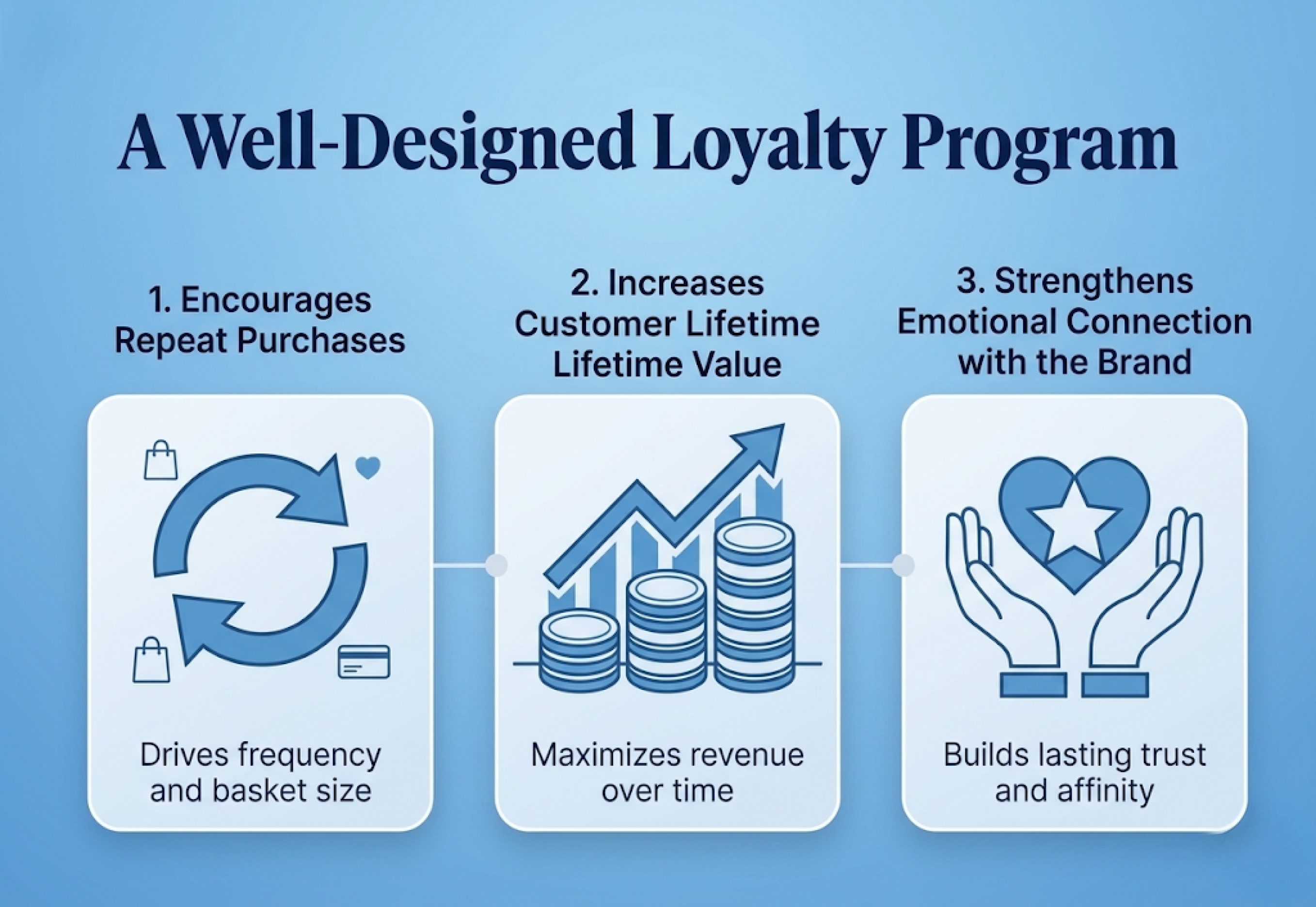
At its core, a customer loyalty program exists to:
- Encourage repeat purchases
- Increase customer lifetime value
- Strengthen emotional connection with the brand
Unlike discounts, which focus on short-term conversions, the best loyalty programs focus on long-term customer relationships. Common rewards include:
- Points that can be redeemed for discounts or perks
- Tier-based benefits
- Exclusive access or early launches
- Free products or upgrades
How do loyalty rewards programs work?
While implementations vary, most loyalty retail programs follow a simple loop:
- Customer action (purchase, referrals, sign-up, engagement)
- Reward earned (points, perks, status)
- Redemption or benefit
- Increased likelihood of repeat purchases
This loop reinforces positive behavior and keeps customers engaged with the brand.
In e-commerce, loyalty marketing programs often integrate directly with the store, so rewards are:
- Automatically tracked
- Visible in customer accounts
- Redeemable during checkout
For omnichannel brands, loyalty programs may also connect online and POS purchases, ensuring customers earn rewards regardless of where they shop.
Types of loyalty programs
There are several common types of loyalty programs, each designed to influence customer behavior in slightly different ways. The right choice depends on factors like purchase frequency, average order value, and how much engagement a brand wants to encourage beyond transactions.
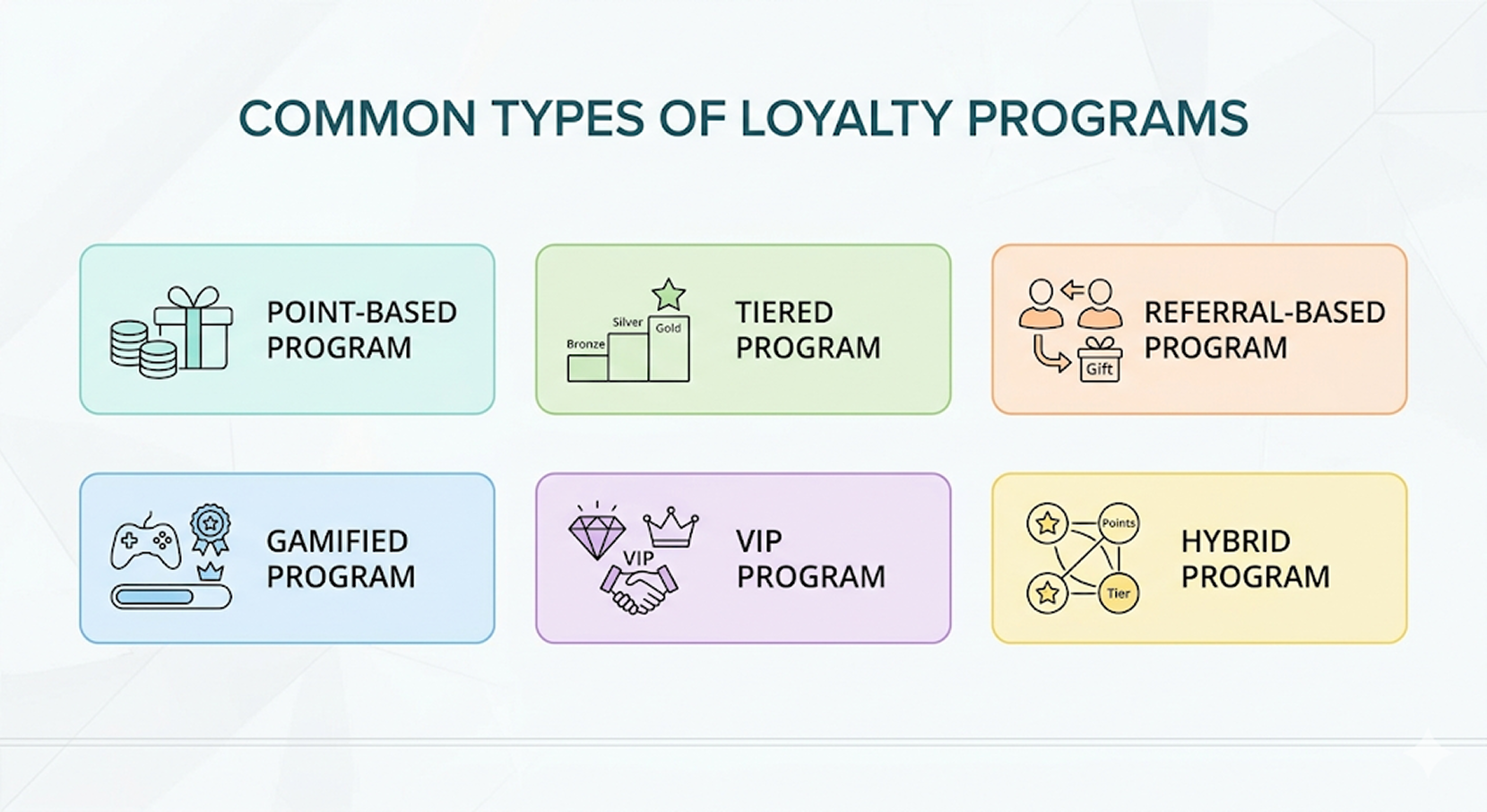
- Points-based program
Points-based rewards programs award customers with points for actions such as purchases, sign-ups, or referrals. These points can later be redeemed for discounts, products, or exclusive perks. They are popular because they are easy to understand and work well for brands with frequent, repeat purchases.
- Tiered program
Tiered loyalty programs group customers into levels based on their engagement or spend. As customers move up tiers, they unlock better rewards, exclusive benefits, or early access.
This structure taps into motivation and status, encouraging customers to stay loyal over time rather than focusing on one-off purchases.
- Referral-based program
Referral-based programs reward existing customers for bringing in new customers. Instead of spending heavily on ads, brands leverage their happiest customers to drive acquisition.
These programs work best when paired with strong products and experiences, as customers are more likely to refer brands they genuinely trust.
- Gamified program
Gamified loyalty programs add elements like challenges, milestones, progress bars, or bonus rewards to make participation more engaging. They encourage customers to interact more frequently with the brand, not just purchase, helping build stronger emotional connections over time.
- VIP or paid program
VIP or paid loyalty programs require customers to pay a fee or meet specific criteria to unlock exclusive benefits. These may include free shipping, early access, or members-only rewards. Flits is all set to launch its very own VIP tiered loyalty program. Stay tuned for more details.
They work best for brands with high brand affinity and customers who see clear, ongoing value in membership perks.
How to choose the right type of loyalty program
Most successful brands don’t rely on a single type. Instead, they combine multiple loyalty structures. For instance, points with tiers or referrals with gamification, to match different customer motivations and stages in the lifecycle.
The key is choosing a structure that aligns with how your customers already behave, rather than forcing engagement through overly complex rules.
Why do brands use customer loyalty programs?
Companies with loyalty programs use such marketing tools to consistently improve not just mere engagement but the entire economics of retention.
When implemented well, loyalty influences customer behavior in measurable, predictable, and scalable ways over time.
Here’s why brands invest in loyalty:
- Increases repeat purchases
Repeat customers are the backbone of sustainable growth. Loyalty gives customers a clear reason to return rather than drift to competitors.
- Research from Adobe shows that repeat customers account for a disproportionately large share of revenue, often generating over 40% of total sales despite being a smaller portion of the customer base.
- Studies also consistently show that existing customers convert at significantly higher rates than new visitors, making retention-driven strategies more efficient than acquisition-heavy ones.
Customer loyalty programs reinforce repeat behavior by making every purchase feel like progress.
- Improves customer lifetime value
One of the strongest arguments in favor of loyalty programs for small businesses is their impact on customer lifetime value.
- Multiple retail and e-commerce studies indicate that loyalty program members spend more annually than non-members, particularly once they begin redeeming rewards.
- Bond’s Loyalty Report has found that customers who actively engage with loyalty reward programs are more likely to increase their spending with the brand.
This makes loyalty especially valuable for brands focused on increasing customer lifetime value.
- Reduces reliance on constant discounts
Discounting drives short-term sales, but it often conditions customers to wait for price cuts. Loyalty campaigns give brands a way to offer value without eroding margins.
- Customers are consistently shown to be willing to spend more with brands that deliver better overall experiences, especially when they feel recognized rather than treated like a transaction.
- Rewards, points, and exclusive benefits feel earned, which makes them psychologically different from flat discounts and less damaging to perceived brand value.
By shifting incentives from “cheaper” to “worth it”, retail loyalty programs help brands protect profitability while still motivating repeat orders.
- Strengthens emotional connection and trust
Customer loyalty is shaped as much by perception and emotion as it is by price or product. People tend to stay with brands that make them feel recognized rather than treated as interchangeable buyers.
- When customers see that their actions are noticed and rewarded, they are more likely to continue engaging with the brand over time.
- Feeling appreciated also makes customers more patient with small issues and more inclined to recommend the brand to others.
Loyalty turns this sense of recognition into a structured, repeatable experience, helping brands build stronger relationships and not relying on occasional goodwill moments.
- Generates valuable first-party data
As privacy regulations tighten and third-party cookies decline, first-party data has become increasingly valuable.
- A thoughtfully program encourages customers to log in, identify themselves, and interact more frequently, giving brands deeper insight into buying behavior, preferences, and engagement patterns.
- Salesforce research highlights that customers expect personalization, and brands that use customer data responsibly to personalize experiences see higher engagement and retention.
Customer loyalty programs act as a bridge between customer data and meaningful action.
- Stabilizes revenue during market fluctuations
Acquisition channels can be unpredictable. Ad costs rise, algorithms change, and external factors impact demand.
- Businesses with a strong base of returning customers are better insulated from these fluctuations, as repeat buyers provide more predictable revenue streams.
- Industry benchmarks consistently show that returning customers contribute a higher share of revenue during slow periods, helping smooth seasonal or market-driven volatility.
- Amplifies word-of-mouth growth
Loyal customers do much more than just buy again. They recommend.
- Nielsen has long reported that recommendations from friends and family are among the most trusted forms of marketing, outperforming traditional advertising.
- Loyalty that includes referrals or recognition amplifies this behavior, turning satisfied customers into an acquisition channel.
This is where loyalty stops being a cost center and starts compounding growth.
When do brands need a loyalty program?
Not every business needs a loyalty program from day one. However, certain signals indicate it’s time to consider one. Common trigger points include:
- Repeat purchase rate has plateaued
- Customers only return when discounts are offered
- Acquisition costs are rising faster than revenue
- Customers shop across multiple channels (online and offline)
- Brand wants to build a community
At this stage, customer loyalty programs move from being a “nice-to-have” feature to a core retention strategy.
How Shopify loyalty programs typically work
For stores built on Shopify, loyalty programs are usually embedded directly into the shopping journey rather than existing as a separate destination. They often embed into:
- Customer account pages, where shoppers can view points, rewards, and progress
- The checkout experience, showing available rewards at the moment of purchase
- Email and SMS flows, reminding customers about unused points or upcoming rewrads
This tight integration ensures customers are reminded of loyalty benefits at moments when they are most likely to act, not after the sale is already lost.
What makes loyalty programs effective for Shopify brands?
Shopify brands tend to see better results when retail loyalty programs are simple, visible, and frictionless. Complexity reduces participation, even if the rewards are valuable.
Creating high-performing Shopify loyalty programs usually means:
- Easy navigation without long explanations
- Clearly visible rewards so customers know what they are working toward
- Seamless integrations with existing apps, checkout, and POS systems
When loyalty is a part of the store navigation, participation increases without additional effort from the brand.
How to promote loyalty reward programs?
A loyalty reward program only works if customers are consistently made aware of it.
Simply launching a program and linking it in the footer is rarely enough, especially in e-commerce, where attention is fragmented, and purchase journeys are short. If customers do not see rewards at the right moments, they have no reason to change their behavior or return sooner than planned.
Visiting is what turns a customer loyalty program from a background feature into an active retention driver. Customers need to be reminded that rewards exist, that they are accumulating value, and that there is a benefit to staying engaged with the brand.
This awareness should be built into the shopping experience itself rather than relying on customers to go looking for it.
Effectively promoting loyalty includes:
- Highlighting rewards on the homepage so new and returning visitors immediately understand the value
- Showing points, tiers, or perks inside customer accounts where customers naturally check order history
- Using email and SMS to remind customers about unused points or expiring rewards
- Educating customers during key moments such as checkout, post-purchase, and account login
How to measure and optimize loyalty for long-term success?
Launching a loyalty campaign is only the beginning. Long-term success depends on ongoing measurement and optimization.
Key areas to monitor:
- Engagement rates
- Redemption rates
- Impact on repeat purchases
- Impact on overall revenue
Optimization often involves:
- Adjusting reward thresholds
- Improving reward visibility
- Simplifying rules
- Aligning rewards with customer motivations
Real-life use cases for loyalty
Loyalty is used across industries, but common e-commerce use cases include:
- DTC brands wanting to reward repeat buyers
- Omnichannel retailers syncing POS and online rewards
- Subscription brands reducing churn
- High-AOV stores encouraging long-term retention
Starbucks has one of the most prolific loyalty campaigns. The Starbucks loyalty program setup shows how powerful loyalty becomes when it is embedded in everyday buying behavior. Rewards are easy to understand, and progress is visible. Earning feels automatic. Loyalty reward programs work best when they stay consistently present across the customer journey.
Common mistakes and challenges
Most loyalty campaigns fail not because the idea is flawed, but because execution is poor. Common mistakes brands commit during execution include:
- Overcomplicated rules
- Insignificant rewards
- Poor visibility across the store
- Fragmented tools for POS and online loyalty
Unlike physical stores, e-commerce brands do not have staff on the floor to explain how a loyalty program works or why it matters. Everything has to make sense instantly, often within a few seconds of attention. Common challenges include:
- No in-staff to explain benefits, rewards, or how points are earned
- Short attention spans, where customers skim instead of reading in detail
- Multiple touchpoints across devices and channels, such as mobile, desktop, email, and ads
Because of this, loyalty in e-commerce must be designed to explain itself visually and contextually, without requiring effort from the customers.
How to create a loyalty program with Flits
Creating a program does not have to be complex. At Flits, we help brands centralize loyalty, rewards, and customer engagement within the customer account experience. With the right setup, brands can:
- Launch loyalty faster
- Make rewards more personal
- Create POS-focused loyalty strategies
- Scale without manual work
Talk to us about your setup
Every brand’s loyalty strategy is different. What works for one store may not work for another.
If you’re evaluating whether a customer loyalty rewards program makes sense for your business, or how to improve an existing one, talk to us about your setup. Our team can help you assess what fits your customers, channels, growth stage, and more.
FAQs
- What are loyalty program tiers?
Loyalty tiers group customers by engagement or spend, offering higher rewards as customers move up.
- What are the best practices for loyalty programs?
Some of the common yet best practices include -
- Keeping rewards simple
- Making benefits visible
- Aligning rewards with customer behavior
- Optimizing regularly based on data collected
- How to launch a loyalty program?
Launching typically involves defining goals, choosing reward structures, setting earning rules, and promoting the program consistently across channels. If you have any doubts or questions, reach out to us.
- What key loyalty metrics must you track?
Some common key metrics to track are repeat purchase rate, redemption rate, customer lifetime value, and average order value, to name a few.
- How long does it take to see results from a loyalty incentive program?
Most brands begin seeing engagement signals within weeks, but meaningful retention impact typically takes 2-3 months, depending on traffic and purchase cycles.